



 Chat with AI
Exam 6: Supply, demand, and Government Policies

Exam 1: Ten Principles of Economics237 Questions
Exam 2: Thinking Like an Economist267 Questions
Exam 3: Interdependence and the Gains From Trade217 Questions
Exam 4: The Market Forces of Supply and Demand303 Questions
Exam 5: Elasticity and Its Applications282 Questions
Exam 6: Supply, demand, and Government Policies252 Questions
Exam 7: Consumers, producers, and the Efficiency of Markets248 Questions
Exam 8: Application: the Costs of Taxation245 Questions
Exam 9: Application: International Trade245 Questions
Exam 10: Externalities288 Questions
Exam 11: Public Goods and Common Resources258 Questions
Exam 12: The Design of the Tax System328 Questions
Exam 13: The Costs of Production303 Questions
Exam 14: Firms in Competitive Markets271 Questions
Exam 15: Monopoly306 Questions
Exam 16: Oligopoly291 Questions
Exam 17: Monopolistic Competition257 Questions
Exam 18: The Markets for the Factors of Production284 Questions
Exam 19: Earnings and Discrimination286 Questions
Exam 20: Income Inequality and Poverty247 Questions
Exam 21: The Theory of Consumer Choice238 Questions
Exam 22: Frontiers of Microeconomics199 Questions
Exam 23: Measuring a Nations Income215 Questions
Exam 24: Measuring the Cost of Living208 Questions
Exam 25: Production and Growth240 Questions
Exam 26: Saving, investment, and the Financial System282 Questions
Exam 27: The Basic Tools of Finance249 Questions
Exam 28: Unemployment242 Questions
Exam 29: The Monetary System277 Questions
Exam 30: Money Growth and Inflation224 Questions
Exam 31: Open-Economy Macroeconomics: Basic Concepts256 Questions
Exam 32: A Macroeconomic Theory of the Open Economy217 Questions
Exam 33: Aggregate Demand and Aggregate Supply302 Questions
Exam 34: The Influence of Monetary and Fiscal Policy on Aggregate Demand249 Questions
Exam 35: The Short Run Trade Off Between Inflation and Unemployment246 Questions
Exam 36: Five Debates Over Macroeconomic Policy140 Questions
Select questions type


If a binding price ceiling were imposed in the computer market,
(Multiple Choice)
4.9/5  (80)
(80) The long-run effects of rent controls are a good illustration of the principle that
(Multiple Choice)
4.8/5 (78)
(78) Figure 6-10
 -Refer to Figure 6-10.Buyers effectively pay how much of the tax per unit?
 (Multiple Choice)
4.8/5 (77)
(77) Lawmakers can decide whether the buyers or the sellers must send a tax to the government,but they cannot legislate the true burden of a tax.
(True/False)
4.9/5 (84)
(84) Figure 6-4
 -Refer to Figure 6-4.Suppose a price floor of $7.00 is imposed.As a result,
 (Multiple Choice)
4.9/5 (78)
(78) The Federal Insurance Contribution Act (FICA)tax is an example of
(Multiple Choice)
4.8/5 (79)
(79) In the United States,rent-control policies were first adopted during
(Multiple Choice)
4.8/5 (90)
(90) In 1990,Congress passed a new luxury tax on items such as yachts,private airplanes,furs,jewelry,and expensive cars.The goal of the tax was to
(Multiple Choice)
4.8/5 (70)
(70) Figure 6-14.
 -Refer to Figure 6-14.The per-unit burden of the tax on buyers is
 (Multiple Choice)
4.9/5 (76)
(76) If buyers are required to pay a $0.10 tax per bag on Hershey's kisses,the demand curve for kisses will shift
(Multiple Choice)
4.9/5 (70)
(70) Approximately what proportion of rental apartments in New York City are subject to some sort of rent control?
(Multiple Choice)
4.8/5 (78)
(78) Rent subsidies and wage subsidies are better than price controls at helping the poor because they have no costs associated with them.
(True/False)
4.8/5 (77)
(77) When a tax is imposed on tea and buyers of tea are required to send in the tax payments to the government,
(Multiple Choice)
4.8/5 (88)
(88) Figure 6-12
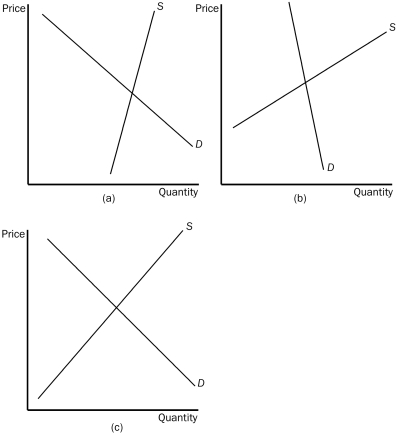 -Refer to Figure 6-12.In which market will the tax burden be most equally divided between the buyer and the seller?
 (Multiple Choice)
4.8/5 (72)
(72) Studies of the effects of the minimum wage typically find that a 10 percent increase in the minimum wage depresses teenage employment by about
(Multiple Choice)
4.8/5 (89)
(89) 
Filters
- Essay(0)
- Multiple Choice(0)
- Short Answer(0)
- True False(0)
- Matching(0)