



 Chat with AI
Exam 6: Supply, demand, and Government Policies

Exam 1: Ten Principles of Economics237 Questions
Exam 2: Thinking Like an Economist267 Questions
Exam 3: Interdependence and the Gains From Trade217 Questions
Exam 4: The Market Forces of Supply and Demand303 Questions
Exam 5: Elasticity and Its Applications282 Questions
Exam 6: Supply, demand, and Government Policies252 Questions
Exam 7: Consumers, producers, and the Efficiency of Markets248 Questions
Exam 8: Application: the Costs of Taxation245 Questions
Exam 9: Application: International Trade245 Questions
Exam 10: Externalities288 Questions
Exam 11: Public Goods and Common Resources258 Questions
Exam 12: The Design of the Tax System328 Questions
Exam 13: The Costs of Production303 Questions
Exam 14: Firms in Competitive Markets271 Questions
Exam 15: Monopoly306 Questions
Exam 16: Oligopoly291 Questions
Exam 17: Monopolistic Competition257 Questions
Exam 18: The Markets for the Factors of Production284 Questions
Exam 19: Earnings and Discrimination286 Questions
Exam 20: Income Inequality and Poverty247 Questions
Exam 21: The Theory of Consumer Choice238 Questions
Exam 22: Frontiers of Microeconomics199 Questions
Exam 23: Measuring a Nations Income215 Questions
Exam 24: Measuring the Cost of Living208 Questions
Exam 25: Production and Growth240 Questions
Exam 26: Saving, investment, and the Financial System282 Questions
Exam 27: The Basic Tools of Finance249 Questions
Exam 28: Unemployment242 Questions
Exam 29: The Monetary System277 Questions
Exam 30: Money Growth and Inflation224 Questions
Exam 31: Open-Economy Macroeconomics: Basic Concepts256 Questions
Exam 32: A Macroeconomic Theory of the Open Economy217 Questions
Exam 33: Aggregate Demand and Aggregate Supply302 Questions
Exam 34: The Influence of Monetary and Fiscal Policy on Aggregate Demand249 Questions
Exam 35: The Short Run Trade Off Between Inflation and Unemployment246 Questions
Exam 36: Five Debates Over Macroeconomic Policy140 Questions
Select questions type


Figure 6-14.
 -Refer to Figure 6-14.As the figure is drawn,who directly pays the tax to the government?
 (Multiple Choice)
4.8/5  (65)
(65) Figure 6-4
 -Refer to Figure 6-4.If the government imposes a price ceiling in this market at a price of $5.00,the result would be a
 (Multiple Choice)
4.8/5 (88)
(88) Using the graph shown,answer the following questions.
a.What was the equilibrium price and quantity in this market before the tax?
b.What is the amount of the tax?
c.How much of the tax will the buyers pay?
d.How much of the tax will the sellers pay?
e.How much will the buyer pay for the product after the tax is imposed?
f.How much will the seller receive after the tax is imposed?
g.As a result of the tax, what has happened to the level of market activity?
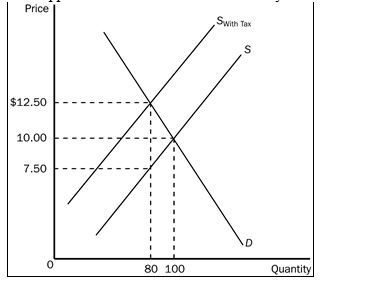
(Essay)
4.9/5 (78)
(78) You have responsibility for economic policy in the country of Freedonia.Recently the neighboring country of Sylvania has cut off all exports of oranges to Freedonia.Harpo,who is one of your advisors,suggests that you should impose a binding price ceiling in order to avoid a shortage of oranges.Chico,another one of your advisors,argues that without a binding price floor,a shortage will certainly develop.Zeppo,a third advisor,says that the best way to avoid a shortage of oranges is to take no action at all.Which of your three advisors is most likely to have studied economics?
(Multiple Choice)
4.8/5 (71)
(71) An alternative to rent-control laws that would not reduce the quantity of housing supplied is
(Multiple Choice)
4.8/5 (83)
(83) Suppose that a tax is placed on DVDs.If the sellers end up bearing most of the tax burden,we know that the
(Multiple Choice)
4.9/5 (77)
(77) If a tax is levied on the sellers of a product,the demand curve
(Multiple Choice)
4.8/5 (78)
(78) Figure 6-9
 -Refer to Figure 6-9.How much tax revenue does this tax produce for the government?
 (Multiple Choice)
4.7/5 (86)
(86) If buyers of a product are required to pay a tax,the demand curve for the product will shift downward by exactly the size of the tax.
(True/False)
4.9/5 (79)
(79) If a tax is imposed on a market with inelastic demand and elastic supply,
(Multiple Choice)
4.8/5 (91)
(91) Figure 6-1
 -Refer to Figure 6-1.A binding price ceiling is shown in
 (Multiple Choice)
4.8/5 (69)
(69) Figure 6-6
 -Refer to Figure 6-6.Which of the following statements best relates the figure to the events of the 1970s?
 (Multiple Choice)
4.8/5 (83)
(83) In the 1970s,long lines at gas stations in the United States were primarily a result of the fact that
(Multiple Choice)
4.9/5 (96)
(96) Figure 6-9
-Refer to Figure 6-9.The price received by sellers after the tax is imposed is
-Refer to Figure 6-9.The price received by sellers after the tax is imposed is (Multiple Choice)
4.9/5 (82)
(82) Which of the following statements about rent control in New York City is accurate?
(Multiple Choice)
4.9/5 (75)
(75) Figure 6-14.
-Refer to Figure 6-14.The effective price that buyers will pay after the tax is imposed is
-Refer to Figure 6-14.The effective price that buyers will pay after the tax is imposed is (Multiple Choice)
4.9/5 (81)
(81) 
Filters
- Essay(0)
- Multiple Choice(0)
- Short Answer(0)
- True False(0)
- Matching(0)