



 Chat with AI
Exam 4: The Market Forces of Supply and Demand

Exam 1: Ten Principles of Economics237 Questions
Exam 2: Thinking Like an Economist267 Questions
Exam 3: Interdependence and the Gains From Trade217 Questions
Exam 4: The Market Forces of Supply and Demand303 Questions
Exam 5: Elasticity and Its Applications282 Questions
Exam 6: Supply, demand, and Government Policies252 Questions
Exam 7: Consumers, producers, and the Efficiency of Markets248 Questions
Exam 8: Application: the Costs of Taxation245 Questions
Exam 9: Application: International Trade245 Questions
Exam 10: Externalities288 Questions
Exam 11: Public Goods and Common Resources258 Questions
Exam 12: The Design of the Tax System328 Questions
Exam 13: The Costs of Production303 Questions
Exam 14: Firms in Competitive Markets271 Questions
Exam 15: Monopoly306 Questions
Exam 16: Oligopoly291 Questions
Exam 17: Monopolistic Competition257 Questions
Exam 18: The Markets for the Factors of Production284 Questions
Exam 19: Earnings and Discrimination286 Questions
Exam 20: Income Inequality and Poverty247 Questions
Exam 21: The Theory of Consumer Choice238 Questions
Exam 22: Frontiers of Microeconomics199 Questions
Exam 23: Measuring a Nations Income215 Questions
Exam 24: Measuring the Cost of Living208 Questions
Exam 25: Production and Growth240 Questions
Exam 26: Saving, investment, and the Financial System282 Questions
Exam 27: The Basic Tools of Finance249 Questions
Exam 28: Unemployment242 Questions
Exam 29: The Monetary System277 Questions
Exam 30: Money Growth and Inflation224 Questions
Exam 31: Open-Economy Macroeconomics: Basic Concepts256 Questions
Exam 32: A Macroeconomic Theory of the Open Economy217 Questions
Exam 33: Aggregate Demand and Aggregate Supply302 Questions
Exam 34: The Influence of Monetary and Fiscal Policy on Aggregate Demand249 Questions
Exam 35: The Short Run Trade Off Between Inflation and Unemployment246 Questions
Exam 36: Five Debates Over Macroeconomic Policy140 Questions
Select questions type


An early frost in the vineyards of Napa Valley would cause
(Multiple Choice)
4.8/5  (76)
(76) 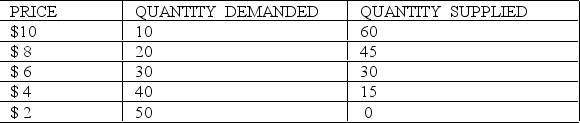 -Refer to Table 4-2.If the price were $8,a
Despite the fact that not all markets are perfectly competitive,the study of perfect competition is worthwhile,in part because
(Multiple Choice)
4.9/5 (86)
(86) Table 4-3. The demand schedule below pertains to sandwiches demanded per week.
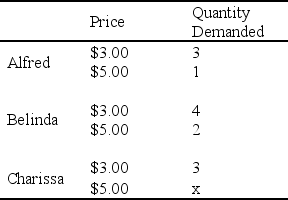 -Refer to Table 4-3.Suppose Alfred,Belinda,and Charissa are the only demanders of sandwiches and that the market demand violates the law of demand.Then,in the table,
 (Multiple Choice)
4.9/5 (77)
(77) New cars are normal goods.What will happen to the equilibrium price of new cars if the price of gasoline rises,the price of steel falls,public transportation becomes cheaper and more comfortable,auto-workers accept lower wages and automobile insurance becomes more expensive?
(Multiple Choice)
4.7/5 (92)
(92) If the demand for a good falls when income falls,the good is called an inferior good.
(True/False)
4.9/5 (73)
(73) Figure 4-7
 -Refer to Figure 4-7.At what price would there be an excess demand amounting to 200 units of the good?
 (Multiple Choice)
4.8/5 (72)
(72) The downward slope of the typical demand curve reflects which of the following concepts?
(Multiple Choice)
4.8/5 (67)
(67) Funsters,Inc.,the largest toy company in the country,sells its most popular doll for $15.It has just learned that its leading competitor Toysorama is mass producing an excellent copy and plans to flood the market with their $5 doll in 6 weeks.Funsters should
(Multiple Choice)
4.7/5 (74)
(74) If a company making frozen orange juice expects the price of their product to be higher next month,it will supply more to the market this month.
(True/False)
4.8/5 (75)
(75) Pens are normal goods.What will happen to the equilibrium price of pens if the price of pencils rises,consumers experience an increase in income,writing in ink becomes fashionable,people expect the price of pens to rise in the near future,the population increases,fewer firms manufacture pens,and the wages of pen-makers increase?
(Multiple Choice)
4.8/5 (75)
(75) When an increase in the price of one good lowers the demand for another good,the two goods are called complements.
(True/False)
4.9/5 (83)
(83) Which of the following is a determinant of market supply curve but not a determinant of an individual seller's supply?
(Multiple Choice)
4.7/5 (84)
(84) 
Filters
- Essay(0)
- Multiple Choice(0)
- Short Answer(0)
- True False(0)
- Matching(0)