



 Chat with AI
Exam 4: The Market Forces of Supply and Demand

Exam 1: Ten Principles of Economics237 Questions
Exam 2: Thinking Like an Economist267 Questions
Exam 3: Interdependence and the Gains From Trade217 Questions
Exam 4: The Market Forces of Supply and Demand303 Questions
Exam 5: Elasticity and Its Applications282 Questions
Exam 6: Supply, demand, and Government Policies252 Questions
Exam 7: Consumers, producers, and the Efficiency of Markets248 Questions
Exam 8: Application: the Costs of Taxation245 Questions
Exam 9: Application: International Trade245 Questions
Exam 10: Externalities288 Questions
Exam 11: Public Goods and Common Resources258 Questions
Exam 12: The Design of the Tax System328 Questions
Exam 13: The Costs of Production303 Questions
Exam 14: Firms in Competitive Markets271 Questions
Exam 15: Monopoly306 Questions
Exam 16: Oligopoly291 Questions
Exam 17: Monopolistic Competition257 Questions
Exam 18: The Markets for the Factors of Production284 Questions
Exam 19: Earnings and Discrimination286 Questions
Exam 20: Income Inequality and Poverty247 Questions
Exam 21: The Theory of Consumer Choice238 Questions
Exam 22: Frontiers of Microeconomics199 Questions
Exam 23: Measuring a Nations Income215 Questions
Exam 24: Measuring the Cost of Living208 Questions
Exam 25: Production and Growth240 Questions
Exam 26: Saving, investment, and the Financial System282 Questions
Exam 27: The Basic Tools of Finance249 Questions
Exam 28: Unemployment242 Questions
Exam 29: The Monetary System277 Questions
Exam 30: Money Growth and Inflation224 Questions
Exam 31: Open-Economy Macroeconomics: Basic Concepts256 Questions
Exam 32: A Macroeconomic Theory of the Open Economy217 Questions
Exam 33: Aggregate Demand and Aggregate Supply302 Questions
Exam 34: The Influence of Monetary and Fiscal Policy on Aggregate Demand249 Questions
Exam 35: The Short Run Trade Off Between Inflation and Unemployment246 Questions
Exam 36: Five Debates Over Macroeconomic Policy140 Questions
Select questions type


What will happen in the rice market if buyers are expecting higher rice prices in the near future?
(Multiple Choice)
4.7/5  (77)
(77) A group of buyers and sellers of a particular good or service is called a
(Multiple Choice)
4.9/5 (69)
(69) For teens,a 10 percent increase in the price of cigarettes leads to a
(Multiple Choice)
4.8/5 (84)
(84) The price at which quantity supplied equals quantity demanded is called the
(Multiple Choice)
4.9/5 (81)
(81) Table 4-3. The demand schedule below pertains to sandwiches demanded per week.
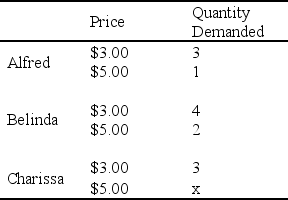 -Refer to Table 4-3.Suppose Alfred,Belinda,and Charissa are the only demanders of sandwiches.Also suppose: • x = 2;
• the current price of a sandwich is $3.00;
• the market quantity supplied of sandwiches is 5;
• the slope of the supply curve is 1.
Then
-Refer to Table 4-3.Suppose Alfred,Belinda,and Charissa are the only demanders of sandwiches.Also suppose: • x = 2;
• the current price of a sandwich is $3.00;
• the market quantity supplied of sandwiches is 5;
• the slope of the supply curve is 1.
Then (Multiple Choice)
5.0/5 (71)
(71) Which of the following changes would not shift the demand curve for a good or service?
(Multiple Choice)
4.9/5 (83)
(83) Table 4-3. The demand schedule below pertains to sandwiches demanded per week.
-Refer to Table 4-3.Regarding Alfred and Belinda,for whom are sandwiches a normal good?
-Refer to Table 4-3.Regarding Alfred and Belinda,for whom are sandwiches a normal good? (Multiple Choice)
4.8/5 (78)
(78) New oak tables are normal goods.What would happen to the equilibrium price and quantity in the market for oak tables if the price of maple tables rises,the price of oak wood rises,more buyers enter the market for oak tables and the price of wood saws increased?
(Multiple Choice)
4.9/5 (62)
(62) The behavior of buyers and sellers drives markets toward equilibrium.
(Essay)
4.8/5 (84)
(84) In a market economy,supply and demand are important because they
(Multiple Choice)
4.9/5 (83)
(83) Table 4-4
 -Refer to Table 4-4.Which space represents an increase in equilibrium quantity and an indeterminate change in equilibrium price?
 (Multiple Choice)
4.9/5 (81)
(81) 
Filters
- Essay(0)
- Multiple Choice(0)
- Short Answer(0)
- True False(0)
- Matching(0)