



 Chat with AI
Exam 4: The Market Forces of Supply and Demand

Exam 1: Ten Principles of Economics237 Questions
Exam 2: Thinking Like an Economist267 Questions
Exam 3: Interdependence and the Gains From Trade217 Questions
Exam 4: The Market Forces of Supply and Demand303 Questions
Exam 5: Elasticity and Its Applications282 Questions
Exam 6: Supply, demand, and Government Policies252 Questions
Exam 7: Consumers, producers, and the Efficiency of Markets248 Questions
Exam 8: Application: the Costs of Taxation245 Questions
Exam 9: Application: International Trade245 Questions
Exam 10: Externalities288 Questions
Exam 11: Public Goods and Common Resources258 Questions
Exam 12: The Design of the Tax System328 Questions
Exam 13: The Costs of Production303 Questions
Exam 14: Firms in Competitive Markets271 Questions
Exam 15: Monopoly306 Questions
Exam 16: Oligopoly291 Questions
Exam 17: Monopolistic Competition257 Questions
Exam 18: The Markets for the Factors of Production284 Questions
Exam 19: Earnings and Discrimination286 Questions
Exam 20: Income Inequality and Poverty247 Questions
Exam 21: The Theory of Consumer Choice238 Questions
Exam 22: Frontiers of Microeconomics199 Questions
Exam 23: Measuring a Nations Income215 Questions
Exam 24: Measuring the Cost of Living208 Questions
Exam 25: Production and Growth240 Questions
Exam 26: Saving, investment, and the Financial System282 Questions
Exam 27: The Basic Tools of Finance249 Questions
Exam 28: Unemployment242 Questions
Exam 29: The Monetary System277 Questions
Exam 30: Money Growth and Inflation224 Questions
Exam 31: Open-Economy Macroeconomics: Basic Concepts256 Questions
Exam 32: A Macroeconomic Theory of the Open Economy217 Questions
Exam 33: Aggregate Demand and Aggregate Supply302 Questions
Exam 34: The Influence of Monetary and Fiscal Policy on Aggregate Demand249 Questions
Exam 35: The Short Run Trade Off Between Inflation and Unemployment246 Questions
Exam 36: Five Debates Over Macroeconomic Policy140 Questions
Select questions type


Figure 4-10
 -Refer to Figure 4-10.Which of the four graphs represents the market for pizza delivery in a college town as we go from summer to the beginning of the fall semester?
 (Multiple Choice)
4.7/5  (79)
(79) If car manufacturers begin utilizing new labor-saving technology on their assembly lines,we would not expect
(Multiple Choice)
4.9/5 (68)
(68) Figure 4-1
 -Refer to Figure 4-1.The movement from point A to point B on the graph would be caused by
 (Multiple Choice)
4.9/5 (88)
(88) Suppose today people change their expectations about the future.This change in expectations
(Multiple Choice)
4.9/5 (76)
(76) The market demand is the average of all of the individual demands for a particular good or service.
(True/False)
4.9/5 (64)
(64) Suppose that demand for a good increases and,at the same time,supply of the good decreases.What would happen in the market for the good?
(Multiple Choice)
4.9/5 (63)
(63) The amount of the good buyers are willing and able to purchase is called the
(Multiple Choice)
4.9/5 (84)
(84) Recent forest fires in the western states are expected to cause the price of lumber to rise in the next 6 months.As a result we can expect the supply of lumber to
(Multiple Choice)
4.9/5 (74)
(74) Table 4-3. The demand schedule below pertains to sandwiches demanded per week.
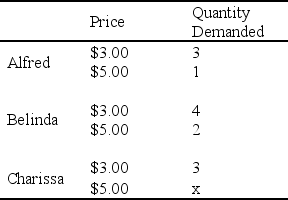 -Refer to Table 4-3.Suppose x = 1.Then it must be true that
 (Multiple Choice)
4.9/5 (83)
(83) Suppose that a decrease in the price of good X results in fewer units of good Y being sold.This implies that X and Y are
(Multiple Choice)
4.9/5 (103)
(103) The difference between a supply schedule and a supply curve is that
(Multiple Choice)
4.8/5 (92)
(92) Suppose that demand decreases and supply decreases.What would you expect to occur in the market for the good?
(Multiple Choice)
4.9/5 (79)
(79) In a perfectly competitive market,buyers and sellers are price setters.
(True/False)
4.7/5 (70)
(70) Figure 4-5
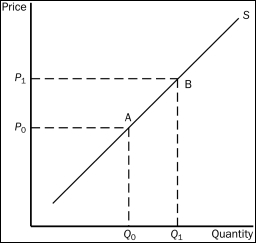 -Refer to Figure 4-5.The movement from point A to point B on the graph is called
 (Multiple Choice)
4.9/5 (81)
(81) 
Filters
- Essay(0)
- Multiple Choice(0)
- Short Answer(0)
- True False(0)
- Matching(0)