



 Chat with AI
Exam 14: Oligopoly and Monopolistic Competition

Exam 1: The Principles and Practice of Economics103 Questions
Exam 2: Economic Methods and Economic Questions94 Questions
Exam 3: Optimization: Doing the Best You Can94 Questions
Exam 4: Demand, supply, and Equilibrium185 Questions
Exam 5: Consumers and Incentives187 Questions
Exam 6: Sellers and Incentives261 Questions
Exam 7: Perfect Competition and the Invisible Hand251 Questions
Exam 8: Trade264 Questions
Exam 9: Externalities and Public Goods223 Questions
Exam 10: The Government in the Economy: Taxation and Regulation244 Questions
Exam 11: Markets for Factors of Production237 Questions
Exam 12: Monopoly295 Questions
Exam 13: Game Theory and Strategic Play199 Questions
Exam 14: Oligopoly and Monopolistic Competition264 Questions
Exam 15: Trade-Offs Involving Time and Risk147 Questions
Exam 16: The Economics of Information119 Questions
Exam 17: Auctions and Bargaining123 Questions
Exam 18: Social Economics111 Questions
Select questions type


Market research finds that nearly 80 percent of vehicle owners purchase tires at the business that performs routine maintenance on their vehicles.Increasingly,new car dealers carry tires and sell to car owners who bring their vehicles to the dealer for maintenance.Many car manufacturers negotiate prices on replacement tires and sell through to their dealers.The growing incidence of new car dealers selling replacement tires spiked up in the aftermath of the Great Recession,as new car dealers looked for ways to boost franchise sales in the face of low levels of new car sales.Given that Bresnahan and Reiss's paper was published more than 25 years ago,local tire markets are ________.
(Multiple Choice)
4.8/5  (88)
(88) ________ is a market structure in which many rival firms produce differentiated products.
(Multiple Choice)
4.8/5 (81)
(81) The quantity produced in a monopolistically competitive market is ________ than the quantity produced in a perfectly competitive market,and the price charged in a monopolistically competitive market is ________ than the price charged in a perfectly competitive market.
(Multiple Choice)
4.9/5 (71)
(71) Suppose a monopolistically competitive market has 10 firms.The largest firm has a 90 percent share of the market and the other nine firms each have 1 percent of the market.The Herfindahl-Hirschman Index for this industry is ________.
(Multiple Choice)
4.9/5 (73)
(73) A firm is said to have market power if it charges a price ________ of production.
(Multiple Choice)
4.8/5 (79)
(79) The following table shows a firm's total cost of producing different quantities of output and the price that consumers are willing to pay for those quantities of the good.
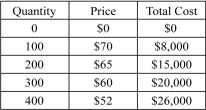 a)If the firm is monopolistically competitive,what is the equilibrium output for the firm?
b)What is the equilibrium price charged by the firm?
c)Calculate the profit earned or the loss incurred by the firm in the short run.
a)If the firm is monopolistically competitive,what is the equilibrium output for the firm?
b)What is the equilibrium price charged by the firm?
c)Calculate the profit earned or the loss incurred by the firm in the short run. (Essay)
4.9/5 (75)
(75) There are two firms in an industry,and their products are perfect substitutes for each other.Each firm had a market share of 50 percent and charged equal prices.However,when the demand for the good declined because of a recession,Firm A lowered its price to increase its sales.Firm B responded by lowering its price further.This is an example of the ________ of oligopoly.
(Multiple Choice)
5.0/5 (78)
(78) Scenario: Two firms, Firm 1 and Firm 2, make differentiated products and compete in a duopoly market. The firms do not have a fixed cost. Firm 1's cost is $30 per unit, while Firm 2's cost is $25 per unit. (So they are the marginal cost and the average total cost). There are 1,000 consumers in this market. The demand is divided between the two firm in the following way:
• If Firm 1's price is less than twice Firm 2's price, then everyone buys from Firm 1.
• If Firm 1's price is more than twice Firm 2's price, then everyone buys from Firm 2.
• If Firm 1's price is equal to twice Firm 2's price, then half of the consumers buy from Firm 1 and the other half buy from Firm 2.
-Refer to the scenario above.Suppose Firm 1 sets the price at $50.If Firm 2 sets its price above $25,then its profit is ________.If Firm 2 sets its price below $25,then its profit is ________.If Firm 2 sets its price at $25,then its profit is ________.
(Multiple Choice)
4.9/5 (83)
(83) Scenario: The market demand for soccer balls in a small town is 2,500 units, and there are two rival sports brands selling soccer balls in this town, Sporty and Go! The products of the two brands are identical.
 -Refer to the scenario above.If Aqua Inc.charges a price of $70 for each unit of Good A and Blu Corp.charges a price of $50,Blu Corp.will face a demand of ________ units.
 (Multiple Choice)
4.8/5 (74)
(74) Suppose a monopolistic competitor produces 1,250 units of a good in equilibrium and charges a price of $7.50 for each unit.If the average total cost of producing 1,250 units of the good is $8,what is the total loss incurred by the producer?
(Multiple Choice)
4.8/5 (70)
(70) The following figure shows the cost curves (ATC, average total cost; MC, marginal cost) of a firm that operates in a monopolistic competition market, as well as the demand (D) facing the firm and the marginal revenue (MR) of this firm.
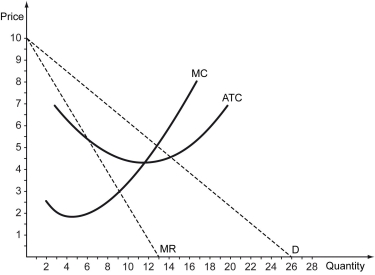 -Refer to the figure above.What is the profit-maximizing price that this firm should charge in the short run?
 (Multiple Choice)
4.9/5 (73)
(73) Which of the following is a difference between a perfectly competitive market and a monopoly?
(Multiple Choice)
5.0/5 (78)
(78) An oligopoly market with differentiated products is similar to a ________,but the key difference is ________.
(Multiple Choice)
4.9/5 (72)
(72) The following figure shows the cost curves (ATC, average total cost; MC, marginal cost) of a firm that operates in a monopolistic competition market, as well as the demand (D) facing the firm and the marginal revenue (MR) of this firm.
-Refer to the figure above.What is the profit-maximizing level of output that this firm should supply in the short run?
-Refer to the figure above.What is the profit-maximizing level of output that this firm should supply in the short run? (Multiple Choice)
4.9/5 (77)
(77) Firms in an oligopoly often do not collude with one another because ________.
(Multiple Choice)
4.8/5 (80)
(80) 
Filters
- Essay(0)
- Multiple Choice(0)
- Short Answer(0)
- True False(0)
- Matching(0)