



 Chat with AI
Exam 14: Oligopoly and Monopolistic Competition

Exam 1: The Principles and Practice of Economics103 Questions
Exam 2: Economic Methods and Economic Questions94 Questions
Exam 3: Optimization: Doing the Best You Can94 Questions
Exam 4: Demand, supply, and Equilibrium185 Questions
Exam 5: Consumers and Incentives187 Questions
Exam 6: Sellers and Incentives261 Questions
Exam 7: Perfect Competition and the Invisible Hand251 Questions
Exam 8: Trade264 Questions
Exam 9: Externalities and Public Goods223 Questions
Exam 10: The Government in the Economy: Taxation and Regulation244 Questions
Exam 11: Markets for Factors of Production237 Questions
Exam 12: Monopoly295 Questions
Exam 13: Game Theory and Strategic Play199 Questions
Exam 14: Oligopoly and Monopolistic Competition264 Questions
Exam 15: Trade-Offs Involving Time and Risk147 Questions
Exam 16: The Economics of Information119 Questions
Exam 17: Auctions and Bargaining123 Questions
Exam 18: Social Economics111 Questions
Select questions type


Differentiate between oligopoly and monopolistic competition on the basis of the number of firms and the degree of product differentiation.
(Essay)
4.9/5  (96)
(96) There are a few ship manufacturers in Polonia,and each firm faces a downward-sloping demand curve.The ship-building industry in Polonia will fall under a(n)________ market structure.
(Multiple Choice)
4.9/5 (73)
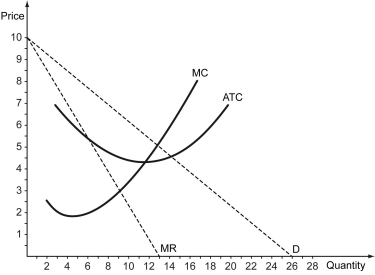
(73) The following figure shows the cost curves (average total cost,ATC; marginal cost,MC)of a firm that operates in a monopolistic competition market,as well as the demand (D)facing the firm and its marginal revenue (MR).In the long-run,this firm's MR curve will ________.
(Multiple Choice)
4.8/5 (81)
(81) Scenario: Two firms, Firm 1 and Firm 2, make differentiated products and compete in a duopoly market. The firms do not have a fixed cost. Firm 1's cost is $30 per unit, while Firm 2's cost is $25 per unit. (So they are the marginal cost and the average total cost). There are 1,000 consumers in this market. The demand is divided between the two firm in the following way:
• If Firm 1's price is less than twice Firm 2's price, then everyone buys from Firm 1.
• If Firm 1's price is more than twice Firm 2's price, then everyone buys from Firm 2.
• If Firm 1's price is equal to twice Firm 2's price, then half of the consumers buy from Firm 1 and the other half buy from Firm 2.
-Refer to the scenario above.Suppose Firm 2 sets the price at $25.If Firm 1 sets its price above $50,then its profit is ________.If Firm 1 sets its price above $30 and below $50,then its profit is ________.If Firm 1 sets its price below $30,then its profit is ________.
(Multiple Choice)
4.8/5 (81)
(81) 
Filters
- Essay(0)
- Multiple Choice(0)
- Short Answer(0)
- True False(0)
- Matching(0)