



 Chat with AI
Exam 14: Oligopoly and Monopolistic Competition

Exam 1: The Principles and Practice of Economics103 Questions
Exam 2: Economic Methods and Economic Questions94 Questions
Exam 3: Optimization: Doing the Best You Can94 Questions
Exam 4: Demand, supply, and Equilibrium185 Questions
Exam 5: Consumers and Incentives187 Questions
Exam 6: Sellers and Incentives261 Questions
Exam 7: Perfect Competition and the Invisible Hand251 Questions
Exam 8: Trade264 Questions
Exam 9: Externalities and Public Goods223 Questions
Exam 10: The Government in the Economy: Taxation and Regulation244 Questions
Exam 11: Markets for Factors of Production237 Questions
Exam 12: Monopoly295 Questions
Exam 13: Game Theory and Strategic Play199 Questions
Exam 14: Oligopoly and Monopolistic Competition264 Questions
Exam 15: Trade-Offs Involving Time and Risk147 Questions
Exam 16: The Economics of Information119 Questions
Exam 17: Auctions and Bargaining123 Questions
Exam 18: Social Economics111 Questions
Select questions type


The flatter (more relatively elastic)is the residual demand curve is,________.
(Multiple Choice)
4.8/5  (85)
(85) Which option correctly sorts different market structures in terms of competitiveness,from the most competitive to the least?
(Multiple Choice)
5.0/5 (89)
(89) Consider the following table.Which option correctly fills the blanks in the table?

(Multiple Choice)
4.7/5 (77)
(77) The Organization of the Petroleum Exporting Countries (OPEC)is an example of a ________.
(Multiple Choice)
4.8/5 (73)
(73) The figure below depicts a monopolistically competitive firm in the short run.
 -Refer to the figure above.In the short run,the profit-maximizing monopolistically competitive firm produces a level of output that results in a deadweight loss equal to ________.
 (Multiple Choice)
4.7/5 (71)
(71) Which of the following will happen if a firm in a duopoly with homogeneous products increases its price above its marginal cost once a Nash equilibrium is reached?
(Multiple Choice)
4.9/5 (73)
(73) The table below summarizes the information possessed by a firm in a monopolistically competitive market. Quantity demanded is in thousands of units.
 -Refer to the table above.If this market were perfectly competitive,the long-run equilibrium price would be ________.
 (Multiple Choice)
5.0/5 (82)
(82) Answer: The market for candy bars has excess capacity. This is because firms in a monopolistically competitive market do not produce at the minimum point on their average total cost curve, unlike firms in a perfectly competitive market. The monopolistically competitive firms produce at a level below the efficient scale of production, as can be seen in the following figure.
 The firm in the figure above does not increase production up to the level associated with the minimum point on the ATC curve, QMᵢn, because it would then need to cut the price it charges for its goods, resulting in lower profits. Firms in a perfectly competitive market charge a price equal to the marginal cost of production and produce at the minimum point on the average total cost curve, as shown in the figure below.
 -Refer to the figure above.This 's profit maximizing choice happens when it ________.
The firm in the figure above does not increase production up to the level associated with the minimum point on the ATC curve, QMᵢn, because it would then need to cut the price it charges for its goods, resulting in lower profits. Firms in a perfectly competitive market charge a price equal to the marginal cost of production and produce at the minimum point on the average total cost curve, as shown in the figure below.
-Refer to the figure above.This 's profit maximizing choice happens when it ________. (Multiple Choice)
4.8/5 (73)
(73) In which of the following market structures is social surplus maximized?
(Multiple Choice)
4.9/5 (81)
(81) The following figure depicts four different market situations.
 -Refer to the figure above.Which of the four market situations depicts a monopolistically competitive firm making positive profits?
 (Multiple Choice)
5.0/5 (78)
(78) In an oligopoly industry with differentiated products,price ________.
(Multiple Choice)
4.9/5 (83)
(83) Suppose that a firm in a monopolistically competitive market has a constant marginal cost and it is making a positive profit in the short run.What will happen in the long-run equilibrium?
(Multiple Choice)
4.9/5 (90)
(90) The following figure depicts four different market situations.
-Refer to the figure above.Which of the four market situations depicts a monopolistically competitive firm in the long run?
-Refer to the figure above.Which of the four market situations depicts a monopolistically competitive firm in the long run? (Multiple Choice)
4.8/5 (81)
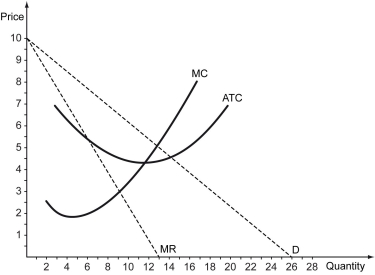
(81) The following figure shows the cost curves (ATC,average total cost; MC,marginal cost)of firm that operates in a monopolistic competition market,as well as the demand (D)facing the firm and its marginal revenue (MR).How much profit does this firm make in the short run?
(Multiple Choice)
4.9/5 (79)
(79) The following figure shows the cost curves (ATC, average total cost; MC, marginal cost) of a firm that operates in a monopolistic competition market, as well as the demand (D) facing this firm and its marginal revenue (MR).
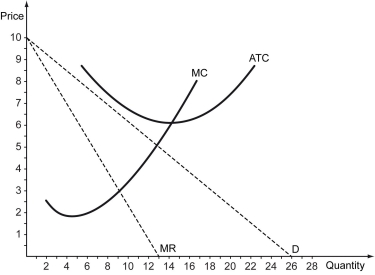 -Refer to the figure above.What is the profit-maximizing level of output that this firm should supply in the short run?
 (Multiple Choice)
4.8/5 (84)
(84) 
Filters
- Essay(0)
- Multiple Choice(0)
- Short Answer(0)
- True False(0)
- Matching(0)