



 Chat with AI
Exam 14: Oligopoly and Monopolistic Competition

Exam 1: The Principles and Practice of Economics103 Questions
Exam 2: Economic Methods and Economic Questions94 Questions
Exam 3: Optimization: Doing the Best You Can94 Questions
Exam 4: Demand, supply, and Equilibrium185 Questions
Exam 5: Consumers and Incentives187 Questions
Exam 6: Sellers and Incentives261 Questions
Exam 7: Perfect Competition and the Invisible Hand251 Questions
Exam 8: Trade264 Questions
Exam 9: Externalities and Public Goods223 Questions
Exam 10: The Government in the Economy: Taxation and Regulation244 Questions
Exam 11: Markets for Factors of Production237 Questions
Exam 12: Monopoly295 Questions
Exam 13: Game Theory and Strategic Play199 Questions
Exam 14: Oligopoly and Monopolistic Competition264 Questions
Exam 15: Trade-Offs Involving Time and Risk147 Questions
Exam 16: The Economics of Information119 Questions
Exam 17: Auctions and Bargaining123 Questions
Exam 18: Social Economics111 Questions
Select questions type


The following excerpt is from "Sotheby's Agree to Pay $512 Million Collusion Settlement," Wall Street Journal, September 25, 2000.
Sotheby's Holdings Inc. and rival Christie's International agreed to pay $512 million to settle claims by art buyers and sellers that the auction houses colluded on prices and cheated them, with nearly one-third of the tab to be paid by Sotheby's former chairman, A. Alfred Taubman. The proposed civil settlement comes as Justice Department prosecutors are reaching a critical stage in their three-year criminal probe of the world's largest auction houses. They are close to reaching agreements with Sotheby's and its former chief executive, Diane "Dede" Brooks, that would secure their testimony against Mr. Taubman in exchange for leniency and lighter penalties, according to people familiar with the matter.
-Refer to the excerpt above.The story illustrates a government use of ________ to regulate market power.
(Multiple Choice)
4.9/5  (88)
(88) Suppose there are only two firms in an industry and their products are perfect substitutes for each other.Each firm has 50 percent of the market share,and they have the same marginal cost.The Hirfindahl Hirschman Index (HHI)in this market is ________,and the government should ________.
(Multiple Choice)
4.9/5 (81)
(81) A profit-maximizing monopolistic competitor continues production until ________.
(Multiple Choice)
4.9/5 (75)
(75) Goods that are similar but are not perfect substitutes are called ________ goods.
(Multiple Choice)
4.8/5 (80)
(80) Which of the following is a difference between an oligopoly with homogeneous products and a monopoly?
(Multiple Choice)
4.9/5 (81)
(81) There are two firms competing à la Bertrand,and Firm A has a marginal cost strictly greater than that of Firm B.What will happen in this case?
(Multiple Choice)
4.8/5 (89)
(89) Which of the following is a difference between a monopolistically competitive market and a perfectly competitive market in the long run?
(Multiple Choice)
4.9/5 (79)
(79) The following figure shows the demand and cost curves faced by a monopolistic competitor.
 -Refer to the figure above.The optimal quantity produced by the monopolistic competitor is ________.
 (Multiple Choice)
5.0/5 (83)
(83) A monopolistic competitor earns zero economic profits if it charges a price that is ________.
(Multiple Choice)
4.9/5 (86)
(86) An industry composed of four identical firms is likely to have a Herfindahl-Hirschman Index of ________.
(Multiple Choice)
4.7/5 (72)
(72) The figure below depicts a monopolistically competitive firm in the short run.
 -Refer to the figure above.At the profit-maximizing level of output,the monopolistically competitive firm earns profits equal to ________ in the short run.
 (Multiple Choice)
4.8/5 (81)
(81) In which of the following market structures is there at least the possibility of earning profits in the long-run equilibrium?
(Multiple Choice)
4.8/5 (73)
(73) A monopolistically competitive firm always faces a(n)________.
(Multiple Choice)
4.9/5 (67)
(67) The table below summarizes the information possessed by a firm in a monopolistically competitive market. Quantity demanded is in thousands of units.
 -Refer to the table above.The optimal quantity produced by the monopolistic competitor is ________.
 (Multiple Choice)
4.8/5 (61)
(61) Suppose there are only two firms in an industry,and their products are perfect substitutes for each other.Each firm had a fixed marginal cost of $5,and zero fixed cost of operation.The highest the consumers of this product are willing to pay for it is $10,and there are 200 consumers in this market.The two firms agree to collude and come up with a pricing scheme that maximizes their joint profit.The agreed-on price of this collusion will be ________,and this collusion is ________.
(Multiple Choice)
4.8/5 (81)
(81) How does the exit of firms from a monopolistically competitive market affect the demand curves faced by the existing firms?
(Essay)
4.7/5 (78)
(78) There are two firms in an industry,Firm A and Firm B.Both firms sell a homogenous product.If one firm sets a price higher than the other firm,then all the demand goes to the firm setting the lower price.If prices are equal,the demand is shared equally between the two firms.The following figure depicts the demand faced by Firm A.What is Firm B's strategy that could explain such a demand curve faced by Firm A?

(Multiple Choice)
4.9/5 (65)
(65) Which of the following is a similarity between a monopoly and an oligopoly with differentiated products?
(Multiple Choice)
5.0/5 (75)
(75) The following figure shows the demand curve (DD), the marginal revenue curve (MR), and the cost curves of a monopolistic competitor.
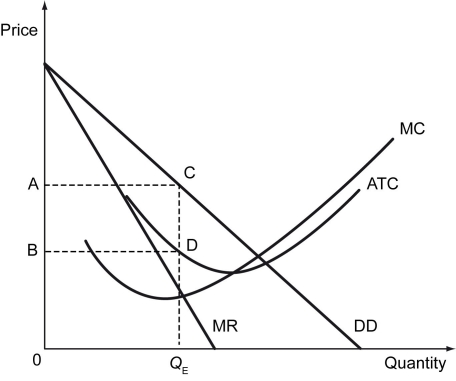 -Refer to the figure above.What does the region ABDC denote?
 (Multiple Choice)
4.8/5 (77)
(77) 
Filters
- Essay(0)
- Multiple Choice(0)
- Short Answer(0)
- True False(0)
- Matching(0)