



 Chat with AI
Exam 54: Male Reproductive and Genital Problems

Exam 1: Professional Nursing Practice21 Questions
Exam 2: Health Disparities and Culturally Competent Care18 Questions
Exam 3: Health History and Physical Examination15 Questions
Exam 4: Patient and Caregiver Teaching21 Questions
Exam 5: Chronic Illness and Older Adults21 Questions
Exam 6: Stress and Stress Management12 Questions
Exam 7: Sleep and Sleep Disorders11 Questions
Exam 8: Pain26 Questions
Exam 9: Palliative Care at End of Life16 Questions
Exam 10: Substance Use Disorders25 Questions
Exam 11: Inflammation and Wound Healing22 Questions
Exam 12: Genetics and Genomics7 Questions
Exam 13: Altered Immune Responses and Transplantation26 Questions
Exam 14: Infection and Human Immunodeficiency Virus Infection26 Questions
Exam 15: Cancer43 Questions
Exam 16: Fluid, electrolyte, and Acid-Base Imbalances37 Questions
Exam 17: Preoperative Care21 Questions
Exam 18: Intraoperative Care18 Questions
Exam 19: Postoperative Care25 Questions
Exam 20: Assessment of Visual and Auditory Systems25 Questions
Exam 21: Visual and Auditory Problems47 Questions
Exam 22: Assessment of Integumentary System14 Questions
Exam 23: Integumentary Problems25 Questions
Exam 24: Burns31 Questions
Exam 25: Assessment of Respiratory System24 Questions
Exam 26: Upper Respiratory Problems25 Questions
Exam 27: Lower Respiratory Problems51 Questions
Exam 28: Obstructive Pulmonary Diseases44 Questions
Exam 29: Assessment of Hematologic System16 Questions
Exam 30: Hematologic Problems48 Questions
Exam 31: Assessment of Cardiovascular System24 Questions
Exam 32: Hypertension24 Questions
Exam 33: Coronary Artery Disease and Acute Coronary Syndrome43 Questions
Exam 34: Heart Failure25 Questions
Exam 35: Dysrhythmias31 Questions
Exam 36: Inflammatory and Structural Heart Disorders35 Questions
Exam 37: Vascular Disorders36 Questions
Exam 38: Assessment of Gastrointestinal System17 Questions
Exam 39: Nutritional Problems24 Questions
Exam 40: Obesity20 Questions
Exam 41: Upper Gastrointestinal Problems47 Questions
Exam 42: Lower Gastrointestinal Problems55 Questions
Exam 43: Liver, pancreas, and Biliary Tract Problems46 Questions
Exam 44: Assessment of Urinary System23 Questions
Exam 45: Renal and Urologic Problems45 Questions
Exam 46: Acute Kidney Injury and Chronic Kidney Disease38 Questions
Exam 47: Assessment of Endocrine System22 Questions
Exam 48: Diabetes Mellitus49 Questions
Exam 49: Endocrine Problems46 Questions
Exam 50: Assessment of Reproductive System19 Questions
Exam 51: Breast Disorders28 Questions
Exam 52: Sexually Transmitted Infections19 Questions
Exam 53: Female Reproductive and Genital Problems49 Questions
Exam 54: Male Reproductive and Genital Problems35 Questions
Exam 55: Assessment of Nervous System21 Questions
Exam 56: Acute Intracranial Problems40 Questions
Exam 57: Stroke30 Questions
Exam 58: Chronic Neurologic Problems36 Questions
Exam 59: Dementia and Delirium21 Questions
Exam 60: Spinal Cord and Peripheral Nerve Problems33 Questions
Exam 61: Assessment of Musculoskeletal System15 Questions
Exam 62: Musculoskeletal Trauma and Orthopedic Surgery47 Questions
Exam 63: Musculoskeletal Problems25 Questions
Exam 64: Arthritis and Connective Tissue Diseases47 Questions
Exam 65: Critical Care40 Questions
Exam 66: Shock, sepsis, and Multiple Organ Dysfunction Syndrome29 Questions
Exam 67: Acute Respiratory Failure and Acute Respiratory Distress Syndrome27 Questions
Exam 68: Emergency and Disaster Nursing26 Questions
Select questions type


A patient with urinary obstruction from benign prostatic hyperplasia (BPH)tells the nurse,"My symptoms are much worse this week." Which response by the nurse is appropriate?

Free
(Multiple Choice)
4.9/5  (68)
(68) Correct Answer: Verified
A
After reviewing the electronic medical record shown in the accompanying figure for a patient who had transurethral resection of the prostate the previous day,which information requires the most rapid action by the nurse? 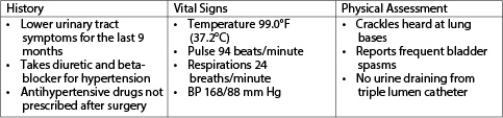
Free
(Multiple Choice)
4.7/5 (68)
(68) Correct Answer:Verified
VerifiedB
When caring for a patient with continuous bladder irrigation after having transurethral resection of the prostate,which action could the nurse delegate to unlicensed assistive personnel (UAP)?
Free
(Multiple Choice)
4.7/5 (67)
(67) Correct Answer:Verified
VerifiedB
When performing discharge teaching for a patient after a vasectomy,the nurse instructs the patient that he
(Multiple Choice)
4.7/5 (97)
(97) A 70-yr-old patient who has had a transurethral resection of the prostate (TURP)for benign prostatic hyperplasia (BPH)is being discharged from the hospital today. Which patient statement indicates a need for the nurse to provide additional instruction?
(Multiple Choice)
4.9/5 (77)
(77) A 27-yr-old patient who has testicular cancer is being admitted for a unilateral orchiectomy. The patient does not talk to his wife and speaks to the nurse only to answer the admission questions. Which action is appropriate for the nurse to take?
(Multiple Choice)
4.7/5 (78)
(78) The nurse will plan to teach a 67-yr-old patient who has been diagnosed with orchitis about
(Multiple Choice)
4.9/5 (87)
(87) The nurse in a health clinic receives requests for appointments from several patients. Which patient should be seen by the health care provider first?
(Multiple Choice)
4.7/5 (92)
(92) After a transurethral resection of the prostate (TURP),a 64-yr-old patient with continuous bladder irrigation complains of painful bladder spasms. The nurse observes clots in the urine. Which action should the nurse take first?
(Multiple Choice)
4.8/5 (84)
(84) A 58-yr-old patient with erectile dysfunction (ED)tells the nurse he is interested in using sildenafil (Viagra). Which action should the nurse take first?
(Multiple Choice)
4.8/5 (90)
(90) A patient tells the nurse that he decided to seek treatment for erectile dysfunction (ED)because his wife "is losing patience with the situation." The nurse's follow-up questions should focus on the man's identified concern with
(Multiple Choice)
4.9/5 (87)
(87) Which information will the nurse teach a patient who has chronic prostatitis?
(Multiple Choice)
4.8/5 (74)
(74) The following male patients recently arrived in the emergency department. Which one should the nurse assess first?
(Multiple Choice)
4.8/5 (83)
(83) The nurse in the clinic notes elevated prostate specific antigen (PSA)levels in the laboratory results of these patients. Which patient's PSA result is not expected to be elevated?
(Multiple Choice)
4.9/5 (78)
(78) The plan of care for a patient immediately after a perineal radical prostatectomy will include decreasing the risk for infection related to
(Multiple Choice)
4.8/5 (75)
(75) The health care provider prescribes finasteride (Proscar)for a patient who has benign prostatic hyperplasia (BPH). When teaching the patient about the drug,the nurse informs him that
(Multiple Choice)
4.9/5 (68)
(68) Which information will the nurse plan to include when teaching a young adult who has a family history of testicular cancer about testicular self-examination?
(Multiple Choice)
5.0/5 (79)
(79) Several patients call the urology clinic requesting appointments with the health care provider as soon as possible. Which patient will the nurse schedule to be seen first?
(Multiple Choice)
4.8/5 (90)
(90) The nurse performing a focused examination to determine possible causes of infertility will assess for
(Multiple Choice)
4.8/5 (70)
(70) The nurse will plan to teach the patient scheduled for photovaporization of the prostate (PVP)
(Multiple Choice)
4.8/5 (79)
(79) 
Filters
- Essay(0)
- Multiple Choice(0)
- Short Answer(0)
- True False(0)
- Matching(0)