



 Chat with AI
Exam 31: Assessment of Cardiovascular System

Exam 1: Professional Nursing Practice21 Questions
Exam 2: Health Disparities and Culturally Competent Care18 Questions
Exam 3: Health History and Physical Examination15 Questions
Exam 4: Patient and Caregiver Teaching21 Questions
Exam 5: Chronic Illness and Older Adults21 Questions
Exam 6: Stress and Stress Management12 Questions
Exam 7: Sleep and Sleep Disorders11 Questions
Exam 8: Pain26 Questions
Exam 9: Palliative Care at End of Life16 Questions
Exam 10: Substance Use Disorders25 Questions
Exam 11: Inflammation and Wound Healing22 Questions
Exam 12: Genetics and Genomics7 Questions
Exam 13: Altered Immune Responses and Transplantation26 Questions
Exam 14: Infection and Human Immunodeficiency Virus Infection26 Questions
Exam 15: Cancer43 Questions
Exam 16: Fluid, electrolyte, and Acid-Base Imbalances37 Questions
Exam 17: Preoperative Care21 Questions
Exam 18: Intraoperative Care18 Questions
Exam 19: Postoperative Care25 Questions
Exam 20: Assessment of Visual and Auditory Systems25 Questions
Exam 21: Visual and Auditory Problems47 Questions
Exam 22: Assessment of Integumentary System14 Questions
Exam 23: Integumentary Problems25 Questions
Exam 24: Burns31 Questions
Exam 25: Assessment of Respiratory System24 Questions
Exam 26: Upper Respiratory Problems25 Questions
Exam 27: Lower Respiratory Problems51 Questions
Exam 28: Obstructive Pulmonary Diseases44 Questions
Exam 29: Assessment of Hematologic System16 Questions
Exam 30: Hematologic Problems48 Questions
Exam 31: Assessment of Cardiovascular System24 Questions
Exam 32: Hypertension24 Questions
Exam 33: Coronary Artery Disease and Acute Coronary Syndrome43 Questions
Exam 34: Heart Failure25 Questions
Exam 35: Dysrhythmias31 Questions
Exam 36: Inflammatory and Structural Heart Disorders35 Questions
Exam 37: Vascular Disorders36 Questions
Exam 38: Assessment of Gastrointestinal System17 Questions
Exam 39: Nutritional Problems24 Questions
Exam 40: Obesity20 Questions
Exam 41: Upper Gastrointestinal Problems47 Questions
Exam 42: Lower Gastrointestinal Problems55 Questions
Exam 43: Liver, pancreas, and Biliary Tract Problems46 Questions
Exam 44: Assessment of Urinary System23 Questions
Exam 45: Renal and Urologic Problems45 Questions
Exam 46: Acute Kidney Injury and Chronic Kidney Disease38 Questions
Exam 47: Assessment of Endocrine System22 Questions
Exam 48: Diabetes Mellitus49 Questions
Exam 49: Endocrine Problems46 Questions
Exam 50: Assessment of Reproductive System19 Questions
Exam 51: Breast Disorders28 Questions
Exam 52: Sexually Transmitted Infections19 Questions
Exam 53: Female Reproductive and Genital Problems49 Questions
Exam 54: Male Reproductive and Genital Problems35 Questions
Exam 55: Assessment of Nervous System21 Questions
Exam 56: Acute Intracranial Problems40 Questions
Exam 57: Stroke30 Questions
Exam 58: Chronic Neurologic Problems36 Questions
Exam 59: Dementia and Delirium21 Questions
Exam 60: Spinal Cord and Peripheral Nerve Problems33 Questions
Exam 61: Assessment of Musculoskeletal System15 Questions
Exam 62: Musculoskeletal Trauma and Orthopedic Surgery47 Questions
Exam 63: Musculoskeletal Problems25 Questions
Exam 64: Arthritis and Connective Tissue Diseases47 Questions
Exam 65: Critical Care40 Questions
Exam 66: Shock, sepsis, and Multiple Organ Dysfunction Syndrome29 Questions
Exam 67: Acute Respiratory Failure and Acute Respiratory Distress Syndrome27 Questions
Exam 68: Emergency and Disaster Nursing26 Questions
Select questions type


The nurse has received the laboratory results for a patient who developed chest pain 4 hours ago and may be having a myocardial infarction. The laboratory test result most helpful in indicating myocardial damage will be

Free
(Multiple Choice)
4.9/5  (82)
(82) Correct Answer: Verified
B
During a physical examination of an older patient,the nurse palpates the point of maximal impulse (PMI)in the sixth intercostal space lateral to the left midclavicular line. The best follow-up action for the nurse to take will be to
Free
(Multiple Choice)
4.8/5 (72)
(72) Correct Answer:Verified
VerifiedC
To auscultate for S3 or S4 gallops in the mitral area,the nurse listens with the
Free
(Multiple Choice)
4.8/5 (76)
(76) Correct Answer:Verified
VerifiedB
While listening at the mitral area,the nurse notes abnormal heart sounds at the patient's fifth intercostal space,midclavicular line. After listening to the audio clip,describe how the nurse will document the assessment finding.
(Multiple Choice)
4.9/5 (85)
(85) Which action will the nurse implement for a patient who arrives for a calcium-scoring CT scan?
(Multiple Choice)
4.8/5 (98)
(98) When assessing a newly admitted patient,the nurse notes a murmur along the left sternal border. To acquire more information about the murmur,which action will the nurse take?
(Multiple Choice)
4.8/5 (79)
(79) The nurse is reviewing the laboratory results for newly admitted patients on the cardiovascular unit. Which laboratory result is most important to communicate as soon as possible to the health care provider?
(Multiple Choice)
4.7/5 (84)
(84) When admitting a patient for a cardiac catheterization and coronary angiogram,which information about the patient is most important for the nurse to communicate to the health care provider?
(Multiple Choice)
4.8/5 (60)
(60) When the nurse is screening patients for possible peripheral arterial disease,indicate where the posterior tibial artery will be palpated. 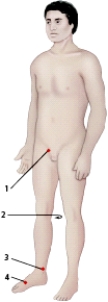
(Multiple Choice)
4.8/5 (92)
(92) A transesophageal echocardiogram (TEE)is ordered for a patient with possible endocarditis. Which action included in the standard TEE orders will the nurse need to accomplish first?
(Multiple Choice)
4.8/5 (69)
(69) The nurse hears a murmur between the S1 and S2 heart sounds at the patient's left fifth intercostal space and midclavicular line. How will the nurse record this information?
(Multiple Choice)
4.9/5 (87)
(87) The nurse is reviewing the 12-lead electrocardiograph (ECG)for a healthy 74-yr-old patient who is having an annual physical examination. What finding is of most concern to the nurse?
(Multiple Choice)
4.7/5 (84)
(84) When auscultating over the patient's abdominal aorta,the nurse hears a loud humming sound. The nurse documents this finding as a
(Multiple Choice)
4.9/5 (92)
(92) The nurse teaches the patient being evaluated for rhythm disturbances with a Holter monitor to
(Multiple Choice)
4.9/5 (72)
(72) The standard policy on the cardiac unit states,"Notify the health care provider for mean arterial pressure (MAP)less than 70 mm Hg." The nurse will need to call the health care provider about the
(Multiple Choice)
4.8/5 (83)
(83) The nurse notes that a patient who was admitted with heart failure has jugular venous distention (JVD)when lying flat in bed. Which follow-up action should the nurse take next?
(Multiple Choice)
4.9/5 (88)
(88) Which information obtained by the nurse who is admitting the patient for magnetic resonance imaging (MRI)will be important to report to the health care provider before the MRI?
(Multiple Choice)
4.9/5 (71)
(71) While doing the hospital admission assessment for a thin older adult,the nurse observes pulsation of the abdominal aorta in the epigastric area. Which action should the nurse take next?
(Multiple Choice)
4.8/5 (81)
(81) A registered nurse (RN)is observing a student nurse who is doing a physical assessment on a patient. The RN will need to intervene immediately if the student nurse
(Multiple Choice)
4.8/5 (78)
(78) The nurse and unlicensed assistive personnel (UAP)on the telemetry unit are caring for four patients. Which nursing action can be delegated to the UAP?
(Multiple Choice)
4.8/5 (77)
(77) 
Filters
- Essay(0)
- Multiple Choice(0)
- Short Answer(0)
- True False(0)
- Matching(0)