



 Chat with AI
Exam 25: Assessment of Respiratory System

Exam 1: Professional Nursing Practice21 Questions
Exam 2: Health Disparities and Culturally Competent Care18 Questions
Exam 3: Health History and Physical Examination15 Questions
Exam 4: Patient and Caregiver Teaching21 Questions
Exam 5: Chronic Illness and Older Adults21 Questions
Exam 6: Stress and Stress Management12 Questions
Exam 7: Sleep and Sleep Disorders11 Questions
Exam 8: Pain26 Questions
Exam 9: Palliative Care at End of Life16 Questions
Exam 10: Substance Use Disorders25 Questions
Exam 11: Inflammation and Wound Healing22 Questions
Exam 12: Genetics and Genomics7 Questions
Exam 13: Altered Immune Responses and Transplantation26 Questions
Exam 14: Infection and Human Immunodeficiency Virus Infection26 Questions
Exam 15: Cancer43 Questions
Exam 16: Fluid, electrolyte, and Acid-Base Imbalances37 Questions
Exam 17: Preoperative Care21 Questions
Exam 18: Intraoperative Care18 Questions
Exam 19: Postoperative Care25 Questions
Exam 20: Assessment of Visual and Auditory Systems25 Questions
Exam 21: Visual and Auditory Problems47 Questions
Exam 22: Assessment of Integumentary System14 Questions
Exam 23: Integumentary Problems25 Questions
Exam 24: Burns31 Questions
Exam 25: Assessment of Respiratory System24 Questions
Exam 26: Upper Respiratory Problems25 Questions
Exam 27: Lower Respiratory Problems51 Questions
Exam 28: Obstructive Pulmonary Diseases44 Questions
Exam 29: Assessment of Hematologic System16 Questions
Exam 30: Hematologic Problems48 Questions
Exam 31: Assessment of Cardiovascular System24 Questions
Exam 32: Hypertension24 Questions
Exam 33: Coronary Artery Disease and Acute Coronary Syndrome43 Questions
Exam 34: Heart Failure25 Questions
Exam 35: Dysrhythmias31 Questions
Exam 36: Inflammatory and Structural Heart Disorders35 Questions
Exam 37: Vascular Disorders36 Questions
Exam 38: Assessment of Gastrointestinal System17 Questions
Exam 39: Nutritional Problems24 Questions
Exam 40: Obesity20 Questions
Exam 41: Upper Gastrointestinal Problems47 Questions
Exam 42: Lower Gastrointestinal Problems55 Questions
Exam 43: Liver, pancreas, and Biliary Tract Problems46 Questions
Exam 44: Assessment of Urinary System23 Questions
Exam 45: Renal and Urologic Problems45 Questions
Exam 46: Acute Kidney Injury and Chronic Kidney Disease38 Questions
Exam 47: Assessment of Endocrine System22 Questions
Exam 48: Diabetes Mellitus49 Questions
Exam 49: Endocrine Problems46 Questions
Exam 50: Assessment of Reproductive System19 Questions
Exam 51: Breast Disorders28 Questions
Exam 52: Sexually Transmitted Infections19 Questions
Exam 53: Female Reproductive and Genital Problems49 Questions
Exam 54: Male Reproductive and Genital Problems35 Questions
Exam 55: Assessment of Nervous System21 Questions
Exam 56: Acute Intracranial Problems40 Questions
Exam 57: Stroke30 Questions
Exam 58: Chronic Neurologic Problems36 Questions
Exam 59: Dementia and Delirium21 Questions
Exam 60: Spinal Cord and Peripheral Nerve Problems33 Questions
Exam 61: Assessment of Musculoskeletal System15 Questions
Exam 62: Musculoskeletal Trauma and Orthopedic Surgery47 Questions
Exam 63: Musculoskeletal Problems25 Questions
Exam 64: Arthritis and Connective Tissue Diseases47 Questions
Exam 65: Critical Care40 Questions
Exam 66: Shock, sepsis, and Multiple Organ Dysfunction Syndrome29 Questions
Exam 67: Acute Respiratory Failure and Acute Respiratory Distress Syndrome27 Questions
Exam 68: Emergency and Disaster Nursing26 Questions
Select questions type


A patient who has a history of chronic obstructive pulmonary disease (COPD)was hospitalized for increasing shortness of breath and chronic hypoxemia (SaO2 levels of 89% to 90%). In planning for discharge,which action by the nurse will be most effective in improving compliance with discharge teaching?

Free
(Multiple Choice)
4.8/5  (80)
(80) Correct Answer: Verified
C
On auscultation of a patient's lungs,the nurse hears low-pitched,bubbling sounds during inhalation in the lower third of both lungs. How should the nurse document this finding?
Free
(Multiple Choice)
5.0/5 (77)
(77) Correct Answer:Verified
VerifiedA
Which assessment finding indicates that the nurse should take immediate action for an older patient?
Free
(Multiple Choice)
4.9/5 (77)
(77) Correct Answer:Verified
VerifiedD
The nurse teaches a patient about pulmonary spirometry testing. Which statement,if made by the patient,indicates teaching was effective?
(Multiple Choice)
4.8/5 (81)
(81) The nurse prepares a patient with a left-sided pleural effusion for a thoracentesis. How should the nurse position the patient?
(Multiple Choice)
4.9/5 (80)
(80) The nurse observes that a patient with respiratory disease experiences a decrease in SpO2 from 93% to 88% while the patient is ambulating. What is the priority action of the nurse?
(Multiple Choice)
4.8/5 (80)
(80) While listening to the posterior chest of a patient who is experiencing acute shortness of breath,the nurse hears these sounds. How should the nurse document the lung sounds? HYPERLINK "http://static.us.elsevierhealth.com/lewis_9e/wheezing.mp3" Click here to listen to the audio clip
(Multiple Choice)
4.8/5 (73)
(73) The nurse analyzes the results of a patient's arterial blood gases (ABGs). Which finding would require immediate action?
(Multiple Choice)
4.8/5 (89)
(89) A patient in metabolic alkalosis is admitted to the emergency department and pulse oximetry (SpO2)indicates that the O2 saturation is 94%. Which action should the nurse expect to take next?
(Multiple Choice)
4.8/5 (79)
(79) A patient with acute dyspnea is scheduled for a spiral computed tomography (CT)scan. Which information obtained by the nurse is a priority to communicate to the health care provider before the CT?
(Multiple Choice)
4.9/5 (81)
(81) The nurse completes a shift assessment on a patient admitted in the early phase of heart failure. When auscultating the patient's lungs,which finding would the nurse most likely hear?
(Multiple Choice)
4.9/5 (81)
(81) The nurse admits a patient who has a diagnosis of an acute asthma attack. Which statement indicates that the patient may need teaching regarding medication use?
(Multiple Choice)
4.8/5 (70)
(70) A patient is scheduled for a computed tomography (CT)scan of the chest with contrast media. Which assessment findings should the nurse report to the health care provider before the patient goes for the CT ?
(Multiple Choice)
4.8/5 (67)
(67) Which action is appropriate for the nurse to delegate to unlicensed assistive personnel (UAP)?
(Multiple Choice)
4.8/5 (80)
(80) After the nurse has received change-of-shift report,which patient should the nurse assess first?
(Multiple Choice)
4.9/5 (64)
(64) A patient with acute shortness of breath is admitted to the hospital. Which action should the nurse take during the initial assessment of the patient?
(Multiple Choice)
4.7/5 (86)
(86) Using the illustrated technique,the nurse is assessing for which finding in a patient with chronic obstructive pulmonary disease (COPD)? 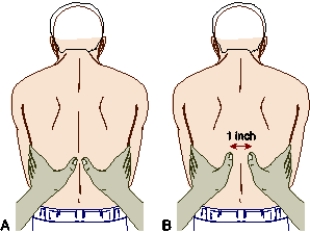
(Multiple Choice)
4.9/5 (77)
(77) The laboratory has just called with the arterial blood gas (ABG)results on four patients. Which result is most important for the nurse to report immediately to the health care provider?
(Multiple Choice)
4.9/5 (80)
(80) A diabetic patient's arterial blood gas (ABG)results are pH 7.28; PaCO2 34 mm Hg; PaO2 85 mm Hg; HCO3- 18 mEq/L. The nurse would expect which finding?
(Multiple Choice)
4.8/5 (72)
(72) The nurse palpates the posterior chest while the patient says "99" and notes absent fremitus. Which action should the nurse take next?
(Multiple Choice)
4.8/5 (78)
(78) 
Filters
- Essay(0)
- Multiple Choice(0)
- Short Answer(0)
- True False(0)
- Matching(0)