



 Chat with AI
Exam 29: Assessment of Hematologic System

Exam 1: Professional Nursing Practice21 Questions
Exam 2: Health Disparities and Culturally Competent Care18 Questions
Exam 3: Health History and Physical Examination15 Questions
Exam 4: Patient and Caregiver Teaching21 Questions
Exam 5: Chronic Illness and Older Adults21 Questions
Exam 6: Stress and Stress Management12 Questions
Exam 7: Sleep and Sleep Disorders11 Questions
Exam 8: Pain26 Questions
Exam 9: Palliative Care at End of Life16 Questions
Exam 10: Substance Use Disorders25 Questions
Exam 11: Inflammation and Wound Healing22 Questions
Exam 12: Genetics and Genomics7 Questions
Exam 13: Altered Immune Responses and Transplantation26 Questions
Exam 14: Infection and Human Immunodeficiency Virus Infection26 Questions
Exam 15: Cancer43 Questions
Exam 16: Fluid, electrolyte, and Acid-Base Imbalances37 Questions
Exam 17: Preoperative Care21 Questions
Exam 18: Intraoperative Care18 Questions
Exam 19: Postoperative Care25 Questions
Exam 20: Assessment of Visual and Auditory Systems25 Questions
Exam 21: Visual and Auditory Problems47 Questions
Exam 22: Assessment of Integumentary System14 Questions
Exam 23: Integumentary Problems25 Questions
Exam 24: Burns31 Questions
Exam 25: Assessment of Respiratory System24 Questions
Exam 26: Upper Respiratory Problems25 Questions
Exam 27: Lower Respiratory Problems51 Questions
Exam 28: Obstructive Pulmonary Diseases44 Questions
Exam 29: Assessment of Hematologic System16 Questions
Exam 30: Hematologic Problems48 Questions
Exam 31: Assessment of Cardiovascular System24 Questions
Exam 32: Hypertension24 Questions
Exam 33: Coronary Artery Disease and Acute Coronary Syndrome43 Questions
Exam 34: Heart Failure25 Questions
Exam 35: Dysrhythmias31 Questions
Exam 36: Inflammatory and Structural Heart Disorders35 Questions
Exam 37: Vascular Disorders36 Questions
Exam 38: Assessment of Gastrointestinal System17 Questions
Exam 39: Nutritional Problems24 Questions
Exam 40: Obesity20 Questions
Exam 41: Upper Gastrointestinal Problems47 Questions
Exam 42: Lower Gastrointestinal Problems55 Questions
Exam 43: Liver, pancreas, and Biliary Tract Problems46 Questions
Exam 44: Assessment of Urinary System23 Questions
Exam 45: Renal and Urologic Problems45 Questions
Exam 46: Acute Kidney Injury and Chronic Kidney Disease38 Questions
Exam 47: Assessment of Endocrine System22 Questions
Exam 48: Diabetes Mellitus49 Questions
Exam 49: Endocrine Problems46 Questions
Exam 50: Assessment of Reproductive System19 Questions
Exam 51: Breast Disorders28 Questions
Exam 52: Sexually Transmitted Infections19 Questions
Exam 53: Female Reproductive and Genital Problems49 Questions
Exam 54: Male Reproductive and Genital Problems35 Questions
Exam 55: Assessment of Nervous System21 Questions
Exam 56: Acute Intracranial Problems40 Questions
Exam 57: Stroke30 Questions
Exam 58: Chronic Neurologic Problems36 Questions
Exam 59: Dementia and Delirium21 Questions
Exam 60: Spinal Cord and Peripheral Nerve Problems33 Questions
Exam 61: Assessment of Musculoskeletal System15 Questions
Exam 62: Musculoskeletal Trauma and Orthopedic Surgery47 Questions
Exam 63: Musculoskeletal Problems25 Questions
Exam 64: Arthritis and Connective Tissue Diseases47 Questions
Exam 65: Critical Care40 Questions
Exam 66: Shock, sepsis, and Multiple Organ Dysfunction Syndrome29 Questions
Exam 67: Acute Respiratory Failure and Acute Respiratory Distress Syndrome27 Questions
Exam 68: Emergency and Disaster Nursing26 Questions
Select questions type


A patient's complete blood count (CBC)shows a hemoglobin of 19 g/dL and a hematocrit of 54%. Which question should the nurse ask to determine possible causes of this finding?

Free
(Multiple Choice)
4.9/5  (81)
(81) Correct Answer: Verified
B
The health care provider's progress note for a patient states that the complete blood count (CBC)shows a "shift to the left." Which assessment finding will the nurse expect?
Free
(Multiple Choice)
4.8/5 (76)
(76) Correct Answer:Verified
VerifiedC
The nurse examines the lymph nodes of a patient during a physical assessment. Which assessment finding would be of most concern to the nurse?
Free
(Multiple Choice)
4.9/5 (86)
(86) Correct Answer:Verified
VerifiedA
The nurse is reviewing laboratory results and notes a patient's activated partial thromboplastin time (aPTT)level of 28 seconds. The nurse should notify the health care provider in anticipation of adjusting which medication?
(Multiple Choice)
5.0/5 (75)
(75) Which information shown in the table below about a patient who has just arrived in the emergency department is most urgent for the nurse to communicate to the health care provider? 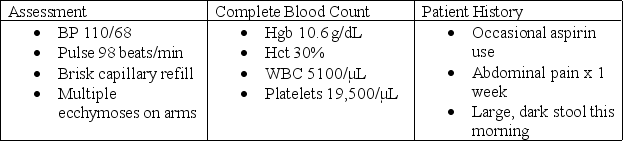
(Multiple Choice)
4.8/5 (85)
(85) A patient who had a total hip replacement had an intraoperative hemorrhage 14 hours ago. Which laboratory test result would the nurse expect?
(Multiple Choice)
4.9/5 (80)
(80) The nurse assesses a patient with pernicious anemia. Which assessment finding would the nurse expect?
(Multiple Choice)
5.0/5 (92)
(92) The nurse assesses a patient who has numerous petechiae on both arms. Which question should the nurse ask the patient?
(Multiple Choice)
4.8/5 (80)
(80) A patient with pancytopenia of unknown origin is scheduled for the following diagnostic tests. The nurse will provide a consent form to sign for which test?
(Multiple Choice)
4.9/5 (86)
(86) The nurse notes pallor of the skin and nail beds in a newly admitted patient. The nurse should ensure that which laboratory test has been ordered?
(Multiple Choice)
4.9/5 (82)
(82) A patient with pancytopenia has a bone marrow aspiration from the left posterior iliac crest. Which action would be important for the nurse to take after the procedure?
(Multiple Choice)
4.8/5 (86)
(86) The health care provider orders a liver and spleen scan for a patient who has been in a motor vehicle crash. Which action should the nurse take before this procedure?
(Multiple Choice)
4.8/5 (83)
(83) The nurse is caring for a patient who is being discharged after an emergency splenectomy following a motor vehicle crash. Which instructions should the nurse include in the discharge teaching?
(Multiple Choice)
4.9/5 (81)
(81) The nurse reviews the laboratory test results of a patient admitted with abdominal pain. Which information will be most important for the nurse to communicate to the health care provider?
(Multiple Choice)
4.9/5 (83)
(83) A nurse reviews the laboratory data for an older patient. The nurse would be most concerned about which finding?
(Multiple Choice)
4.9/5 (82)
(82) The complete blood count (CBC)indicates that a patient is thrombocytopenic. Which action should the nurse include in the plan of care?
(Multiple Choice)
4.9/5 (80)
(80) 
Filters
- Essay(0)
- Multiple Choice(0)
- Short Answer(0)
- True False(0)
- Matching(0)