



 Chat with AI
Exam 32: Defenses Against Disease

Exam 1: The Nature of Science and the Characteristics of Life82 Questions
Exam 2: Biological Diversity, Bacteria, and Archaea101 Questions
Exam 3: Protista, Plantae, and Fungi83 Questions
Exam 4: Animalia81 Questions
Exam 5: The Chemistry of Life92 Questions
Exam 6: Cell Structure and Internal Compartments87 Questions
Exam 7: Cell Membranes, Transport, and Communication85 Questions
Exam 8: Energy, Metabolism, and Enzymes81 Questions
Exam 9: Photosynthesis and Cellular Respiration84 Questions
Exam 10: Cell Division89 Questions
Exam 11: Stem Cells, Cancer, and Human Health93 Questions
Exam 12: Patterns of Inheritance75 Questions
Exam 13: Chromosomes and Human Genetics75 Questions
Exam 14: Dna and Genes105 Questions
Exam 15: From Gene to Protein80 Questions
Exam 16: Dna Technology80 Questions
Exam 17: How Evolution Works80 Questions
Exam 18: Evolution of Populations80 Questions
Exam 19: Speciation and the Origins of Biological Diversity80 Questions
Exam 20: The Evolutionary History of Life100 Questions
Exam 21: The Biosphere89 Questions
Exam 22: Growth of Populations69 Questions
Exam 23: Ecological Communities133 Questions
Exam 24: Ecosystems75 Questions
Exam 25: Global Change70 Questions
Exam 26: Internal Organization and Homeostasis79 Questions
Exam 27: Nutrition and Digestion80 Questions
Exam 28: Circulation and Gas Exchange77 Questions
Exam 29: Animal Hormones78 Questions
Exam 30: Nervous and Sensory Systems78 Questions
Exam 31: Skeletons, Muscles, and Movement78 Questions
Exam 32: Defenses Against Disease78 Questions
Exam 33: Reproduction and Development76 Questions
Exam 34: Animal Behavior76 Questions
Exam 35: Plant Structure, Nutrition, and Transport80 Questions
Exam 36: Plant Growth and Reproduction80 Questions
Select questions type


If HIV is allowed to enter the epithelium of the vaginal walls, what is the first level of the immune system it would have to defeat to cause an infection?
(Multiple Choice)
4.8/5  (86)
(86) During the inflammatory response, swelling occurs as a result of the leaking of ____________________ out of the blood vessels.
(Short Answer)
4.8/5 (71)
(71) Lymphocytes surround and digest the damaged host cells and the marked cells of the invading organism.
(True/False)
4.8/5 (80)
(80) The diagnosis of cancer represents a failure of the body's cancer ____________________ system.
(Short Answer)
4.8/5 (81)
(81) ____________________ cells remain in our body after the initial exposure to a disease organism and help the immune system recognize that particular organism during a second exposure.
(Short Answer)
4.9/5 (76)
(76) Examine the figure below. 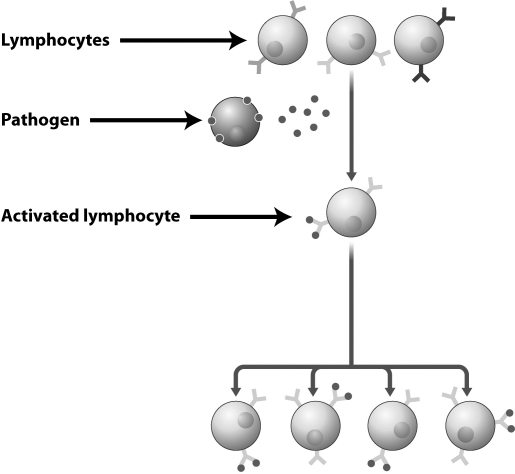 Why is only one of the lymphocytes in this diagram activated by the pathogen?
 (Multiple Choice)
4.9/5 (70)
(70) Fevers are a defense mechanism that helps our bodies fight off invading parasites. Based on this information, should you "starve a fever"?
(Multiple Choice)
4.7/5 (91)
(91) Macrophages and neutrophils make up a ____________________ response to invaders.
(Short Answer)
4.9/5 (86)
(86) Which of the following is likely to be first on the scene of a bacterial infection?
(Multiple Choice)
4.7/5 (74)
(74) A fever is the product of an out-of-control immune response to a parasite.
(True/False)
4.8/5 (71)
(71) The immune system can distinguish a self cell from a nonself cell based on the mixture of ____________________ and ____________________ on the plasma membrane.
(Short Answer)
4.8/5 (88)
(88) Which of the following statements about the human immune response is true?
(Multiple Choice)
4.8/5 (85)
(85) Our first exposure to a particular antigen brings on a(n)____________________ immune response.
(Short Answer)
4.7/5 (84)
(84) 
Filters
- Essay(0)
- Multiple Choice(0)
- Short Answer(0)
- True False(0)
- Matching(0)