



 Chat with AI
Exam 32: Defenses Against Disease

Exam 1: The Nature of Science and the Characteristics of Life82 Questions
Exam 2: Biological Diversity, Bacteria, and Archaea101 Questions
Exam 3: Protista, Plantae, and Fungi83 Questions
Exam 4: Animalia81 Questions
Exam 5: The Chemistry of Life92 Questions
Exam 6: Cell Structure and Internal Compartments87 Questions
Exam 7: Cell Membranes, Transport, and Communication85 Questions
Exam 8: Energy, Metabolism, and Enzymes81 Questions
Exam 9: Photosynthesis and Cellular Respiration84 Questions
Exam 10: Cell Division89 Questions
Exam 11: Stem Cells, Cancer, and Human Health93 Questions
Exam 12: Patterns of Inheritance75 Questions
Exam 13: Chromosomes and Human Genetics75 Questions
Exam 14: Dna and Genes105 Questions
Exam 15: From Gene to Protein80 Questions
Exam 16: Dna Technology80 Questions
Exam 17: How Evolution Works80 Questions
Exam 18: Evolution of Populations80 Questions
Exam 19: Speciation and the Origins of Biological Diversity80 Questions
Exam 20: The Evolutionary History of Life100 Questions
Exam 21: The Biosphere89 Questions
Exam 22: Growth of Populations69 Questions
Exam 23: Ecological Communities133 Questions
Exam 24: Ecosystems75 Questions
Exam 25: Global Change70 Questions
Exam 26: Internal Organization and Homeostasis79 Questions
Exam 27: Nutrition and Digestion80 Questions
Exam 28: Circulation and Gas Exchange77 Questions
Exam 29: Animal Hormones78 Questions
Exam 30: Nervous and Sensory Systems78 Questions
Exam 31: Skeletons, Muscles, and Movement78 Questions
Exam 32: Defenses Against Disease78 Questions
Exam 33: Reproduction and Development76 Questions
Exam 34: Animal Behavior76 Questions
Exam 35: Plant Structure, Nutrition, and Transport80 Questions
Exam 36: Plant Growth and Reproduction80 Questions
Select questions type


Which of the following would explain why doctors are very careful to match certain DNA sequences in an organ donor to those of an organ recipient in the case of a necessary organ transplant?
(Multiple Choice)
4.8/5  (75)
(75) Interferons are thought to "interfere" with viral infection because they
(Multiple Choice)
4.8/5 (86)
(86) A lymphocyte is activated when unique ____________________-binding proteins on its surface recognize specific molecules found on the surface of a specific pathogen.
(Short Answer)
4.9/5 (81)
(81) Which of the following areas of the human body is not the location of a major concentration of white blood cells?
(Multiple Choice)
4.8/5 (80)
(80) Different genetic versions of a particular pathogen are known as different
(Multiple Choice)
4.8/5 (84)
(84) Which of the following statements about fighting invasions of disease-causing agents in humans is false?
(Multiple Choice)
4.9/5 (88)
(88) Each T cell and each B cell binds only to one specific type of
(Multiple Choice)
4.7/5 (70)
(70) The immune system can detect cancerous cells because they display different cell surface proteins and carbohydrates than normal self cells.
(True/False)
4.8/5 (91)
(91) Examine the figure below. 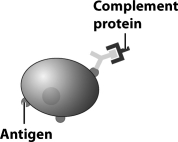 Which of the following could happen to the pathogen depicted in this figure?
 (Multiple Choice)
4.9/5 (87)
(87) Interferons summon ____________________ cells that destroy any self cells that display viral proteins.
(Essay)
4.7/5 (68)
(68) As an evolutionary advantage, adaptive immunity is faster to mobilize than innate immunity.
(True/False)
4.9/5 (68)
(68) In clinical studies, the control group receives a "sugar pill" known as a(n)____________________.
(Short Answer)
4.7/5 (85)
(85) Neutrophils usually get to a wound site ____________________ [before or after] macrophages begin phagocytizing bacteria.
(Short Answer)
4.8/5 (81)
(81) ____________________ nodes are pockets that contain specialized cells and trap bacteria and viruses roaming the body.
(Short Answer)
4.9/5 (80)
(80) 
Filters
- Essay(0)
- Multiple Choice(0)
- Short Answer(0)
- True False(0)
- Matching(0)