



 Chat with AI
Exam 30: Nervous and Sensory Systems

Exam 1: The Nature of Science and the Characteristics of Life82 Questions
Exam 2: Biological Diversity, Bacteria, and Archaea101 Questions
Exam 3: Protista, Plantae, and Fungi83 Questions
Exam 4: Animalia81 Questions
Exam 5: The Chemistry of Life92 Questions
Exam 6: Cell Structure and Internal Compartments87 Questions
Exam 7: Cell Membranes, Transport, and Communication85 Questions
Exam 8: Energy, Metabolism, and Enzymes81 Questions
Exam 9: Photosynthesis and Cellular Respiration84 Questions
Exam 10: Cell Division89 Questions
Exam 11: Stem Cells, Cancer, and Human Health93 Questions
Exam 12: Patterns of Inheritance75 Questions
Exam 13: Chromosomes and Human Genetics75 Questions
Exam 14: Dna and Genes105 Questions
Exam 15: From Gene to Protein80 Questions
Exam 16: Dna Technology80 Questions
Exam 17: How Evolution Works80 Questions
Exam 18: Evolution of Populations80 Questions
Exam 19: Speciation and the Origins of Biological Diversity80 Questions
Exam 20: The Evolutionary History of Life100 Questions
Exam 21: The Biosphere89 Questions
Exam 22: Growth of Populations69 Questions
Exam 23: Ecological Communities133 Questions
Exam 24: Ecosystems75 Questions
Exam 25: Global Change70 Questions
Exam 26: Internal Organization and Homeostasis79 Questions
Exam 27: Nutrition and Digestion80 Questions
Exam 28: Circulation and Gas Exchange77 Questions
Exam 29: Animal Hormones78 Questions
Exam 30: Nervous and Sensory Systems78 Questions
Exam 31: Skeletons, Muscles, and Movement78 Questions
Exam 32: Defenses Against Disease78 Questions
Exam 33: Reproduction and Development76 Questions
Exam 34: Animal Behavior76 Questions
Exam 35: Plant Structure, Nutrition, and Transport80 Questions
Exam 36: Plant Growth and Reproduction80 Questions
Select questions type


How does the central nervous system recognize how important a particular stimulus is?
(Multiple Choice)
4.8/5  (75)
(75) To best help it "sniff out" a fox, a hunting dog probably has a high concentration of
(Multiple Choice)
4.7/5 (70)
(70) One interneuron can send signals to the peripheral nervous system and the brain at the same time.
(True/False)
4.7/5 (90)
(90) The flow of ions across an axon's plasma membrane generates an electrical impulse known as the ____________________.
(Short Answer)
4.8/5 (68)
(68) The ____________________ nervous system ferries signals to and from the central nervous system.
(Short Answer)
4.8/5 (72)
(72) At resting potential, the overall charge of the plasma membrane is
(Multiple Choice)
4.7/5 (79)
(79) The area of the brain that filters and sorts signals from the spinal cord also determines which signals require an action without awareness and which signals need to be sent to the conscious perception centers. This area of the brain is known as the
(Multiple Choice)
4.7/5 (72)
(72) The figure below illustrates how a neuron with a myelinated axon transmits signals. 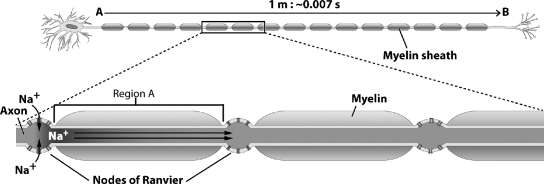 What is happening in Region A of this figure?
 (Multiple Choice)
4.9/5 (78)
(78) In bright light, the openings in the pupils of our eyes become smaller.
(True/False)
4.9/5 (95)
(95) Compound eyes of insects use mechanoreceptors rather than photoreceptors.
(True/False)
4.9/5 (78)
(78) To respond to an incoming signal, such as your fingertip being burned by a candle's flame, the signal must be transmitted to the brain before your muscles can be told to respond and pull away.
(True/False)
4.7/5 (79)
(79) Everyone who abuses drugs from an early age will become an addict.
(True/False)
4.9/5 (75)
(75) In the eyes of animals that are primarily active at night, such as raccoons, the retina would
(Multiple Choice)
4.8/5 (77)
(77) After a signal has been transmitted to a receiving cell, neurotransmitters are rapidly removed from the synaptic cleft because
(Multiple Choice)
4.9/5 (83)
(83) 
Filters
- Essay(0)
- Multiple Choice(0)
- Short Answer(0)
- True False(0)
- Matching(0)