



 Chat with AI
Exam 30: Nervous and Sensory Systems

Exam 1: The Nature of Science and the Characteristics of Life82 Questions
Exam 2: Biological Diversity, Bacteria, and Archaea101 Questions
Exam 3: Protista, Plantae, and Fungi83 Questions
Exam 4: Animalia81 Questions
Exam 5: The Chemistry of Life92 Questions
Exam 6: Cell Structure and Internal Compartments87 Questions
Exam 7: Cell Membranes, Transport, and Communication85 Questions
Exam 8: Energy, Metabolism, and Enzymes81 Questions
Exam 9: Photosynthesis and Cellular Respiration84 Questions
Exam 10: Cell Division89 Questions
Exam 11: Stem Cells, Cancer, and Human Health93 Questions
Exam 12: Patterns of Inheritance75 Questions
Exam 13: Chromosomes and Human Genetics75 Questions
Exam 14: Dna and Genes105 Questions
Exam 15: From Gene to Protein80 Questions
Exam 16: Dna Technology80 Questions
Exam 17: How Evolution Works80 Questions
Exam 18: Evolution of Populations80 Questions
Exam 19: Speciation and the Origins of Biological Diversity80 Questions
Exam 20: The Evolutionary History of Life100 Questions
Exam 21: The Biosphere89 Questions
Exam 22: Growth of Populations69 Questions
Exam 23: Ecological Communities133 Questions
Exam 24: Ecosystems75 Questions
Exam 25: Global Change70 Questions
Exam 26: Internal Organization and Homeostasis79 Questions
Exam 27: Nutrition and Digestion80 Questions
Exam 28: Circulation and Gas Exchange77 Questions
Exam 29: Animal Hormones78 Questions
Exam 30: Nervous and Sensory Systems78 Questions
Exam 31: Skeletons, Muscles, and Movement78 Questions
Exam 32: Defenses Against Disease78 Questions
Exam 33: Reproduction and Development76 Questions
Exam 34: Animal Behavior76 Questions
Exam 35: Plant Structure, Nutrition, and Transport80 Questions
Exam 36: Plant Growth and Reproduction80 Questions
Select questions type


The cerebral cortex of the human brain is much more highly and intricately folded than the same region in other animals. Why might this be the case?
(Multiple Choice)
4.8/5  (84)
(84) The figure below illustrates the organ of Corti, a part of the cochlea in the human inner ear. 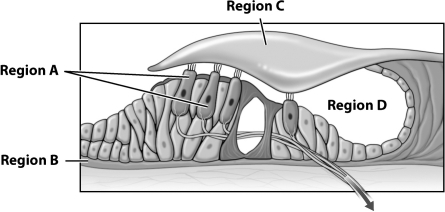 What labeled region of this figure of the organ of Corti is directly stimulated to vibrate in response to the air movements caused by sound?
 (Multiple Choice)
4.8/5 (95)
(95) Where would you expect to see an absence of neurotransmitters?
(Multiple Choice)
5.0/5 (82)
(82) A person who, as a result of a mutation, could not produce one of the pigment molecules found in cones
(Multiple Choice)
4.8/5 (79)
(79) A resting neuron is negatively charged inside relative to the outside.
(True/False)
4.9/5 (75)
(75) As you complete this exam, which part of the brain is helping you decide which answer is correct?
(Multiple Choice)
4.9/5 (87)
(87) The cerebrum has four major lobes. Which of the following is one of these?
(Multiple Choice)
4.8/5 (77)
(77) Botulism is a type of paralysis (inability to move muscles)caused by a specific type of bacteria. The bacteria release a toxin that prevents the release of acetylcholine (a neurotransmitter)from the neurons that form synapses with muscle cells. Why might botulism toxin cause paralysis?
(Multiple Choice)
4.8/5 (85)
(85) Researchers have suggested a fifth taste in humans known as umami and attribute the taste to the compound glutamate. Which of the following would support the belief that umami is a real "taste"?
(Multiple Choice)
4.8/5 (77)
(77) Although many people worry about their sodium intake from salty foods, it would be unwise to eliminate sodium from one's diet completely. Which of the following problems would occur if there were no sodium in the body?
(Multiple Choice)
4.8/5 (85)
(85) A person with vitamin B deficiency often exhibits a "slow" nervous system. For example, their knee-jerk reflex is much slower than normal. Which of the following might explain why this is the case?
(Multiple Choice)
4.8/5 (69)
(69) Neurotransmitters are released into a synaptic cleft by the process of ____________________.
(Short Answer)
4.8/5 (88)
(88) Action potentials move faster in myelinated nerve fibers because
(Multiple Choice)
4.9/5 (77)
(77) Which of the following is not one of the three major regions of the human brain?
(Multiple Choice)
4.7/5 (86)
(86) The human skin has numerous sensory receptors that take in information about our environment, and these receptors are concentrated in areas where detailed information on touch is needed. Which of the following body areas is likely to have the smallest number of sensory receptors?
(Multiple Choice)
4.8/5 (84)
(84) Which of the following would not be found in the retina of a horse?
(Multiple Choice)
4.7/5 (81)
(81) 
Filters
- Essay(0)
- Multiple Choice(0)
- Short Answer(0)
- True False(0)
- Matching(0)