



 Chat with AI
Exam 29: Animal Hormones

Exam 1: The Nature of Science and the Characteristics of Life82 Questions
Exam 2: Biological Diversity, Bacteria, and Archaea101 Questions
Exam 3: Protista, Plantae, and Fungi83 Questions
Exam 4: Animalia81 Questions
Exam 5: The Chemistry of Life92 Questions
Exam 6: Cell Structure and Internal Compartments87 Questions
Exam 7: Cell Membranes, Transport, and Communication85 Questions
Exam 8: Energy, Metabolism, and Enzymes81 Questions
Exam 9: Photosynthesis and Cellular Respiration84 Questions
Exam 10: Cell Division89 Questions
Exam 11: Stem Cells, Cancer, and Human Health93 Questions
Exam 12: Patterns of Inheritance75 Questions
Exam 13: Chromosomes and Human Genetics75 Questions
Exam 14: Dna and Genes105 Questions
Exam 15: From Gene to Protein80 Questions
Exam 16: Dna Technology80 Questions
Exam 17: How Evolution Works80 Questions
Exam 18: Evolution of Populations80 Questions
Exam 19: Speciation and the Origins of Biological Diversity80 Questions
Exam 20: The Evolutionary History of Life100 Questions
Exam 21: The Biosphere89 Questions
Exam 22: Growth of Populations69 Questions
Exam 23: Ecological Communities133 Questions
Exam 24: Ecosystems75 Questions
Exam 25: Global Change70 Questions
Exam 26: Internal Organization and Homeostasis79 Questions
Exam 27: Nutrition and Digestion80 Questions
Exam 28: Circulation and Gas Exchange77 Questions
Exam 29: Animal Hormones78 Questions
Exam 30: Nervous and Sensory Systems78 Questions
Exam 31: Skeletons, Muscles, and Movement78 Questions
Exam 32: Defenses Against Disease78 Questions
Exam 33: Reproduction and Development76 Questions
Exam 34: Animal Behavior76 Questions
Exam 35: Plant Structure, Nutrition, and Transport80 Questions
Exam 36: Plant Growth and Reproduction80 Questions
Select questions type


A single hormone can have different effects on different tissues.
(True/False)
4.9/5  (76)
(76) Which of the following choices best explains how one hormone can regulate several different developmental events?
(Multiple Choice)
4.9/5 (81)
(81) Excessive amounts of growth hormone (GH)after puberty can cause acromegaly.
(True/False)
4.8/5 (74)
(74) When blood glucose levels are low, insulin is released to promote homeostasis.
(True/False)
4.9/5 (81)
(81) Because steroid hormones are ____________________, they are able to pass through a cell's plasma membrane without the assistance of membrane transport proteins.
(Short Answer)
4.7/5 (68)
(68) The high levels of progesterone seen after ovulation in the human female are produced by a specific region of the ovary known as the ____________________, which disappears if pregnancy does not occur.
(Short Answer)
4.9/5 (74)
(74) You are walking in the woods and suddenly find yourself between a mother bear and her two cubs. All four nervous systems would send the same emergency message to the
(Multiple Choice)
4.9/5 (66)
(66) Which of the following statements correctly describes the activity of adrenaline?
(Multiple Choice)
4.9/5 (71)
(71) Endocrine glands have ducts that open directly into blood vessels.
(True/False)
4.9/5 (84)
(84) In human females, eggs begin to develop at puberty due to the release of
(Multiple Choice)
5.0/5 (75)
(75) The lining of the uterus is thickened and prepared to receive a fertilized egg by
(Multiple Choice)
4.9/5 (75)
(75) Which of the following statements about the human reproductive system is true?
(Multiple Choice)
4.8/5 (84)
(84) The graph below shows the levels of gonadotropins throughout the menstrual cycle.
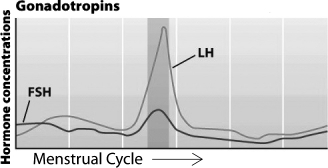 The darker gray region of the graph corresponds to the period when ____________________ occurs in the ovaries.
 (Short Answer)
4.8/5 (79)
(79) 
Filters
- Essay(0)
- Multiple Choice(0)
- Short Answer(0)
- True False(0)
- Matching(0)