



 Chat with AI
Exam 29: Animal Hormones

Exam 1: The Nature of Science and the Characteristics of Life82 Questions
Exam 2: Biological Diversity, Bacteria, and Archaea101 Questions
Exam 3: Protista, Plantae, and Fungi83 Questions
Exam 4: Animalia81 Questions
Exam 5: The Chemistry of Life92 Questions
Exam 6: Cell Structure and Internal Compartments87 Questions
Exam 7: Cell Membranes, Transport, and Communication85 Questions
Exam 8: Energy, Metabolism, and Enzymes81 Questions
Exam 9: Photosynthesis and Cellular Respiration84 Questions
Exam 10: Cell Division89 Questions
Exam 11: Stem Cells, Cancer, and Human Health93 Questions
Exam 12: Patterns of Inheritance75 Questions
Exam 13: Chromosomes and Human Genetics75 Questions
Exam 14: Dna and Genes105 Questions
Exam 15: From Gene to Protein80 Questions
Exam 16: Dna Technology80 Questions
Exam 17: How Evolution Works80 Questions
Exam 18: Evolution of Populations80 Questions
Exam 19: Speciation and the Origins of Biological Diversity80 Questions
Exam 20: The Evolutionary History of Life100 Questions
Exam 21: The Biosphere89 Questions
Exam 22: Growth of Populations69 Questions
Exam 23: Ecological Communities133 Questions
Exam 24: Ecosystems75 Questions
Exam 25: Global Change70 Questions
Exam 26: Internal Organization and Homeostasis79 Questions
Exam 27: Nutrition and Digestion80 Questions
Exam 28: Circulation and Gas Exchange77 Questions
Exam 29: Animal Hormones78 Questions
Exam 30: Nervous and Sensory Systems78 Questions
Exam 31: Skeletons, Muscles, and Movement78 Questions
Exam 32: Defenses Against Disease78 Questions
Exam 33: Reproduction and Development76 Questions
Exam 34: Animal Behavior76 Questions
Exam 35: Plant Structure, Nutrition, and Transport80 Questions
Exam 36: Plant Growth and Reproduction80 Questions
Select questions type


A(n)____________________ is a specialized organ in which hormones are produced.
(Short Answer)
4.9/5  (67)
(67) Luteinizing hormone and follicle-stimulating hormone both come from the pituitary gland.
(True/False)
4.9/5 (78)
(78) The graph below shows the levels of estrogen and progesterone over the course of the menstrual cycle. 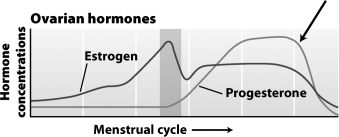 What event is caused by the rapid decrease in hormones in the region indicated by the arrow in the upper right portion of the graph?
 (Multiple Choice)
4.9/5 (85)
(85) The parathyroid gland of a person with hyperparathyroidism produces very high levels of parathyroid hormone (PTH). You would expect a person with this condition to have
(Multiple Choice)
4.9/5 (88)
(88) The hormone-producing tissues of animals make up the ____________________ system.
(Short Answer)
4.9/5 (80)
(80) The pancreas regulates ____________________ levels in the blood by producing a pair of antagonistic hormones.
(Short Answer)
4.8/5 (73)
(73) In a human female, the hormone ____________________ controls the development of female reproductive structures.
(Short Answer)
4.8/5 (81)
(81) Inadequate amounts of one hormone does not affect production of another hormone.
(True/False)
4.8/5 (83)
(83) Which of the following hormones are not produced by gonads?
(Multiple Choice)
4.9/5 (90)
(90) Four to six weeks after conception, sex hormones trigger the production of the appropriate male or female ____________________, or sex organs, in an embryo.
(Short Answer)
4.8/5 (73)
(73) Serotonin, one of the hormones thought to be involved in depression, is a water-soluble molecule. Where on the target cell would you expect to find receptors for this hormone?
(Multiple Choice)
4.8/5 (71)
(71) The target cells of epinephrine and norepinephrine are in the
(Multiple Choice)
4.8/5 (72)
(72) In a human male, the ____________________ secrete hormones that coordinate the development of male reproductive structures.
(Short Answer)
4.9/5 (83)
(83) The beginning of ____________________ is marked by a sudden rise in sex hormone production by the gonads of adolescent humans.
(Short Answer)
4.8/5 (82)
(82) A single hormone molecule can have dramatic effects on a target cell, because it
(Multiple Choice)
4.7/5 (71)
(71) 
Filters
- Essay(0)
- Multiple Choice(0)
- Short Answer(0)
- True False(0)
- Matching(0)