



 Chat with AI
Exam 29: Animal Hormones

Exam 1: The Nature of Science and the Characteristics of Life82 Questions
Exam 2: Biological Diversity, Bacteria, and Archaea101 Questions
Exam 3: Protista, Plantae, and Fungi83 Questions
Exam 4: Animalia81 Questions
Exam 5: The Chemistry of Life92 Questions
Exam 6: Cell Structure and Internal Compartments87 Questions
Exam 7: Cell Membranes, Transport, and Communication85 Questions
Exam 8: Energy, Metabolism, and Enzymes81 Questions
Exam 9: Photosynthesis and Cellular Respiration84 Questions
Exam 10: Cell Division89 Questions
Exam 11: Stem Cells, Cancer, and Human Health93 Questions
Exam 12: Patterns of Inheritance75 Questions
Exam 13: Chromosomes and Human Genetics75 Questions
Exam 14: Dna and Genes105 Questions
Exam 15: From Gene to Protein80 Questions
Exam 16: Dna Technology80 Questions
Exam 17: How Evolution Works80 Questions
Exam 18: Evolution of Populations80 Questions
Exam 19: Speciation and the Origins of Biological Diversity80 Questions
Exam 20: The Evolutionary History of Life100 Questions
Exam 21: The Biosphere89 Questions
Exam 22: Growth of Populations69 Questions
Exam 23: Ecological Communities133 Questions
Exam 24: Ecosystems75 Questions
Exam 25: Global Change70 Questions
Exam 26: Internal Organization and Homeostasis79 Questions
Exam 27: Nutrition and Digestion80 Questions
Exam 28: Circulation and Gas Exchange77 Questions
Exam 29: Animal Hormones78 Questions
Exam 30: Nervous and Sensory Systems78 Questions
Exam 31: Skeletons, Muscles, and Movement78 Questions
Exam 32: Defenses Against Disease78 Questions
Exam 33: Reproduction and Development76 Questions
Exam 34: Animal Behavior76 Questions
Exam 35: Plant Structure, Nutrition, and Transport80 Questions
Exam 36: Plant Growth and Reproduction80 Questions
Select questions type


Four stages in the process of balancing glucose levels in the blood are highlighted by letters in the figure below. 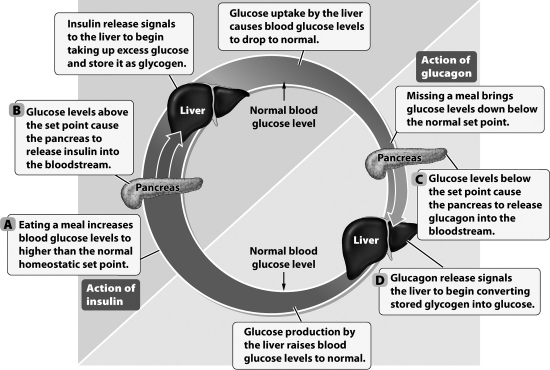 Which letter corresponds to the stage that is impacted by type 2 diabetes?
 (Multiple Choice)
4.7/5  (79)
(79) In response to a dangerous situation, your body has produced epinephrine and norepinephrine. As the danger dissipates, how might the pancreas respond?
(Multiple Choice)
4.9/5 (83)
(83) By what mechanism do most hormones travel through the organism that produces them?
(Multiple Choice)
4.8/5 (82)
(82) The 28-day menstrual cycle is regulated by ____________________ and ____________________, both of which are produced in the female gonad.
(Short Answer)
4.7/5 (77)
(77) Some hormones do not need receptors and can directly interact with genes in a target cell's nucleus.
(True/False)
4.9/5 (67)
(67) Which of the following would be least affected by gonadotropins?
(Multiple Choice)
4.8/5 (89)
(89) After studying the image below, which of the following conclusions can be drawn? 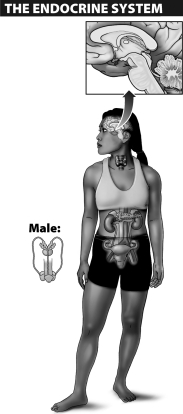
(Multiple Choice)
4.8/5 (82)
(82) The development of all female reproductive structures is under the control of a single hormone.
(True/False)
4.7/5 (77)
(77) Some hormone responses can take months to occur in reference to growth and development.
(True/False)
4.8/5 (90)
(90) Hormone replacement therapy (HRT)is used to ease or reduce the symptoms of ____________________.
(Short Answer)
4.9/5 (85)
(85) Hormones often alter ____________________ by turning a certain gene or group of genes on or off.
(Short Answer)
4.8/5 (79)
(79) Birth control pills prevent pregnancy by maintaining high levels of the hormone ____________________, tricking the body into thinking it is pregnant.
(Short Answer)
4.7/5 (85)
(85) When liver cells are unable to respond to insulin, the level of glucose in the blood remains ____________________ than normal.
(Short Answer)
5.0/5 (78)
(78) Gonadotropins continue playing a role in human development even after puberty is complete.
(True/False)
4.8/5 (68)
(68) 
Filters
- Essay(0)
- Multiple Choice(0)
- Short Answer(0)
- True False(0)
- Matching(0)