



 Chat with AI
Exam 19: Speciation and the Origins of Biological Diversity

Exam 1: The Nature of Science and the Characteristics of Life82 Questions
Exam 2: Biological Diversity, Bacteria, and Archaea101 Questions
Exam 3: Protista, Plantae, and Fungi83 Questions
Exam 4: Animalia81 Questions
Exam 5: The Chemistry of Life92 Questions
Exam 6: Cell Structure and Internal Compartments87 Questions
Exam 7: Cell Membranes, Transport, and Communication85 Questions
Exam 8: Energy, Metabolism, and Enzymes81 Questions
Exam 9: Photosynthesis and Cellular Respiration84 Questions
Exam 10: Cell Division89 Questions
Exam 11: Stem Cells, Cancer, and Human Health93 Questions
Exam 12: Patterns of Inheritance75 Questions
Exam 13: Chromosomes and Human Genetics75 Questions
Exam 14: Dna and Genes105 Questions
Exam 15: From Gene to Protein80 Questions
Exam 16: Dna Technology80 Questions
Exam 17: How Evolution Works80 Questions
Exam 18: Evolution of Populations80 Questions
Exam 19: Speciation and the Origins of Biological Diversity80 Questions
Exam 20: The Evolutionary History of Life100 Questions
Exam 21: The Biosphere89 Questions
Exam 22: Growth of Populations69 Questions
Exam 23: Ecological Communities133 Questions
Exam 24: Ecosystems75 Questions
Exam 25: Global Change70 Questions
Exam 26: Internal Organization and Homeostasis79 Questions
Exam 27: Nutrition and Digestion80 Questions
Exam 28: Circulation and Gas Exchange77 Questions
Exam 29: Animal Hormones78 Questions
Exam 30: Nervous and Sensory Systems78 Questions
Exam 31: Skeletons, Muscles, and Movement78 Questions
Exam 32: Defenses Against Disease78 Questions
Exam 33: Reproduction and Development76 Questions
Exam 34: Animal Behavior76 Questions
Exam 35: Plant Structure, Nutrition, and Transport80 Questions
Exam 36: Plant Growth and Reproduction80 Questions
Select questions type


The great diversity of life on Earth is caused by ____________________-the formation of new species.
(Short Answer)
4.8/5  (72)
(72) Which of the following is an example of a postzygotic barrier?
(Multiple Choice)
4.8/5 (78)
(78) The soapberry bugs shown in the figure below adapted to a change in food source in as fast as 30 years. For evolution to occur this quickly 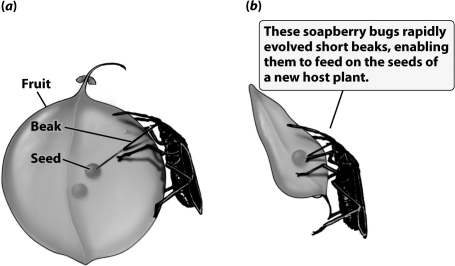
(Multiple Choice)
4.8/5 (70)
(70) When speciation is caused by a rapid change in chromosomal number such as ____________________, new species form in a single generation.
(Short Answer)
4.9/5 (92)
(92) Great controversy exists regarding the "hobbits" of Flores Island. Which of the following arguments would not support the hypothesis that hobbits are the same species as modern humans?
(Multiple Choice)
4.7/5 (76)
(76) Ninety-nine percent of all the species that ever existed on Earth are now extinct.
(True/False)
4.9/5 (67)
(67) Which of the following is an example of reproductive isolation?
(Multiple Choice)
4.9/5 (68)
(68) Which of the following most likely is not an adaptation by plants to attract animals for assistance with mating?
(Multiple Choice)
4.9/5 (81)
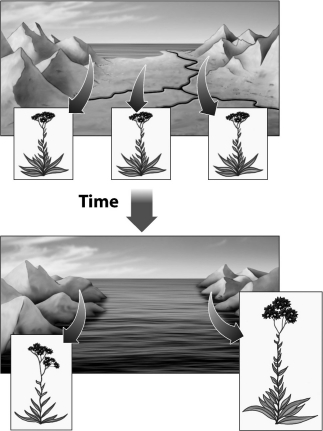
(81) In the example below, two new species are created as a result of ____________________ speciation.
(Short Answer)
4.8/5 (86)
(86) An ecological ____________________ can limit a population's ability to adapt to its environment, as the organisms must compromise between what is possible developmentally and what is possible genetically.
(Short Answer)
4.8/5 (70)
(70) Two species live in the same area but breed in different parts of their habitat. These species are
(Multiple Choice)
4.9/5 (83)
(83) The red-breasted nuthatch and the white-breasted nuthatch are similar in appearance and, in many regions of the United States, their ranges overlap. The two organisms do not interbreed. Based on this information, red-breasted and white-breasted nuthatches are
(Multiple Choice)
4.8/5 (82)
(82) The fossils of two adult birds are found in a nest containing several fossilized eggs. Physically, the bird fossils look very different. What are scientists most likely to use to classify these species?
(Multiple Choice)
5.0/5 (89)
(89) 
Filters
- Essay(0)
- Multiple Choice(0)
- Short Answer(0)
- True False(0)
- Matching(0)