



 Chat with AI
Exam 19: Speciation and the Origins of Biological Diversity

Exam 1: The Nature of Science and the Characteristics of Life82 Questions
Exam 2: Biological Diversity, Bacteria, and Archaea101 Questions
Exam 3: Protista, Plantae, and Fungi83 Questions
Exam 4: Animalia81 Questions
Exam 5: The Chemistry of Life92 Questions
Exam 6: Cell Structure and Internal Compartments87 Questions
Exam 7: Cell Membranes, Transport, and Communication85 Questions
Exam 8: Energy, Metabolism, and Enzymes81 Questions
Exam 9: Photosynthesis and Cellular Respiration84 Questions
Exam 10: Cell Division89 Questions
Exam 11: Stem Cells, Cancer, and Human Health93 Questions
Exam 12: Patterns of Inheritance75 Questions
Exam 13: Chromosomes and Human Genetics75 Questions
Exam 14: Dna and Genes105 Questions
Exam 15: From Gene to Protein80 Questions
Exam 16: Dna Technology80 Questions
Exam 17: How Evolution Works80 Questions
Exam 18: Evolution of Populations80 Questions
Exam 19: Speciation and the Origins of Biological Diversity80 Questions
Exam 20: The Evolutionary History of Life100 Questions
Exam 21: The Biosphere89 Questions
Exam 22: Growth of Populations69 Questions
Exam 23: Ecological Communities133 Questions
Exam 24: Ecosystems75 Questions
Exam 25: Global Change70 Questions
Exam 26: Internal Organization and Homeostasis79 Questions
Exam 27: Nutrition and Digestion80 Questions
Exam 28: Circulation and Gas Exchange77 Questions
Exam 29: Animal Hormones78 Questions
Exam 30: Nervous and Sensory Systems78 Questions
Exam 31: Skeletons, Muscles, and Movement78 Questions
Exam 32: Defenses Against Disease78 Questions
Exam 33: Reproduction and Development76 Questions
Exam 34: Animal Behavior76 Questions
Exam 35: Plant Structure, Nutrition, and Transport80 Questions
Exam 36: Plant Growth and Reproduction80 Questions
Select questions type


Which of the following is not an example of a prezygotic barrier?
(Multiple Choice)
4.9/5  (82)
(82) Geographic isolation can result in speciation but usually only over long periods of time.
(True/False)
4.9/5 (72)
(72) It takes at least 25 generations of reproduction before a new species can be formed.
(True/False)
4.9/5 (81)
(81) Mutations in developmental genes may provide an advantage at some stages of life, but be fatal at other stages of life.
(True/False)
4.8/5 (79)
(79) The rough-skinned newt produces one of the most potent toxins on the planet. Scientists in Oregon have found that as newts evolve to produce a more deadly toxin, their primary predator, the garter snake, evolves ways to resist the toxin. This is an example of
(Multiple Choice)
4.7/5 (95)
(95) A rainforest is a highly complex habitat, with organisms living at various levels in the trees, on the ground, and underground. Is it possible to consider two populations living in the same tree to be geographically isolated?
(Multiple Choice)
4.8/5 (81)
(81) Two species live near each other but do not respond to each other's courtship displays. This is an example of ____________________ isolation, a type of prezygotic barrier.
(Short Answer)
4.8/5 (68)
(68) A population of crickets in Hawaii exhibits an allele that changes the shape of its wings so that they cannot chirp. Chirping crickets are targeted by parasitic wasps that eventually kill the cricket, but nonchirping crickets have trouble finding their mates. This is an example of
(Multiple Choice)
4.7/5 (82)
(82) The only modern humans that exhibit Neandertal genes are descended from non-African ancestors. This is because
(Multiple Choice)
4.8/5 (73)
(73) An organism is polyploid if it has more than two complete sets of ____________________.
(Short Answer)
4.7/5 (80)
(80) Gene flow prevents two populations from becoming genetically different.
(True/False)
4.8/5 (89)
(89) A flower is red, has a long tube formed by fusion of petals, has nectar at the base of the tube, has no landing platform, and opens during the day. It has probably become adapted to mate with the assistance of
(Multiple Choice)
4.7/5 (83)
(83) Which of the following is an example of a prezygotic barrier that can isolate two species living in the same geographic area?
(Multiple Choice)
4.8/5 (81)
(81) Why have the two plant populations depicted in the diagram below become so different in the time they were separated by the ocean? 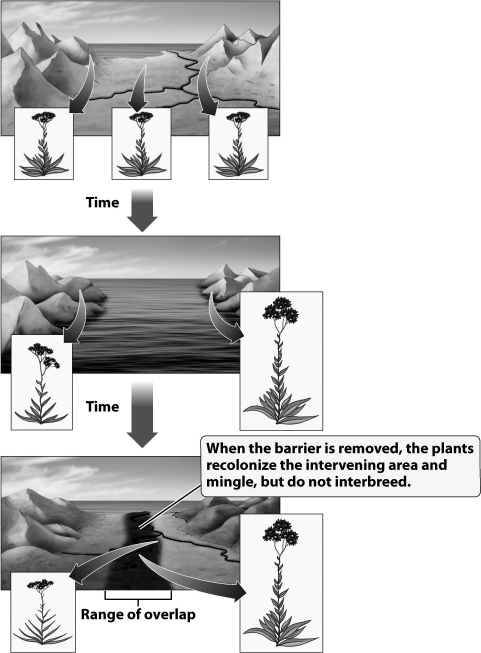
(Multiple Choice)
4.8/5 (75)
(75) Geographic isolation limits the _____ between populations of a species.
(Multiple Choice)
4.8/5 (77)
(77) 
Filters
- Essay(0)
- Multiple Choice(0)
- Short Answer(0)
- True False(0)
- Matching(0)