



 Chat with AI
Exam 19: Speciation and the Origins of Biological Diversity

Exam 1: The Nature of Science and the Characteristics of Life82 Questions
Exam 2: Biological Diversity, Bacteria, and Archaea101 Questions
Exam 3: Protista, Plantae, and Fungi83 Questions
Exam 4: Animalia81 Questions
Exam 5: The Chemistry of Life92 Questions
Exam 6: Cell Structure and Internal Compartments87 Questions
Exam 7: Cell Membranes, Transport, and Communication85 Questions
Exam 8: Energy, Metabolism, and Enzymes81 Questions
Exam 9: Photosynthesis and Cellular Respiration84 Questions
Exam 10: Cell Division89 Questions
Exam 11: Stem Cells, Cancer, and Human Health93 Questions
Exam 12: Patterns of Inheritance75 Questions
Exam 13: Chromosomes and Human Genetics75 Questions
Exam 14: Dna and Genes105 Questions
Exam 15: From Gene to Protein80 Questions
Exam 16: Dna Technology80 Questions
Exam 17: How Evolution Works80 Questions
Exam 18: Evolution of Populations80 Questions
Exam 19: Speciation and the Origins of Biological Diversity80 Questions
Exam 20: The Evolutionary History of Life100 Questions
Exam 21: The Biosphere89 Questions
Exam 22: Growth of Populations69 Questions
Exam 23: Ecological Communities133 Questions
Exam 24: Ecosystems75 Questions
Exam 25: Global Change70 Questions
Exam 26: Internal Organization and Homeostasis79 Questions
Exam 27: Nutrition and Digestion80 Questions
Exam 28: Circulation and Gas Exchange77 Questions
Exam 29: Animal Hormones78 Questions
Exam 30: Nervous and Sensory Systems78 Questions
Exam 31: Skeletons, Muscles, and Movement78 Questions
Exam 32: Defenses Against Disease78 Questions
Exam 33: Reproduction and Development76 Questions
Exam 34: Animal Behavior76 Questions
Exam 35: Plant Structure, Nutrition, and Transport80 Questions
Exam 36: Plant Growth and Reproduction80 Questions
Select questions type


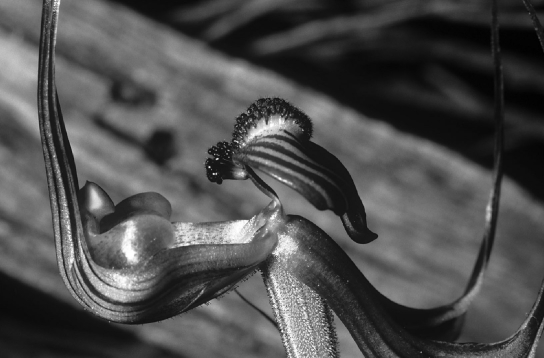
Some species of orchids attract wasps to assist them in reproduction by producing flowers that look like female wasps. The flowers fool male wasps into attempting to mate with them. As a result, the wasp is covered with pollen that it takes with it to the next flower it attempts to mate with. This example shows adaptive evolution by
(Multiple Choice)
4.9/5  (85)
(85) The observation that the flowers of this orchid resemble female wasps is an example of a complex adaptation.
(True/False)
4.8/5 (71)
(71) Before the cultivation of the apple tree, apple maggot flies laid their eggs exclusively on the fruit of Hawthorne trees. As apple orchards became more prominent, apple maggot flies began to lay their eggs on both the fruit of the Hawthorne tree and the fruit of cultivated apple trees. Now, apple maggot flies that live on apple trees mate and lay their eggs at different times of the year than apple maggot flies that live on Hawthorne trees. Is this an example of reproductive isolation?
(Multiple Choice)
4.8/5 (82)
(82) Speciation can occur when populations of a species are separated by a physical barrier becoming ____________________ isolated and subsequently reproductively isolated from one another.
(Short Answer)
4.7/5 (81)
(81) Sympatric speciation can occur in the absence of geographic isolation.
(True/False)
4.9/5 (82)
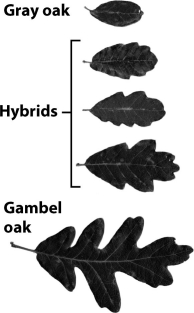
(82) Some species, like the gray oak and the Gambel oak, hybridize to create fertile offspring, but remain phenotypically distinct as shown by the leaves in the image below. As a result, they are considered different species.
(True/False)
4.7/5 (86)
(86) For two populations to accumulate enough genetic differences to cause speciation, the factors that promote these differences
(Multiple Choice)
4.8/5 (78)
(78) Which of the following does not provide an example of geographic isolation?
(Multiple Choice)
4.9/5 (82)
(82) The primary difference between the prezygotic barriers and postzygotic barriers involved in reproductive isolation is that prezygotic barriers
(Multiple Choice)
4.8/5 (76)
(76) The death of zygotes produced by the mating of individuals of two different populations is an example of how ____________________ barriers can lead to reproductive isolation.
(Short Answer)
4.9/5 (72)
(72) Polyploidy can lead to very rapid speciation in plants because
(Multiple Choice)
4.8/5 (92)
(92) In many predator-prey relationships, evolutionary change in the prey will result in evolutionary change in the predator, a phenomenon known as
(Multiple Choice)
4.7/5 (84)
(84) ____________________ speciation occurs when a new species arises in the absence of geographic isolation.
(Short Answer)
4.9/5 (73)
(73) Populations of weaver ants work together to "sew" leaves into a living nest that acts as a protective shelter for the entire population. The nest-building behavior of weaver ants
(Multiple Choice)
4.9/5 (84)
(84) Evidence suggests that Neandertals and humans are the same species.
(True/False)
4.8/5 (81)
(81) Every year, environmental signals in Africa cause flycatchers to return to the Netherlands to breed. When they arrive, they depend on freshly hatched caterpillars for food. Global climate change has caused the caterpillars to hatch earlier in the Netherlands, but the environmental cues in Africa remain the same. Now, when the flycatchers return to the Netherlands the caterpillars are no longer available as a food source. Which of the following is likely to happen to this species of flycatcher?
(Multiple Choice)
4.8/5 (74)
(74) A ____________________ species may exist when an organism's range loops around a geographic barrier. Neighboring populations in the range mate, but populations on opposite sides of the barrier cannot mate.
(Short Answer)
5.0/5 (84)
(84) ____________________ barriers cause speciation to occur by preventing fertilization when two individuals of different populations attempt to mate.
(Short Answer)
4.9/5 (74)
(74) 
Filters
- Essay(0)
- Multiple Choice(0)
- Short Answer(0)
- True False(0)
- Matching(0)