



 Chat with AI
Exam 18: Evolution of Populations

Exam 1: The Nature of Science and the Characteristics of Life82 Questions
Exam 2: Biological Diversity, Bacteria, and Archaea101 Questions
Exam 3: Protista, Plantae, and Fungi83 Questions
Exam 4: Animalia81 Questions
Exam 5: The Chemistry of Life92 Questions
Exam 6: Cell Structure and Internal Compartments87 Questions
Exam 7: Cell Membranes, Transport, and Communication85 Questions
Exam 8: Energy, Metabolism, and Enzymes81 Questions
Exam 9: Photosynthesis and Cellular Respiration84 Questions
Exam 10: Cell Division89 Questions
Exam 11: Stem Cells, Cancer, and Human Health93 Questions
Exam 12: Patterns of Inheritance75 Questions
Exam 13: Chromosomes and Human Genetics75 Questions
Exam 14: Dna and Genes105 Questions
Exam 15: From Gene to Protein80 Questions
Exam 16: Dna Technology80 Questions
Exam 17: How Evolution Works80 Questions
Exam 18: Evolution of Populations80 Questions
Exam 19: Speciation and the Origins of Biological Diversity80 Questions
Exam 20: The Evolutionary History of Life100 Questions
Exam 21: The Biosphere89 Questions
Exam 22: Growth of Populations69 Questions
Exam 23: Ecological Communities133 Questions
Exam 24: Ecosystems75 Questions
Exam 25: Global Change70 Questions
Exam 26: Internal Organization and Homeostasis79 Questions
Exam 27: Nutrition and Digestion80 Questions
Exam 28: Circulation and Gas Exchange77 Questions
Exam 29: Animal Hormones78 Questions
Exam 30: Nervous and Sensory Systems78 Questions
Exam 31: Skeletons, Muscles, and Movement78 Questions
Exam 32: Defenses Against Disease78 Questions
Exam 33: Reproduction and Development76 Questions
Exam 34: Animal Behavior76 Questions
Exam 35: Plant Structure, Nutrition, and Transport80 Questions
Exam 36: Plant Growth and Reproduction80 Questions
Select questions type


A used car is shipped from Australia to the United States. Stowed away in the trunk of the car is a piece of wood infected with Australian termites. Once in the United States, the buyer of the car finds the rotting wood and dumps it on the side of the road. The termites survive and establish a colony on the side of the road, but do not mate with local termite populations. This is an example of
(Multiple Choice)
4.8/5  (73)
(73) Is the effect of an individual permanently leaving a population likely to have a greater genetic effect if the home population was large or if the home population was small?
(Multiple Choice)
4.8/5 (84)
(84) In the figure below, the flying bird moves permanently into the population shown on land. As a result, the allele frequency of A in the population changes from 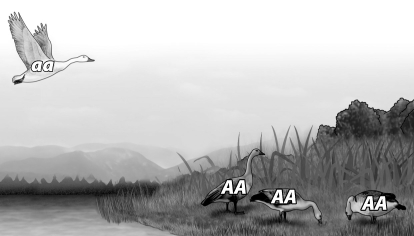
(Multiple Choice)
4.9/5 (75)
(75) Which of the following statements concerning evolution is false?
(Multiple Choice)
4.8/5 (101)
(101) The bell-shaped curve at the top of the figure below shows the distribution of a phenotype in a population at the start of an experiment. The three graphs (lettered A-C)beneath predict what the distribution will look like if a certain type of selection occurs. Which graph represents what the phenotypic distribution will look like if the population undergoes stabilizing selection? 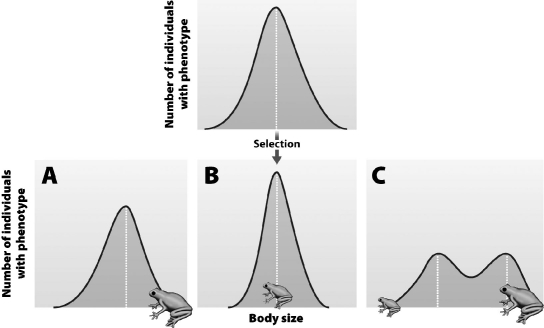
(Multiple Choice)
4.8/5 (96)
(96) Larger male elephant seals have more mates than smaller male elephant seals because they are better at defending their territory (and mates). This is an example of ____________________.
(Short Answer)
5.0/5 (61)
(61) If the genotype values predicted by the Hardy-Weinberg equation are greatly different from the values found in the real population, we can say that the population is ____________________.
(Short Answer)
5.0/5 (80)
(80) What is the total number of alleles present for any given gene in a population of 100 individuals?
(Multiple Choice)
4.9/5 (82)
(82) If a given population has 30 RR individuals, 10 Rr individuals, and 10 rr individuals, what is the genotype frequency of Rr?
(Multiple Choice)
4.7/5 (61)
(61) A student with Strep throat (caused by a strain of bacterium)is given a prescription for an antibiotic and is told to take the drug for two weeks. After a week, the student feels better and stops taking the drug. Two months later, the student again shows symptoms of Strep throat and decides to finish the leftover antibiotic rather than going to the doctor again. Two months later, the student develops Strep throat for a third time and returns to the doctor. This time, the antibiotic does not work. The doctor runs a test and discovers that the bacterial strain the student is carrying is antibiotic resistant. What most likely happened?
(Multiple Choice)
4.7/5 (80)
(80) A few members of a species establish themselves on a small island far from other populations of that species. They may experience a genetic bottleneck due to the ____________________ effect.
(Short Answer)
4.8/5 (69)
(69) Which of the following is not a step in the evolutionary process?
(Multiple Choice)
4.9/5 (79)
(79) In ____________________ selection, individuals with one extreme of an inherited phenotypic trait have an advantage over other individuals in the population.
(Short Answer)
4.9/5 (72)
(72) Although they are protected in many countries, humans still hunt elephants for their ivory tusks. A mutation that results in tuskless elephants is increasing in frequency in some elephant populations as a result of the evolutionary mechanism of ____________________.
(Short Answer)
4.7/5 (74)
(74) A scientist is studying beak length in a species of hummingbird. The scientist establishes a population of birds with beaks ranging from very small to very long and allows the population to breed for 10 years. At the end of the experiment, she finds that the majority of birds in the population have very long beaks. This is an example of _____ selection.
(Multiple Choice)
4.8/5 (65)
(65) If p is the frequency of the W allele in a population, why do we equate the WW individuals with the p² portion of the Hardy-Weinberg equation?
(Multiple Choice)
5.0/5 (89)
(89) A fisherman catches one trout from each of two ponds. Pond A contains 100 trout and pond B contains 1,000 trout. Which population is more affected by the fisherman?
(Multiple Choice)
4.8/5 (90)
(90) 
Filters
- Essay(0)
- Multiple Choice(0)
- Short Answer(0)
- True False(0)
- Matching(0)