



 Chat with AI
Exam 18: Evolution of Populations

Exam 1: The Nature of Science and the Characteristics of Life82 Questions
Exam 2: Biological Diversity, Bacteria, and Archaea101 Questions
Exam 3: Protista, Plantae, and Fungi83 Questions
Exam 4: Animalia81 Questions
Exam 5: The Chemistry of Life92 Questions
Exam 6: Cell Structure and Internal Compartments87 Questions
Exam 7: Cell Membranes, Transport, and Communication85 Questions
Exam 8: Energy, Metabolism, and Enzymes81 Questions
Exam 9: Photosynthesis and Cellular Respiration84 Questions
Exam 10: Cell Division89 Questions
Exam 11: Stem Cells, Cancer, and Human Health93 Questions
Exam 12: Patterns of Inheritance75 Questions
Exam 13: Chromosomes and Human Genetics75 Questions
Exam 14: Dna and Genes105 Questions
Exam 15: From Gene to Protein80 Questions
Exam 16: Dna Technology80 Questions
Exam 17: How Evolution Works80 Questions
Exam 18: Evolution of Populations80 Questions
Exam 19: Speciation and the Origins of Biological Diversity80 Questions
Exam 20: The Evolutionary History of Life100 Questions
Exam 21: The Biosphere89 Questions
Exam 22: Growth of Populations69 Questions
Exam 23: Ecological Communities133 Questions
Exam 24: Ecosystems75 Questions
Exam 25: Global Change70 Questions
Exam 26: Internal Organization and Homeostasis79 Questions
Exam 27: Nutrition and Digestion80 Questions
Exam 28: Circulation and Gas Exchange77 Questions
Exam 29: Animal Hormones78 Questions
Exam 30: Nervous and Sensory Systems78 Questions
Exam 31: Skeletons, Muscles, and Movement78 Questions
Exam 32: Defenses Against Disease78 Questions
Exam 33: Reproduction and Development76 Questions
Exam 34: Animal Behavior76 Questions
Exam 35: Plant Structure, Nutrition, and Transport80 Questions
Exam 36: Plant Growth and Reproduction80 Questions
Select questions type


Scientists have hypothesized that the reason European men have darker skin color than European women is that more than 10,000 years ago, these men preferred to mate with lighter-skinned females. If this is true, skin color is an example of _____ in Europeans.
(Multiple Choice)
4.8/5  (85)
(85) Two-way gene flow increases the differences between two populations of the same species.
(True/False)
4.9/5 (77)
(77) A gene has two alleles, B and B. If the b allele becomes "fixed" in the population, its frequency will be
(Multiple Choice)
4.8/5 (78)
(78) A population has a total of two alleles, G and g, for a given gene. Which one of the following sets of genotype frequencies is possible for that population?
(Multiple Choice)
4.9/5 (85)
(85) Mutations generally cause rapid changes in allele frequencies in populations.
(True/False)
4.8/5 (88)
(88) Which of the following is a valid interpretation of this data regarding prairie chicken populations in several states in the Midwest? 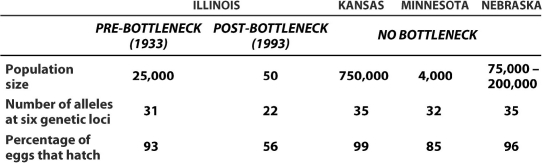
(Multiple Choice)
5.0/5 (83)
(83) The frequency of the genotype AA in a population is 0.36. What is the frequency of Aa?
(Multiple Choice)
4.9/5 (86)
(86) Several related bird species live in a desert. One species is much smaller than the other species. This species nests in holes in cacti. Because the bird is so small, it can easily squeeze between the spines of the cactus and create a well-protected nest. This is an example of
(Multiple Choice)
4.8/5 (77)
(77) If a given population has 30 RR individuals, 10 Rr individuals, and 10 rr individuals, what is the allele frequency of R?
(Multiple Choice)
4.8/5 (74)
(74) Feeding healthy livestock antibiotics makes it more likely that antibiotic-resistant bacteria will evolve.
(True/False)
5.0/5 (85)
(85) ____________________ promote rapid evolution by giving bacteria with resistance genes a selective advantage.
(Short Answer)
4.7/5 (86)
(86) The allele frequency of a recessive allele is always less than the allele frequency of a dominant allele.
(True/False)
4.8/5 (71)
(71) Which of the following is not likely to be a cause of rapid evolution in a population?
(Multiple Choice)
4.9/5 (91)
(91) The color of a certain species of beetle is determined by a single gene. Two beetles homozygous for green coloration produce a single offspring with brown coloration. Brown color appeared in this offspring as a result of a ____________________.
(Short Answer)
4.8/5 (74)
(74) A water plant gets wrapped around the propeller of a boat in Round Pond. This particular plant exhibits an unusual allele that gives it extra branches. The boat owner moves his boat to Big Lake without cleaning the plant off the propeller. The same species of water plant already exists in Big Lake, but none of the plants exhibit the "extra branches" allele. One year later, the frequency of the extra branches allele in Big Lake is much higher. This is an example of
(Multiple Choice)
4.9/5 (81)
(81) 
Filters
- Essay(0)
- Multiple Choice(0)
- Short Answer(0)
- True False(0)
- Matching(0)