



 Chat with AI
Exam 18: Evolution of Populations

Exam 1: The Nature of Science and the Characteristics of Life82 Questions
Exam 2: Biological Diversity, Bacteria, and Archaea101 Questions
Exam 3: Protista, Plantae, and Fungi83 Questions
Exam 4: Animalia81 Questions
Exam 5: The Chemistry of Life92 Questions
Exam 6: Cell Structure and Internal Compartments87 Questions
Exam 7: Cell Membranes, Transport, and Communication85 Questions
Exam 8: Energy, Metabolism, and Enzymes81 Questions
Exam 9: Photosynthesis and Cellular Respiration84 Questions
Exam 10: Cell Division89 Questions
Exam 11: Stem Cells, Cancer, and Human Health93 Questions
Exam 12: Patterns of Inheritance75 Questions
Exam 13: Chromosomes and Human Genetics75 Questions
Exam 14: Dna and Genes105 Questions
Exam 15: From Gene to Protein80 Questions
Exam 16: Dna Technology80 Questions
Exam 17: How Evolution Works80 Questions
Exam 18: Evolution of Populations80 Questions
Exam 19: Speciation and the Origins of Biological Diversity80 Questions
Exam 20: The Evolutionary History of Life100 Questions
Exam 21: The Biosphere89 Questions
Exam 22: Growth of Populations69 Questions
Exam 23: Ecological Communities133 Questions
Exam 24: Ecosystems75 Questions
Exam 25: Global Change70 Questions
Exam 26: Internal Organization and Homeostasis79 Questions
Exam 27: Nutrition and Digestion80 Questions
Exam 28: Circulation and Gas Exchange77 Questions
Exam 29: Animal Hormones78 Questions
Exam 30: Nervous and Sensory Systems78 Questions
Exam 31: Skeletons, Muscles, and Movement78 Questions
Exam 32: Defenses Against Disease78 Questions
Exam 33: Reproduction and Development76 Questions
Exam 34: Animal Behavior76 Questions
Exam 35: Plant Structure, Nutrition, and Transport80 Questions
Exam 36: Plant Growth and Reproduction80 Questions
Select questions type


Although millions of prairie chickens once occupied Illinois, in 1993 only 50 remained. Starting in 1992, scientists moved almost 300 prairie chickens from large populations in other states to Illinois to _____ Illinois prairie chicken populations.
(Multiple Choice)
4.8/5  (76)
(76) Allele frequency refers to the rate of mutation in a population.
(True/False)
4.8/5 (65)
(65) In the Hardy-Weinberg equation, ____________________ represents the predicted frequency of the heterozygous genotype.
(Short Answer)
4.9/5 (94)
(94) Genetic drift causes random changes in ____________________ frequency.
(Short Answer)
4.9/5 (78)
(78) A new allele spreads from one large population to another as a result of genetic flow.
(True/False)
4.8/5 (77)
(77) The increase in antibiotic resistance in E. coli as a result of treating healthy animals with antibiotics is an example of ____________________ driving evolution.
(Short Answer)
4.9/5 (77)
(77) Which of the following is not a reason that farmers give antibiotics to their livestock?
(Multiple Choice)
4.9/5 (70)
(70) Compared to a large mainland population, genetic drift in a small island population is
(Multiple Choice)
4.7/5 (79)
(79) The Hardy-Weinberg equation predicts the following genotype frequencies for a particular gene: BB = 0.36, Bb = 0.48, and bb = 0.16. The population you are studying exhibits the following frequencies: BB = 0.42, Bb = 0.5, and bb = 0.08. What can you conclude?
(Multiple Choice)
4.8/5 (87)
(87) The shell of a particular species of snail exhibits anywhere from 3 to 10 coils when mature. Over a series of three years, a scientist counts the number of coils in the shells of all the mature individuals in a population of snails. Year after year, the most common phenotype is 7 coils. Snails with 3 coils or 10 coils are very rare. This is an example of _____ selection.
(Multiple Choice)
4.9/5 (89)
(89) A gene has two alleles, D and D. The frequency of the D allele is 0.2. What is the frequency of the d allele?
(Multiple Choice)
4.8/5 (78)
(78) The fur in a species of mice ranges from white to black (intermediate phenotypes are different shades of gray). A population of these mice lives in an environment that contains both regions of white sand and regions of black lava rocks. When a scientist examines the frequencies of the different alleles in the population, she finds that, although white mice and black mice are common, gray mice are rare. This is an example of _____ selection.
(Multiple Choice)
4.8/5 (82)
(82) In any given population the genotype frequency is usually the same as the allele frequency.
(True/False)
4.9/5 (74)
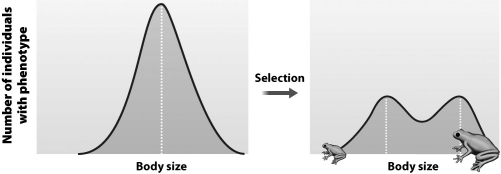
(74) If the phenotypic distribution of a population starts out as shown in the graph on the left and ends as shown in the graph on the right, you can conclude that the population is undergoing directional selection.
(True/False)
4.7/5 (89)
(89) Genetic drift can result in the fixation of a harmful allele in a small population.
(True/False)
4.9/5 (63)
(63) ____________________ is the only mechanism of evolutionary change that is not influenced by chance events.
(Short Answer)
4.7/5 (81)
(81) In a population of 100,000 flies, 30,000 have the AA genotype, 20,000 carry the Aa genotype, and 50,000 have the aa genotype. What is the frequency of the A allele?
(Multiple Choice)
4.8/5 (84)
(84) When a population shrinks, causing low genetic variation or the fixation of a harmful allele, a genetic ____________________ has occurred.
(Short Answer)
4.8/5 (78)
(78) Two populations of geese live near each other. As time passes, the populations are becoming more genetically alike. This is probably due to ____________________.
(Short Answer)
4.9/5 (78)
(78) 
Filters
- Essay(0)
- Multiple Choice(0)
- Short Answer(0)
- True False(0)
- Matching(0)