



 Chat with AI
Exam 17: How Evolution Works

Exam 1: The Nature of Science and the Characteristics of Life82 Questions
Exam 2: Biological Diversity, Bacteria, and Archaea101 Questions
Exam 3: Protista, Plantae, and Fungi83 Questions
Exam 4: Animalia81 Questions
Exam 5: The Chemistry of Life92 Questions
Exam 6: Cell Structure and Internal Compartments87 Questions
Exam 7: Cell Membranes, Transport, and Communication85 Questions
Exam 8: Energy, Metabolism, and Enzymes81 Questions
Exam 9: Photosynthesis and Cellular Respiration84 Questions
Exam 10: Cell Division89 Questions
Exam 11: Stem Cells, Cancer, and Human Health93 Questions
Exam 12: Patterns of Inheritance75 Questions
Exam 13: Chromosomes and Human Genetics75 Questions
Exam 14: Dna and Genes105 Questions
Exam 15: From Gene to Protein80 Questions
Exam 16: Dna Technology80 Questions
Exam 17: How Evolution Works80 Questions
Exam 18: Evolution of Populations80 Questions
Exam 19: Speciation and the Origins of Biological Diversity80 Questions
Exam 20: The Evolutionary History of Life100 Questions
Exam 21: The Biosphere89 Questions
Exam 22: Growth of Populations69 Questions
Exam 23: Ecological Communities133 Questions
Exam 24: Ecosystems75 Questions
Exam 25: Global Change70 Questions
Exam 26: Internal Organization and Homeostasis79 Questions
Exam 27: Nutrition and Digestion80 Questions
Exam 28: Circulation and Gas Exchange77 Questions
Exam 29: Animal Hormones78 Questions
Exam 30: Nervous and Sensory Systems78 Questions
Exam 31: Skeletons, Muscles, and Movement78 Questions
Exam 32: Defenses Against Disease78 Questions
Exam 33: Reproduction and Development76 Questions
Exam 34: Animal Behavior76 Questions
Exam 35: Plant Structure, Nutrition, and Transport80 Questions
Exam 36: Plant Growth and Reproduction80 Questions
Select questions type


Continental drift is the ____________________ of Earth's landmasses through geologic time.
(Short Answer)
4.8/5  (91)
(91) Humans have a reduced tailbone and the muscles to move a tail. This evidence indicates that we descended from an ancestor that had a tail.
(True/False)
4.8/5 (71)
(71) Continental drift predicts that fossils of species that evolved after Pangaea split apart should be found on only one or a few present-day continents.
(True/False)
4.9/5 (91)
(91) When comparing certain amino acid sequences in the protein hemoglobin of humans to those of other animals, scientists found that baboons had 7 amino acids that were different than the human protein, dogs had 10 amino acids that were different than the human protein, gorillas had 1 amino acid that was different than the human protein, and lemurs had 8 amino acids that were different than the human protein. Which of these animals is most closely related to humans?
(Multiple Choice)
4.9/5 (89)
(89) Flounder (a type of fish)generally match the color of the sandy bottoms they inhabit. Their color allows them to hide from other organisms that might eat them. This is an example of
(Multiple Choice)
4.9/5 (75)
(75) The proteins and DNA of organisms that share a recent common ancestor are ____________________ [more or less] similar than the proteins and DNA of organisms that do not share a recent common ancestor.
(Short Answer)
4.9/5 (81)
(81) The genus Lycopodium includes plants that evolved before the breakup of Pangaea. The genus Sequoiadendron (Sequoia trees)evolved after Pangaea split into separate landmasses. Which genus would you expect to have the widest distribution of living representatives across the modern continents?
(Multiple Choice)
4.9/5 (79)
(79) Evolution can cause so many changes among individuals of two populations of the same species that eventually the members of the two populations are no longer able to ____________________ with each other, thus forming a new species.
(Short Answer)
4.9/5 (72)
(72) Jean-Baptiste Lamark proposed that changes in the traits of a population are a result of traits acquired during the lifetime of an organism being inherited by that organism's offspring. What is wrong with this proposal?
(Multiple Choice)
4.9/5 (74)
(74) Mutations occur ____________________ rather than in a predictable manner that ensures the survival of an individual.
(Short Answer)
4.8/5 (76)
(76) In the phrase survival of the fittest, the term "fittest" refers to the individual with the greatest physical strength.
(True/False)
4.8/5 (79)
(79) The fossils of organisms that existed when the continents were connected are distributed across ____________________ [more or fewer] continents than the fossils of organisms that evolved after the continents separated.
(Short Answer)
4.7/5 (88)
(88) One of the reasons scientists have had so much difficulty finding a cure for HIV/AIDS is that the HIV virus is quick to evolve resistance to the drugs used to treat it. What is the most likely mechanism for this type of evolution?
(Multiple Choice)
4.7/5 (75)
(75) Convergent evolution occurs when natural selection causes distantly related organisms to
(Multiple Choice)
4.9/5 (82)
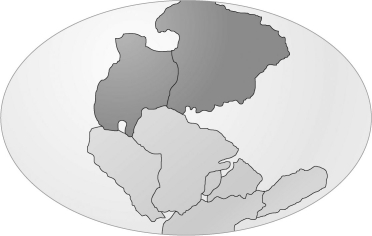
(82) Approximately 200 million years ago, ____________________, the giant land mass shown in the figure below, began to split up into the continents we know today.
(Short Answer)
4.7/5 (75)
(75) Early scholars recognized that species change over time either due to chance or due to changes imposed by the environment.
(True/False)
4.8/5 (72)
(72) 
Filters
- Essay(0)
- Multiple Choice(0)
- Short Answer(0)
- True False(0)
- Matching(0)