



 Chat with AI
Exam 17: How Evolution Works

Exam 1: The Nature of Science and the Characteristics of Life82 Questions
Exam 2: Biological Diversity, Bacteria, and Archaea101 Questions
Exam 3: Protista, Plantae, and Fungi83 Questions
Exam 4: Animalia81 Questions
Exam 5: The Chemistry of Life92 Questions
Exam 6: Cell Structure and Internal Compartments87 Questions
Exam 7: Cell Membranes, Transport, and Communication85 Questions
Exam 8: Energy, Metabolism, and Enzymes81 Questions
Exam 9: Photosynthesis and Cellular Respiration84 Questions
Exam 10: Cell Division89 Questions
Exam 11: Stem Cells, Cancer, and Human Health93 Questions
Exam 12: Patterns of Inheritance75 Questions
Exam 13: Chromosomes and Human Genetics75 Questions
Exam 14: Dna and Genes105 Questions
Exam 15: From Gene to Protein80 Questions
Exam 16: Dna Technology80 Questions
Exam 17: How Evolution Works80 Questions
Exam 18: Evolution of Populations80 Questions
Exam 19: Speciation and the Origins of Biological Diversity80 Questions
Exam 20: The Evolutionary History of Life100 Questions
Exam 21: The Biosphere89 Questions
Exam 22: Growth of Populations69 Questions
Exam 23: Ecological Communities133 Questions
Exam 24: Ecosystems75 Questions
Exam 25: Global Change70 Questions
Exam 26: Internal Organization and Homeostasis79 Questions
Exam 27: Nutrition and Digestion80 Questions
Exam 28: Circulation and Gas Exchange77 Questions
Exam 29: Animal Hormones78 Questions
Exam 30: Nervous and Sensory Systems78 Questions
Exam 31: Skeletons, Muscles, and Movement78 Questions
Exam 32: Defenses Against Disease78 Questions
Exam 33: Reproduction and Development76 Questions
Exam 34: Animal Behavior76 Questions
Exam 35: Plant Structure, Nutrition, and Transport80 Questions
Exam 36: Plant Growth and Reproduction80 Questions
Select questions type


The fact that small, nonfunctioning hind legs are found in the skeletons of many snakes suggests that snakes
(Multiple Choice)
4.9/5  (84)
(84) The number of different types of organisms found on Earth is a result of
(Multiple Choice)
4.9/5 (89)
(89) Darwin's ideas on natural selection were accepted immediately, thus showing that correct ideas are recognized and accepted as soon as they are presented.
(True/False)
4.9/5 (79)
(79) Certain weeds have become resistant to the pesticides that were used to kill them. Which of the following statements is the best explanation for this phenomenon?
(Multiple Choice)
4.8/5 (73)
(73) Evolutionary changes occur when _____ acts upon populations containing individuals with genetic differences.
(Multiple Choice)
4.9/5 (75)
(75) ____________________ are the preserved remains of formerly living organisms.
(Short Answer)
4.8/5 (87)
(87) Some finches on the Galápagos Islands eat insects, an unusual food for finches to eat. These finches
(Multiple Choice)
4.9/5 (69)
(69) For a population to evolve, there must be genetic differences between organisms in that population. These differences arise by
(Multiple Choice)
5.0/5 (72)
(72) A population of mice lives along a river. Some mice cross the river to establish a new population. Eventually, due to genetic changes, these two groups of mice can no longer interbreed. This is an example of
(Multiple Choice)
4.9/5 (67)
(67) Which of the following is not likely to contribute to evolution within a population?
(Multiple Choice)
4.8/5 (71)
(71) A species of cave beetle that lives in total darkness is blind but has remnants of what looks like eyes. These "eyes" are
(Multiple Choice)
4.9/5 (91)
(91) According to the evolutionary tree below, the most closely related ancestor of modern dogs is the coyote.
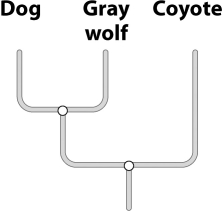
(True/False)
4.8/5 (92)
(92) Which of the following is not homologous to any of the others?
(Multiple Choice)
4.8/5 (81)
(81) In the figure below, the region indicated by the arrow is the only modern-day location of the freshwater lungfish. Fossils of the ancestors of the lungfish, however, have been found all over the world (dots throughout map). What does the distribution of these fossils indicate? 
(Multiple Choice)
4.8/5 (70)
(70) Nonheritable genetic changes can cause evolution within a population.
(True/False)
4.9/5 (71)
(71) A(n)____________________ is a characteristic of an organism that improves the performance of that organism in its environment, thus improving its reproductive success.
(Short Answer)
4.9/5 (69)
(69) The result of ____________________ over evolutionary time spans is that alleles that allow organisms to survive and reproduce at a higher rate than other individuals become more common in the population.
(Short Answer)
4.8/5 (68)
(68) 
Filters
- Essay(0)
- Multiple Choice(0)
- Short Answer(0)
- True False(0)
- Matching(0)