



 Chat with AI
Exam 11: Stem Cells, Cancer, and Human Health

Exam 1: The Nature of Science and the Characteristics of Life82 Questions
Exam 2: Biological Diversity, Bacteria, and Archaea101 Questions
Exam 3: Protista, Plantae, and Fungi83 Questions
Exam 4: Animalia81 Questions
Exam 5: The Chemistry of Life92 Questions
Exam 6: Cell Structure and Internal Compartments87 Questions
Exam 7: Cell Membranes, Transport, and Communication85 Questions
Exam 8: Energy, Metabolism, and Enzymes81 Questions
Exam 9: Photosynthesis and Cellular Respiration84 Questions
Exam 10: Cell Division89 Questions
Exam 11: Stem Cells, Cancer, and Human Health93 Questions
Exam 12: Patterns of Inheritance75 Questions
Exam 13: Chromosomes and Human Genetics75 Questions
Exam 14: Dna and Genes105 Questions
Exam 15: From Gene to Protein80 Questions
Exam 16: Dna Technology80 Questions
Exam 17: How Evolution Works80 Questions
Exam 18: Evolution of Populations80 Questions
Exam 19: Speciation and the Origins of Biological Diversity80 Questions
Exam 20: The Evolutionary History of Life100 Questions
Exam 21: The Biosphere89 Questions
Exam 22: Growth of Populations69 Questions
Exam 23: Ecological Communities133 Questions
Exam 24: Ecosystems75 Questions
Exam 25: Global Change70 Questions
Exam 26: Internal Organization and Homeostasis79 Questions
Exam 27: Nutrition and Digestion80 Questions
Exam 28: Circulation and Gas Exchange77 Questions
Exam 29: Animal Hormones78 Questions
Exam 30: Nervous and Sensory Systems78 Questions
Exam 31: Skeletons, Muscles, and Movement78 Questions
Exam 32: Defenses Against Disease78 Questions
Exam 33: Reproduction and Development76 Questions
Exam 34: Animal Behavior76 Questions
Exam 35: Plant Structure, Nutrition, and Transport80 Questions
Exam 36: Plant Growth and Reproduction80 Questions
Select questions type


Since the controversy involving stem cells recovered from embryos is essentially based on a misunderstanding of the cell recovery process, a better educational effort by advocates of the process should quickly allay any concerns.
(True/False)
4.8/5  (85)
(85) ____________________ starts with a single cell that loses its ability to control cell division.
(Short Answer)
4.8/5 (77)
(77) What term(s)would describe the stem cell depicted in the illustration below? 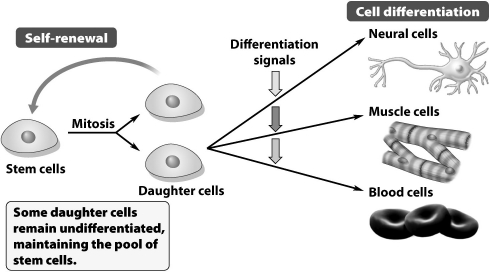
(Multiple Choice)
4.8/5 (75)
(75) Stem cells display two unique characteristics: the ability to _____ and _____.
(Multiple Choice)
4.9/5 (77)
(77) The illustration below shows the developmental sequence leading to an adult human. Every step, except one, requires that mitosis occur; the one exception is 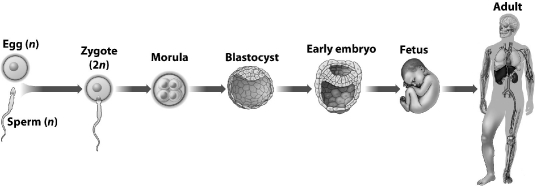
(Multiple Choice)
4.9/5 (76)
(76) Explaining the differentiation of the numerous cell types in a mature organism from the initial zygote has been challenging. Which statement best summarizes the current understanding of the process?
(Multiple Choice)
5.0/5 (74)
(74) Positive growth regulators increase the rate of ____________________.
(Short Answer)
4.9/5 (80)
(80) Normal cellular genes that can be mutated into cancer-causing genes are known as
(Multiple Choice)
4.8/5 (68)
(68) Most cancers are caused by a combination of environmental factors.
(True/False)
4.9/5 (87)
(87) The human papilloma virus is the most common sexually transmitted disease in the United States; at any moment more that 50 percent of the entire population is infected.
(True/False)
4.7/5 (89)
(89) The illustration below shows bone marrow stem cells; it is most likely that these stem cells are _____ because they are derived from _____. 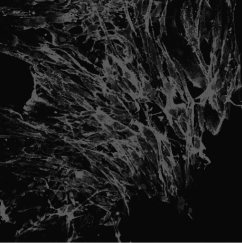
(Multiple Choice)
4.9/5 (80)
(80) For cancer to form in the presence of a tumor suppressor gene, which of the following is necessary?
(Multiple Choice)
4.9/5 (80)
(80) A variety of therapies using adult stem cells have already been developed; for example, adult stem cells are currently used to
(Multiple Choice)
4.8/5 (71)
(71) A physical, chemical, or biological agent that causes cancer is a ____________________.
(Short Answer)
4.9/5 (77)
(77) Chemotherapy often produces hair loss and nausea. What aspect of the treatment impacts these normal nontarget tissues?
(Multiple Choice)
4.9/5 (83)
(83) Even though all people are exposed to potential carcinogens on a daily basis, we do not all develop cancer. Why?
(Multiple Choice)
4.8/5 (79)
(79) A woman who has already had children develops skin cancer from overexposure to the sun. Is it possible for her children to have inherited this cancer from her?
(Multiple Choice)
4.8/5 (79)
(79) 
Filters
- Essay(0)
- Multiple Choice(0)
- Short Answer(0)
- True False(0)
- Matching(0)