



 Chat with AI
Exam 8: Energy, Metabolism, and Enzymes

Exam 1: The Nature of Science and the Characteristics of Life82 Questions
Exam 2: Biological Diversity, Bacteria, and Archaea101 Questions
Exam 3: Protista, Plantae, and Fungi83 Questions
Exam 4: Animalia81 Questions
Exam 5: The Chemistry of Life92 Questions
Exam 6: Cell Structure and Internal Compartments87 Questions
Exam 7: Cell Membranes, Transport, and Communication85 Questions
Exam 8: Energy, Metabolism, and Enzymes81 Questions
Exam 9: Photosynthesis and Cellular Respiration84 Questions
Exam 10: Cell Division89 Questions
Exam 11: Stem Cells, Cancer, and Human Health93 Questions
Exam 12: Patterns of Inheritance75 Questions
Exam 13: Chromosomes and Human Genetics75 Questions
Exam 14: Dna and Genes105 Questions
Exam 15: From Gene to Protein80 Questions
Exam 16: Dna Technology80 Questions
Exam 17: How Evolution Works80 Questions
Exam 18: Evolution of Populations80 Questions
Exam 19: Speciation and the Origins of Biological Diversity80 Questions
Exam 20: The Evolutionary History of Life100 Questions
Exam 21: The Biosphere89 Questions
Exam 22: Growth of Populations69 Questions
Exam 23: Ecological Communities133 Questions
Exam 24: Ecosystems75 Questions
Exam 25: Global Change70 Questions
Exam 26: Internal Organization and Homeostasis79 Questions
Exam 27: Nutrition and Digestion80 Questions
Exam 28: Circulation and Gas Exchange77 Questions
Exam 29: Animal Hormones78 Questions
Exam 30: Nervous and Sensory Systems78 Questions
Exam 31: Skeletons, Muscles, and Movement78 Questions
Exam 32: Defenses Against Disease78 Questions
Exam 33: Reproduction and Development76 Questions
Exam 34: Animal Behavior76 Questions
Exam 35: Plant Structure, Nutrition, and Transport80 Questions
Exam 36: Plant Growth and Reproduction80 Questions
Select questions type


In the reaction H₂O + CO₂ + carbonic anhydraseà H⁺ + HCO₃⁻+ carbonic anhydrase, carbonic anhydrase is a(n)
(Multiple Choice)
4.7/5  (84)
(84) Why is heat shown flowing from the worker in the illustration below? 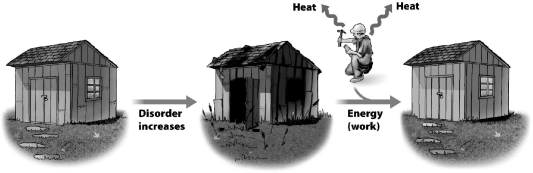
(Multiple Choice)
4.8/5 (82)
(82) Photosynthetic organisms capture energy from sunlight and convert it into chemical bonds by forming
(Multiple Choice)
4.8/5 (87)
(87) Organisms that maintain a constant body temperature rely on the heat produced by cells. Where does this heat come from?
(Multiple Choice)
4.9/5 (75)
(75) The first law of thermodynamics states that the total energy of a system and its surroundings remains constant.
(True/False)
4.9/5 (86)
(86) Fitness appears to have effects even at the cellular level; the ability of cells to process ____________________ to support exercise appears to be proportional to the amount of exercise they have experienced.
(Short Answer)
4.9/5 (85)
(85) A molecule of methane burns, producing carbon dioxide, heat, light, and water. The direction of the event is dictated by the ____________________ law of thermodynamics.
(Short Answer)
4.9/5 (77)
(77) The sequential reaction pathway A → B → C → D is dependent on enzymes for each separate step. How many different enzymes would be required to produce D if starting with A?
(Multiple Choice)
4.9/5 (59)
(59) According to the ____________________ model, the active site of an enzyme adjusts its shape to mold around a substrate after binding.
(Short Answer)
4.8/5 (69)
(69) Carbon dioxide is one product of the metabolic process called ____________________ that occurs in both plants and animals.
(Short Answer)
4.9/5 (86)
(86) Metabolic pathways are relatively uncommon in cells; most biologically significant molecules are obtained intact from a well-balanced diet.
(True/False)
4.8/5 (75)
(75) The heat given off by living systems can increase the likelihood that a given chemical reaction takes place. Why is this true?
(Multiple Choice)
4.8/5 (70)
(70) In the reaction C₆H₁₂O₆ + 6 O₂ → 6 CO₂ + 6 H₂O, the 6 CO₂ molecules are some of the
(Multiple Choice)
4.8/5 (92)
(92) In accordance with the first law of thermodynamics, the energy in a gallon of gas consumed in a mileage test is equal to the
(Multiple Choice)
4.9/5 (85)
(85) Comparative studies have repeatedly shown that smaller animals have faster metabolic rates than larger animals, yet human males are both larger and have a higher average BMR than human females. What explains the variation in the pattern?
(Multiple Choice)
4.9/5 (71)
(71) A molecule of sugar slowly "burns" in one of your cells. The products of these catabolic reactions are _____ than the original sugar molecules.
(Multiple Choice)
5.0/5 (93)
(93) 
Filters
- Essay(0)
- Multiple Choice(0)
- Short Answer(0)
- True False(0)
- Matching(0)