



 Chat with AI
Exam 8: Energy, Metabolism, and Enzymes

Exam 1: The Nature of Science and the Characteristics of Life82 Questions
Exam 2: Biological Diversity, Bacteria, and Archaea101 Questions
Exam 3: Protista, Plantae, and Fungi83 Questions
Exam 4: Animalia81 Questions
Exam 5: The Chemistry of Life92 Questions
Exam 6: Cell Structure and Internal Compartments87 Questions
Exam 7: Cell Membranes, Transport, and Communication85 Questions
Exam 8: Energy, Metabolism, and Enzymes81 Questions
Exam 9: Photosynthesis and Cellular Respiration84 Questions
Exam 10: Cell Division89 Questions
Exam 11: Stem Cells, Cancer, and Human Health93 Questions
Exam 12: Patterns of Inheritance75 Questions
Exam 13: Chromosomes and Human Genetics75 Questions
Exam 14: Dna and Genes105 Questions
Exam 15: From Gene to Protein80 Questions
Exam 16: Dna Technology80 Questions
Exam 17: How Evolution Works80 Questions
Exam 18: Evolution of Populations80 Questions
Exam 19: Speciation and the Origins of Biological Diversity80 Questions
Exam 20: The Evolutionary History of Life100 Questions
Exam 21: The Biosphere89 Questions
Exam 22: Growth of Populations69 Questions
Exam 23: Ecological Communities133 Questions
Exam 24: Ecosystems75 Questions
Exam 25: Global Change70 Questions
Exam 26: Internal Organization and Homeostasis79 Questions
Exam 27: Nutrition and Digestion80 Questions
Exam 28: Circulation and Gas Exchange77 Questions
Exam 29: Animal Hormones78 Questions
Exam 30: Nervous and Sensory Systems78 Questions
Exam 31: Skeletons, Muscles, and Movement78 Questions
Exam 32: Defenses Against Disease78 Questions
Exam 33: Reproduction and Development76 Questions
Exam 34: Animal Behavior76 Questions
Exam 35: Plant Structure, Nutrition, and Transport80 Questions
Exam 36: Plant Growth and Reproduction80 Questions
Select questions type


In many organelles, groups of different enzymes are located on membranes in close proximity to each other because
(Multiple Choice)
4.9/5  (83)
(83) It is possible to predict the amount of energy released during a chemical reaction (as shown in the illustration below)because the _____ law of thermodynamics states that _____. 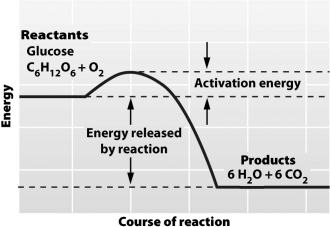
(Multiple Choice)
4.9/5 (70)
(70) Some kinds of drain cleaners use enzymes rather than strong, more dangerous chemicals. These enzymes must be able to
(Multiple Choice)
4.8/5 (79)
(79) Plants and animals use different energy storage molecules, yet they both use the same mechanism to "burn" their stored energy. How can plants and animals both be successful, even though they "burn" different energy storage molecules?
(Multiple Choice)
4.9/5 (89)
(89) Sugar molecules are more oxidized than carbon dioxide molecules.
(True/False)
4.9/5 (86)
(86) Physiologists monitored metabolite concentrations generated during exercise in three groups of individuals (those with poor fitness, average fitness, and exceptional fitness); which statement best summarizes their findings?
(Multiple Choice)
4.7/5 (76)
(76) An insect devouring a leaf is an example of the second law of thermodynamics in action.
(True/False)
4.9/5 (89)
(89) Photosynthesis creates energy and cellular respiration destroys energy.
(True/False)
4.9/5 (84)
(84) Almost all the chemical reactions that occur in cells are catalyzed by ____________________ .
(Short Answer)
4.9/5 (84)
(84) Maltase splits the disaccharide maltose into two sugar monomers. Maltose is the ____________________ of maltase.
(Short Answer)
4.8/5 (92)
(92) When ATP breaks into ADP and a phosphate group, energy is given off.
(True/False)
4.8/5 (69)
(69) A catalyst affects the ____________________ at which a chemical reaction occurs, but it is not itself changed during the reaction.
(Short Answer)
4.8/5 (82)
(82) 
Filters
- Essay(0)
- Multiple Choice(0)
- Short Answer(0)
- True False(0)
- Matching(0)