



 Chat with AI
Exam 8: Energy, Metabolism, and Enzymes

Exam 1: The Nature of Science and the Characteristics of Life82 Questions
Exam 2: Biological Diversity, Bacteria, and Archaea101 Questions
Exam 3: Protista, Plantae, and Fungi83 Questions
Exam 4: Animalia81 Questions
Exam 5: The Chemistry of Life92 Questions
Exam 6: Cell Structure and Internal Compartments87 Questions
Exam 7: Cell Membranes, Transport, and Communication85 Questions
Exam 8: Energy, Metabolism, and Enzymes81 Questions
Exam 9: Photosynthesis and Cellular Respiration84 Questions
Exam 10: Cell Division89 Questions
Exam 11: Stem Cells, Cancer, and Human Health93 Questions
Exam 12: Patterns of Inheritance75 Questions
Exam 13: Chromosomes and Human Genetics75 Questions
Exam 14: Dna and Genes105 Questions
Exam 15: From Gene to Protein80 Questions
Exam 16: Dna Technology80 Questions
Exam 17: How Evolution Works80 Questions
Exam 18: Evolution of Populations80 Questions
Exam 19: Speciation and the Origins of Biological Diversity80 Questions
Exam 20: The Evolutionary History of Life100 Questions
Exam 21: The Biosphere89 Questions
Exam 22: Growth of Populations69 Questions
Exam 23: Ecological Communities133 Questions
Exam 24: Ecosystems75 Questions
Exam 25: Global Change70 Questions
Exam 26: Internal Organization and Homeostasis79 Questions
Exam 27: Nutrition and Digestion80 Questions
Exam 28: Circulation and Gas Exchange77 Questions
Exam 29: Animal Hormones78 Questions
Exam 30: Nervous and Sensory Systems78 Questions
Exam 31: Skeletons, Muscles, and Movement78 Questions
Exam 32: Defenses Against Disease78 Questions
Exam 33: Reproduction and Development76 Questions
Exam 34: Animal Behavior76 Questions
Exam 35: Plant Structure, Nutrition, and Transport80 Questions
Exam 36: Plant Growth and Reproduction80 Questions
Select questions type


Which of the following is either consumed or synthesized in virtually every cellular reaction?
(Multiple Choice)
4.9/5  (83)
(83) The reuse of the same carbon molecules by plants, animals, and their environments through time is known as
(Multiple Choice)
4.9/5 (85)
(85) During photosynthesis, light energy is converted into chemical energy, a type of
(Multiple Choice)
4.8/5 (83)
(83) When chemical energy is converted into kinetic energy in a biological system, ____________________ [more than all, less than all, or all] of the available energy is converted.
(Short Answer)
4.9/5 (68)
(68) The gain of electrons by one atom from another atom is referred to as ____________________.
(Short Answer)
4.9/5 (83)
(83) All molecules have a combination of kinetic and potential energy. If an external heat source were used to increase the kinetic energy of a group of molecules, the potential energy of the group would
(Multiple Choice)
4.9/5 (78)
(78) If provided with the proper conditions, enzymes recovered from living tissues can be used in cell-free industrial processes; for example,
(Multiple Choice)
4.8/5 (90)
(90) The ____________________ of an enzyme is an area with a specialized shape and/or set of chemical properties that allows the enzyme to bind with a particular substrate.
(Short Answer)
4.8/5 (71)
(71) The compartmentalization present within the mitochondrion improves the efficiency of the ATP production pathway by concentrating the reacting molecules.
(True/False)
4.9/5 (87)
(87) When humans cut down trees for lumber to build permanent structures, what aspect of metabolic cycling is disrupted?
(Multiple Choice)
4.7/5 (79)
(79) In the figure below, E1, E2, and E3 represent three enzymes in the membrane of a mitochondrion. 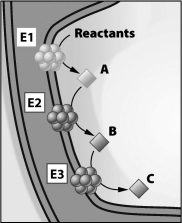 Which of the following is true?
 (Multiple Choice)
5.0/5 (91)
(91) A rotted log indicates that the ____________________ law of thermodynamics has been operating.
(Short Answer)
4.8/5 (84)
(84) The capture and use of energy by living organisms involves numerous chemical reactions. Collectively these processes are known as ____________________.
(Short Answer)
4.9/5 (95)
(95) 
Filters
- Essay(0)
- Multiple Choice(0)
- Short Answer(0)
- True False(0)
- Matching(0)