



 Chat with AI
Exam 7: Cell Membranes, Transport, and Communication

Exam 1: The Nature of Science and the Characteristics of Life82 Questions
Exam 2: Biological Diversity, Bacteria, and Archaea101 Questions
Exam 3: Protista, Plantae, and Fungi83 Questions
Exam 4: Animalia81 Questions
Exam 5: The Chemistry of Life92 Questions
Exam 6: Cell Structure and Internal Compartments87 Questions
Exam 7: Cell Membranes, Transport, and Communication85 Questions
Exam 8: Energy, Metabolism, and Enzymes81 Questions
Exam 9: Photosynthesis and Cellular Respiration84 Questions
Exam 10: Cell Division89 Questions
Exam 11: Stem Cells, Cancer, and Human Health93 Questions
Exam 12: Patterns of Inheritance75 Questions
Exam 13: Chromosomes and Human Genetics75 Questions
Exam 14: Dna and Genes105 Questions
Exam 15: From Gene to Protein80 Questions
Exam 16: Dna Technology80 Questions
Exam 17: How Evolution Works80 Questions
Exam 18: Evolution of Populations80 Questions
Exam 19: Speciation and the Origins of Biological Diversity80 Questions
Exam 20: The Evolutionary History of Life100 Questions
Exam 21: The Biosphere89 Questions
Exam 22: Growth of Populations69 Questions
Exam 23: Ecological Communities133 Questions
Exam 24: Ecosystems75 Questions
Exam 25: Global Change70 Questions
Exam 26: Internal Organization and Homeostasis79 Questions
Exam 27: Nutrition and Digestion80 Questions
Exam 28: Circulation and Gas Exchange77 Questions
Exam 29: Animal Hormones78 Questions
Exam 30: Nervous and Sensory Systems78 Questions
Exam 31: Skeletons, Muscles, and Movement78 Questions
Exam 32: Defenses Against Disease78 Questions
Exam 33: Reproduction and Development76 Questions
Exam 34: Animal Behavior76 Questions
Exam 35: Plant Structure, Nutrition, and Transport80 Questions
Exam 36: Plant Growth and Reproduction80 Questions
Select questions type


Soon after a certain molecule enters a cell, the cell begins producing a new type of protein. The molecule was probably a
(Multiple Choice)
4.9/5  (74)
(74) During ____________________ endocytosis, specific substances interact with proteins located on the plasma membrane of the cell.
(Short Answer)
4.7/5 (79)
(79) The figure below illustrates a plasma membrane. 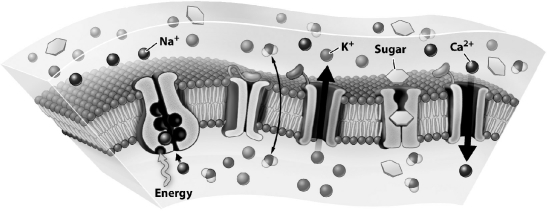 Which solute in the figure is crossing the membrane using simple diffusion?
 (Multiple Choice)
4.9/5 (78)
(78) Which of the following signaling molecules would not be found in animals?
(Multiple Choice)
4.8/5 (84)
(84) Objects suspended in the extracellular fluid can cross the plasma membrane and enter a cell by
(Multiple Choice)
4.9/5 (71)
(71) When the solute concentration outside of a cell is equal to the solute concentration inside of the cell, the cell is in a(n)____________________ solution.
(Short Answer)
4.7/5 (78)
(78) Elevated HDL (high-density lipoprotein)levels seem to provide positive cardiovascular health effects even for individuals with abnormally high blood cholesterol. What best describes the beneficial action of HDL?
(Multiple Choice)
4.9/5 (90)
(90) What best explains the double-headed arrows associated with water, carbon dioxide, and molecular oxygen shown in the illustration below? 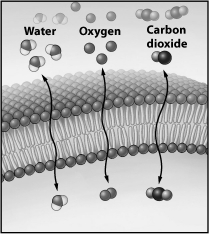
(Multiple Choice)
4.9/5 (69)
(69) Even though the concentration of water in a cell remains constant in an isotonic solution, the random movement of water molecules during ____________________ requires that water be constantly moving in both directions across the plasma membrane.
(Short Answer)
4.9/5 (79)
(79) Why do some hormones, like thyroxin, affect most or all body cells while others only affect a single organ or type of cell?
(Multiple Choice)
4.9/5 (89)
(89) A white blood cell at the site of a puncture wound engulfs a large cluster of bacteria forming a large internal vesicle. This is an example of
(Multiple Choice)
4.9/5 (74)
(74) The figure below shows the movement of solutes across a plasma membrane in the direction indicated by the arrows. 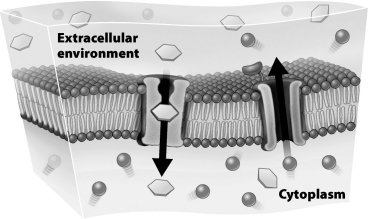 This movement across the membrane
 (Multiple Choice)
4.8/5 (67)
(67) Hikers can detect a dead skunk along a trail long before they actually see it. What process allows the scent of the skunk to be so widely dispersed?
(Multiple Choice)
4.9/5 (76)
(76) To coordinate the contraction of the numerous muscle cells that form the heart, signals must travel rapidly between muscle cells. In order to allow this rapid communication, muscle cells in the heart are connected by
(Multiple Choice)
4.9/5 (67)
(67) After eating a meal high in carbohydrates, the pancreas begins releasing insulin by the process of ____________________.
(Short Answer)
4.8/5 (75)
(75) Passive carrier molecules often require active carrier proteins to provide amino acids for transport.
(True/False)
4.9/5 (77)
(77) 
Filters
- Essay(0)
- Multiple Choice(0)
- Short Answer(0)
- True False(0)
- Matching(0)