Multiple Choice
What best explains the double-headed arrows associated with water, carbon dioxide, and molecular oxygen shown in the illustration below? 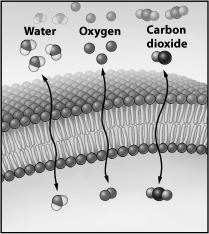
A) Each molecule is unable to cross the membrane, but can be found in relatively large numbers on both sides.
B) The membrane is permeable to these small molecules and they enter or leave rapidly as their concentration gradients change.
C) An isotonic condition exists for each molecule, so no net movement takes place.
D) Homeostasis requires that surplus molecules entering the cell be rejected and returned to the outside.
Correct Answer:

Verified
Correct Answer:
Verified
Q24: The figure below illustrates a plasma membrane.
Q25: Which of the following signaling molecules would
Q26: Objects suspended in the extracellular fluid can
Q27: When the solute concentration outside of a
Q31: Which of the following statements about hormones
Q32: Why do some hormones, like thyroxin, affect
Q48: A white blood cell at the site
Q55: Even though the concentration of water in
Q59: Elevated HDL (high-density lipoprotein)levels seem to provide
Q75: Hydrophilic signaling molecules<br>A) move into cells by