



 Chat with AI
Exam 4: Animalia

Exam 1: The Nature of Science and the Characteristics of Life82 Questions
Exam 2: Biological Diversity, Bacteria, and Archaea101 Questions
Exam 3: Protista, Plantae, and Fungi83 Questions
Exam 4: Animalia81 Questions
Exam 5: The Chemistry of Life92 Questions
Exam 6: Cell Structure and Internal Compartments87 Questions
Exam 7: Cell Membranes, Transport, and Communication85 Questions
Exam 8: Energy, Metabolism, and Enzymes81 Questions
Exam 9: Photosynthesis and Cellular Respiration84 Questions
Exam 10: Cell Division89 Questions
Exam 11: Stem Cells, Cancer, and Human Health93 Questions
Exam 12: Patterns of Inheritance75 Questions
Exam 13: Chromosomes and Human Genetics75 Questions
Exam 14: Dna and Genes105 Questions
Exam 15: From Gene to Protein80 Questions
Exam 16: Dna Technology80 Questions
Exam 17: How Evolution Works80 Questions
Exam 18: Evolution of Populations80 Questions
Exam 19: Speciation and the Origins of Biological Diversity80 Questions
Exam 20: The Evolutionary History of Life100 Questions
Exam 21: The Biosphere89 Questions
Exam 22: Growth of Populations69 Questions
Exam 23: Ecological Communities133 Questions
Exam 24: Ecosystems75 Questions
Exam 25: Global Change70 Questions
Exam 26: Internal Organization and Homeostasis79 Questions
Exam 27: Nutrition and Digestion80 Questions
Exam 28: Circulation and Gas Exchange77 Questions
Exam 29: Animal Hormones78 Questions
Exam 30: Nervous and Sensory Systems78 Questions
Exam 31: Skeletons, Muscles, and Movement78 Questions
Exam 32: Defenses Against Disease78 Questions
Exam 33: Reproduction and Development76 Questions
Exam 34: Animal Behavior76 Questions
Exam 35: Plant Structure, Nutrition, and Transport80 Questions
Exam 36: Plant Growth and Reproduction80 Questions
Select questions type


In all eutherians, and some marsupials, offspring develop internally in association with the ____________________.
(Short Answer)
4.9/5  (81)
(81) A variety of tapeworms can infect humans, but two relatively simple measures can break the infective cycle:
(Multiple Choice)
4.9/5 (86)
(86) The head, thorax, and abdomen of the insect body plan developed as individual segments fused; because each segment originated one pair of appendages a reasonable hypothesis is that the thorax developed when _____ segments fused.
(Multiple Choice)
4.8/5 (64)
(64) Except for the hagfish, lamprey, and their close relatives, all vertebrates have paired jaws; how did jaws form in an evolutionary clade that already had a skeleton?
(Multiple Choice)
4.9/5 (84)
(84) Ctenophores can be distinguished from cnidarians by the presence of a complete digestive system.
(True/False)
4.8/5 (87)
(87) An animal having radial symmetry, a complete gut, and mesoglea would be a(n)____________________.
(Short Answer)
4.9/5 (79)
(79) Because of their abundance and the relative scarcity of other types of vertebrates, the ____________________ era is often called the Age of Reptiles.
(Short Answer)
4.8/5 (71)
(71) Most animals reproduce sexually; fertilization begins a developmental sequence that progresses from
(Multiple Choice)
4.7/5 (81)
(81) Recent analysis of the cell membranes of sponges indicates a much closer relationship to other animals than previously thought.
(True/False)
4.9/5 (84)
(84) Most gardeners are pleased to discover earthworms in their gardens because earthworms improve the soil by
(Multiple Choice)
4.9/5 (83)
(83) Adult sea stars are considered to be radially symmetrical because
(Multiple Choice)
4.9/5 (78)
(78) The success of the amniotic egg was the development of a completely water- and airtight shell that prevented moisture loss.
(True/False)
5.0/5 (75)
(75) Although adult echinoderms display radial symmetry, they are not considered to be closely related to the cnidarians and ctenophores.
(True/False)
4.8/5 (90)
(90) Keratin is an important and widespread structural protein in animals, forming structures as diverse as feathers, toenails, and the carapace of crabs.
(True/False)
4.8/5 (69)
(69) The life cycle for an insect whose developmental strategy is complete metamorphosis is shown below. What advantages are evident from the illustration? 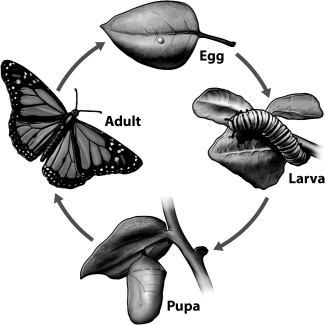
(Multiple Choice)
4.8/5 (69)
(69) Sponges are considered to be the most ancient of animals; although multicellular, sponges have not developed the ____________________ present in all other animals.
(Short Answer)
4.8/5 (90)
(90) The rate of habitat destruction and species loss in the world's tropical rainforests is alarming, perhaps as great as
(Multiple Choice)
4.8/5 (81)
(81) Cephalization is clearly adaptive for the free-living planarians that must locate their food; why would the parasitic flukes and tapeworms retain cephalization?
(Multiple Choice)
4.9/5 (64)
(64) 
Filters
- Essay(0)
- Multiple Choice(0)
- Short Answer(0)
- True False(0)
- Matching(0)