



 Chat with AI
Exam 4: Animalia

Exam 1: The Nature of Science and the Characteristics of Life82 Questions
Exam 2: Biological Diversity, Bacteria, and Archaea101 Questions
Exam 3: Protista, Plantae, and Fungi83 Questions
Exam 4: Animalia81 Questions
Exam 5: The Chemistry of Life92 Questions
Exam 6: Cell Structure and Internal Compartments87 Questions
Exam 7: Cell Membranes, Transport, and Communication85 Questions
Exam 8: Energy, Metabolism, and Enzymes81 Questions
Exam 9: Photosynthesis and Cellular Respiration84 Questions
Exam 10: Cell Division89 Questions
Exam 11: Stem Cells, Cancer, and Human Health93 Questions
Exam 12: Patterns of Inheritance75 Questions
Exam 13: Chromosomes and Human Genetics75 Questions
Exam 14: Dna and Genes105 Questions
Exam 15: From Gene to Protein80 Questions
Exam 16: Dna Technology80 Questions
Exam 17: How Evolution Works80 Questions
Exam 18: Evolution of Populations80 Questions
Exam 19: Speciation and the Origins of Biological Diversity80 Questions
Exam 20: The Evolutionary History of Life100 Questions
Exam 21: The Biosphere89 Questions
Exam 22: Growth of Populations69 Questions
Exam 23: Ecological Communities133 Questions
Exam 24: Ecosystems75 Questions
Exam 25: Global Change70 Questions
Exam 26: Internal Organization and Homeostasis79 Questions
Exam 27: Nutrition and Digestion80 Questions
Exam 28: Circulation and Gas Exchange77 Questions
Exam 29: Animal Hormones78 Questions
Exam 30: Nervous and Sensory Systems78 Questions
Exam 31: Skeletons, Muscles, and Movement78 Questions
Exam 32: Defenses Against Disease78 Questions
Exam 33: Reproduction and Development76 Questions
Exam 34: Animal Behavior76 Questions
Exam 35: Plant Structure, Nutrition, and Transport80 Questions
Exam 36: Plant Growth and Reproduction80 Questions
Select questions type


The vertebrates, which include organisms such as humans, birds, and frogs, illustrate that very different forms can evolve from one basic body plan. The observation that these diverse organisms share a general body plan supports the hypothesis that
(Multiple Choice)
4.8/5  (76)
(76) The conservation organization Ocean Blue has developed a seafood recommendation list that advises avoiding many captive-reared species; why might seafood reared in captivity be less desirable?
(Multiple Choice)
4.9/5 (71)
(71) Sponges have been characterized as lacking tissue; however, recent research indicates that the outer ____________________ interact with one another to create a protective barrier and meet the criteria of a tissue.
(Short Answer)
4.9/5 (83)
(83) Gastropods make extensive use of the radula; which letter on the diagram below indicates its location? 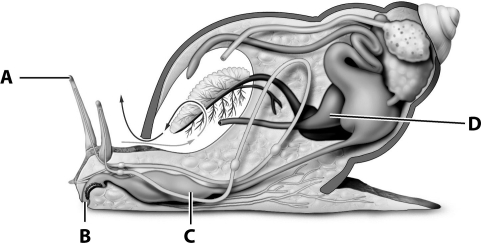
(Multiple Choice)
4.8/5 (83)
(83) Of the labeled features in the diagram below, only the dorsally positioned nerve cord would be present in an echinoderm.
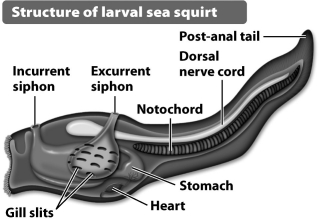
(True/False)
5.0/5 (71)
(71) Two phyla so dominate the diversity of marine ecosystems that any randomly collected animal is likely to be either a _____ or an arthropod.
(Multiple Choice)
4.9/5 (78)
(78) Fossil evidence suggests that feathers existed prior to the development of a flight-capable skeleton; because these feathered animals could not fly, biologists suspect that the initial adaptive value for feathers was related their ability to
(Multiple Choice)
4.9/5 (77)
(77) How do biologists interpret the pattern of species richness shown below? 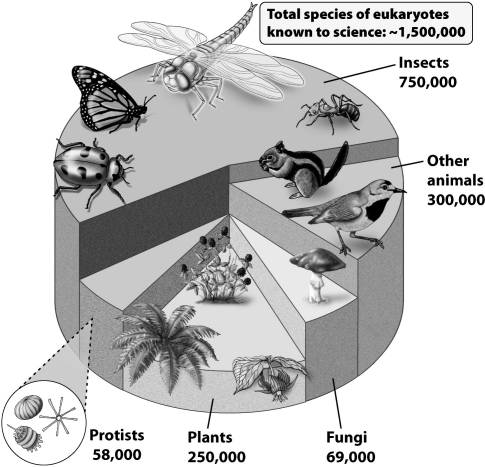
(Multiple Choice)
4.7/5 (85)
(85) The evolution of the lung was a critical development in the adaptation of animals to a terrestrial lifestyle; the first vertebrates to breathe using a lung were the reptiles.
(True/False)
4.9/5 (76)
(76) The addition of a ____________________ to the egg of reptiles and birds permits a longer development time and a more capable individual when hatched.
(Short Answer)
4.8/5 (70)
(70) The figure below shows the vertebrates and arthropods as being distantly related, yet each has features, like limbs and jaws, seen in no other groups. How can such obvious similarities be disregarded in favor of embryological development as a basis for classification? 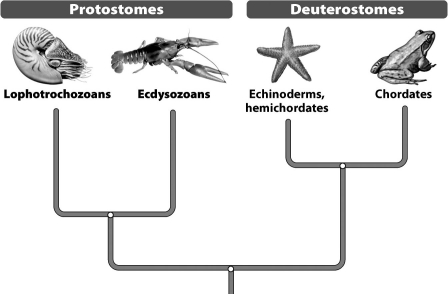
(Multiple Choice)
4.7/5 (76)
(76) Ectothermy describes a strategy to homeostatically regulate a body temperature to be below the ambient temperature; thus leading to the phrase cold-blooded.
(True/False)
4.9/5 (75)
(75) With the exception of the sponges, all animals develop embryologically in one of two ways; the chordates and echinoderms, as deuterostomes,
(Multiple Choice)
4.9/5 (83)
(83) Some mollusks feed on cnidarians, absorb intact cnidocytes, and migrate these cnidocytes into their body surface. What possible benefit could the mollusk derive from this behavior?
(Multiple Choice)
4.8/5 (69)
(69) Endoderm forms the ____________________ layer of an animal embryo.
(Short Answer)
4.9/5 (85)
(85) Recent analysis of the membranes of sponge cells suggests a closer relationship to other animals than previously suspected; if sponges are actually within the eumetazoan clade, as shown in the diagram below, it would require that they possess _____ at some point in their life history. 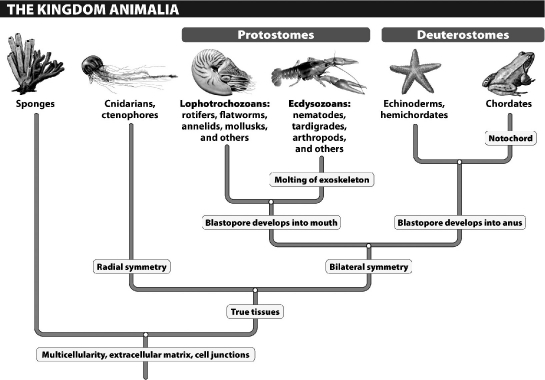
(Multiple Choice)
4.8/5 (83)
(83) Modern sponges produce spicules to deter predation, but as the earliest animals they existed before any predators evolved; how might biologists interpret this observation?
(Multiple Choice)
4.7/5 (82)
(82) The specifics of metamorphosis vary among the arthropods; when the life cycle is characterized by _____ complete metamorphosis has occurred.
(Multiple Choice)
4.7/5 (81)
(81) The success of mammals is due in large part to several highly effective reproductive strategies, which include
(Multiple Choice)
5.0/5 (73)
(73) 
Filters
- Essay(0)
- Multiple Choice(0)
- Short Answer(0)
- True False(0)
- Matching(0)