



 Chat with AI
Exam 4: Animalia

Exam 1: The Nature of Science and the Characteristics of Life82 Questions
Exam 2: Biological Diversity, Bacteria, and Archaea101 Questions
Exam 3: Protista, Plantae, and Fungi83 Questions
Exam 4: Animalia81 Questions
Exam 5: The Chemistry of Life92 Questions
Exam 6: Cell Structure and Internal Compartments87 Questions
Exam 7: Cell Membranes, Transport, and Communication85 Questions
Exam 8: Energy, Metabolism, and Enzymes81 Questions
Exam 9: Photosynthesis and Cellular Respiration84 Questions
Exam 10: Cell Division89 Questions
Exam 11: Stem Cells, Cancer, and Human Health93 Questions
Exam 12: Patterns of Inheritance75 Questions
Exam 13: Chromosomes and Human Genetics75 Questions
Exam 14: Dna and Genes105 Questions
Exam 15: From Gene to Protein80 Questions
Exam 16: Dna Technology80 Questions
Exam 17: How Evolution Works80 Questions
Exam 18: Evolution of Populations80 Questions
Exam 19: Speciation and the Origins of Biological Diversity80 Questions
Exam 20: The Evolutionary History of Life100 Questions
Exam 21: The Biosphere89 Questions
Exam 22: Growth of Populations69 Questions
Exam 23: Ecological Communities133 Questions
Exam 24: Ecosystems75 Questions
Exam 25: Global Change70 Questions
Exam 26: Internal Organization and Homeostasis79 Questions
Exam 27: Nutrition and Digestion80 Questions
Exam 28: Circulation and Gas Exchange77 Questions
Exam 29: Animal Hormones78 Questions
Exam 30: Nervous and Sensory Systems78 Questions
Exam 31: Skeletons, Muscles, and Movement78 Questions
Exam 32: Defenses Against Disease78 Questions
Exam 33: Reproduction and Development76 Questions
Exam 34: Animal Behavior76 Questions
Exam 35: Plant Structure, Nutrition, and Transport80 Questions
Exam 36: Plant Growth and Reproduction80 Questions
Select questions type


During cephalization structures associated with ____________________ and____________________ concentrate at the anterior margin of a bilateral animal.
(Essay)
4.8/5  (72)
(72) The presence of what features(s)would exclude the cnidarians and ctenophores as possibilities for the identity of a newly discovered animal?
(Multiple Choice)
4.8/5 (84)
(84) Neighboring plant or fungi cells share a common cell wall, making multicellularity relatively simple; how do animal cells remain connected to one another?
(Multiple Choice)
4.8/5 (89)
(89) In addition to embryonic similarities the chordates and echinoderms also each possess a hollow nerve cord located on the ____________________ side of the body.
(Short Answer)
4.9/5 (85)
(85) In the diagram below of the flatworm various organs are labeled; which combination of organs forms the flatworm's nervous system? 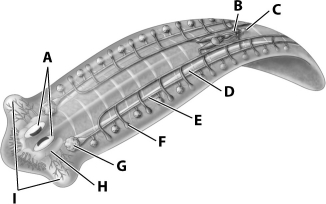
(Multiple Choice)
4.9/5 (68)
(68) The myriapods are a relatively small group of arthropods; its most common members are the ____________________ and ____________________.
(Short Answer)
4.9/5 (94)
(94) The similarity in the cell-adhesion proteins seen in many animal embryos and the colonial chanoflagellates is most reasonably explained as a shared derived trait, and indicates kinship with that group of protists.
(True/False)
4.9/5 (69)
(69) Biologists might have been able to predict that raising lobsters in captivity would be unsuccessful; once a lobster
(Multiple Choice)
4.8/5 (87)
(87) Features like a toothed jaw and a bony tail suggest that Archaeopteryx probably did not fly, possibly using its feathers for insulation or gliding instead of flight.
(True/False)
4.9/5 (95)
(95) Animal body structures and organ systems differentiate predictably from the various layers of the gastrula; which organ system and layer is properly matched?
(Multiple Choice)
4.9/5 (84)
(84) Cnidarians have a gastrovascular cavity rather than a complete gut; in what way(s)would this arrangement be less functional?
(Multiple Choice)
4.7/5 (67)
(67) Mollusks have evolved a variety of defenses; which group is properly matched with its appropriate defensive strategy?
(Multiple Choice)
4.8/5 (77)
(77) Reptiles display many adaptations supporting a terrestrial lifestyle, but _____ is the most significant in reducing their dependency on an aquatic habitat.
(Multiple Choice)
4.7/5 (74)
(74) Cephalopods are demonstrably the most intelligent invertebrate animals; most biologists suspect that their _____ best account(s)for their intellectual development.
(Multiple Choice)
4.7/5 (77)
(77) Rather than mandibles like most arthropods, spiders have fangs, which explains why most spiders
(Multiple Choice)
4.9/5 (87)
(87) Relative brain size (brain weight/total body weight)tends to be largest in the arboreal mammals.
(True/False)
5.0/5 (65)
(65) During the algal blooms called red tides, consumption of bivalves is discouraged and harvesting may be prohibited; what aspect of bivalve life history is responsible for this association?
(Multiple Choice)
4.8/5 (81)
(81) Conservation biologists estimate that 20 percent of the world's bird species that existed 2,000 years ago are now extinct.
(True/False)
4.9/5 (79)
(79) The swim bladder illustrates how an adapted characteristic can be used for a secondary function when environmental pressures change; although first used for buoyancy, it later served as a primitive ____________________.
(Short Answer)
4.8/5 (81)
(81) The vertebrates are grouped into a lineage because all members possess an internal ____________________.
(Short Answer)
4.9/5 (86)
(86) 
Filters
- Essay(0)
- Multiple Choice(0)
- Short Answer(0)
- True False(0)
- Matching(0)