



 Chat with AI
Exam 3: Protista, Plantae, and Fungi

Exam 1: The Nature of Science and the Characteristics of Life82 Questions
Exam 2: Biological Diversity, Bacteria, and Archaea101 Questions
Exam 3: Protista, Plantae, and Fungi83 Questions
Exam 4: Animalia81 Questions
Exam 5: The Chemistry of Life92 Questions
Exam 6: Cell Structure and Internal Compartments87 Questions
Exam 7: Cell Membranes, Transport, and Communication85 Questions
Exam 8: Energy, Metabolism, and Enzymes81 Questions
Exam 9: Photosynthesis and Cellular Respiration84 Questions
Exam 10: Cell Division89 Questions
Exam 11: Stem Cells, Cancer, and Human Health93 Questions
Exam 12: Patterns of Inheritance75 Questions
Exam 13: Chromosomes and Human Genetics75 Questions
Exam 14: Dna and Genes105 Questions
Exam 15: From Gene to Protein80 Questions
Exam 16: Dna Technology80 Questions
Exam 17: How Evolution Works80 Questions
Exam 18: Evolution of Populations80 Questions
Exam 19: Speciation and the Origins of Biological Diversity80 Questions
Exam 20: The Evolutionary History of Life100 Questions
Exam 21: The Biosphere89 Questions
Exam 22: Growth of Populations69 Questions
Exam 23: Ecological Communities133 Questions
Exam 24: Ecosystems75 Questions
Exam 25: Global Change70 Questions
Exam 26: Internal Organization and Homeostasis79 Questions
Exam 27: Nutrition and Digestion80 Questions
Exam 28: Circulation and Gas Exchange77 Questions
Exam 29: Animal Hormones78 Questions
Exam 30: Nervous and Sensory Systems78 Questions
Exam 31: Skeletons, Muscles, and Movement78 Questions
Exam 32: Defenses Against Disease78 Questions
Exam 33: Reproduction and Development76 Questions
Exam 34: Animal Behavior76 Questions
Exam 35: Plant Structure, Nutrition, and Transport80 Questions
Exam 36: Plant Growth and Reproduction80 Questions
Select questions type


Speculate on the diversity of life on Earth if plants had never evolved.
(Multiple Choice)
4.7/5  (82)
(82) The modification allowing a plant to detect explosives involves a natural response designed to detect biologically relevant situations like ____________________.
(Short Answer)
4.8/5 (77)
(77) Note the location of the air bladders in the illustration below of the kelp; how might these structures represent an adaptive advantage? 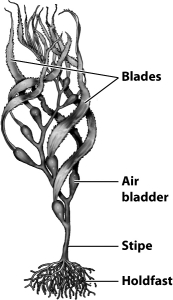
(Multiple Choice)
4.9/5 (81)
(81) Which statement best summarizes the adaptive value of phloem?
(Multiple Choice)
4.9/5 (88)
(88) What capability did the development of a vascular system provide?
(Multiple Choice)
4.8/5 (73)
(73) Without angiosperms, bryophyte reproduction would almost entirely cease.
(True/False)
5.0/5 (65)
(65) Researchers are attempting to develop a plant that will turn from green to white when in the presence of minute amounts of explosives; what plant molecule needs to be removed from the leaf surface for the system to function as intended?
(Multiple Choice)
4.9/5 (99)
(99) The evolutionary tree below illustrates the hypothesized relationships among the six kingdoms and the three domains. 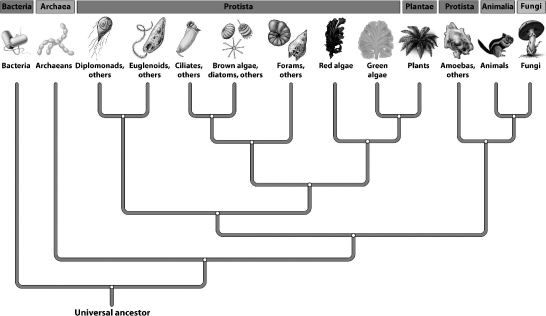 Many biologists have suggested revising the kingdom Protista. One current problem with the protists, as shown in the figure, is that
 (Multiple Choice)
4.8/5 (87)
(87) What best explains the differences in shoot weight shown in the graph below? 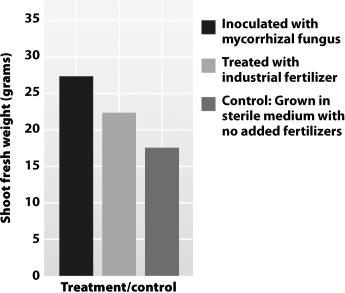
(Multiple Choice)
4.9/5 (79)
(79) In addition to a process similar to binary fission, some eukaryotes can also reproduce asexually by
(Multiple Choice)
4.8/5 (74)
(74) Fungi contribute to several important ecosystem services; among the most important is ____________________ organic matter.
(Short Answer)
4.9/5 (75)
(75) Sexual reproduction requires the fusion of special cells called ____________________.
(Short Answer)
5.0/5 (80)
(80) Eukaryotes display the earliest version of sexual reproduction, whereby
(Multiple Choice)
5.0/5 (76)
(76) Some plants rely on nocturnal bats for pollination rather than insects; in what way might these plants differ from those pollinated by insects?
(Multiple Choice)
4.8/5 (70)
(70) Imagine the discovery of an undescribed nonphotosynthetic multicellular organism. To determine whether it is a(n)_____, you would need to examine it microscopically to determine if its _____.
(Multiple Choice)
5.0/5 (74)
(74) The majority of protists are motile, enabling heterotrophic species to locate organic resources and autotrophic species to orient to sunlight.
(True/False)
4.8/5 (88)
(88) The single-celled protists are often mobile, moving within the environment by means of
(Multiple Choice)
4.8/5 (69)
(69) Which statement best summarizes the adaptive value of xylem?
(Multiple Choice)
4.9/5 (74)
(74) One reason plants can live on land is because they have developed a ____________________, which facilitates the distribution of water and nutrients obtained from the soil.
(Short Answer)
4.8/5 (99)
(99) Sexual reproduction can be observed in all the Eukaryan kingdoms, although not in all Eukaryan species.
(True/False)
4.8/5 (92)
(92) 
Filters
- Essay(0)
- Multiple Choice(0)
- Short Answer(0)
- True False(0)
- Matching(0)