



 Chat with AI
Exam 23: The Metabolism of Nitrogen

Exam 1: Biochemistry and the Organization of Cells73 Questions
Exam 2: Water: the Solvent for Biochemical Reactions85 Questions
Exam 3: Amino Acids and Peptides75 Questions
Exam 4: The Three-Dimensional Structure of Proteins82 Questions
Exam 5: Protein Purification and Characterization Techniques67 Questions
Exam 6: The Behavior of Proteins: Enzymes83 Questions
Exam 7: The Behavior of Proteins: Enzymes, Mechanisms, and Control81 Questions
Exam 8: Lipids and Proteins Are Associated in Biological Membranes90 Questions
Exam 9: Nucleic Acids: How Structure Conveys Information66 Questions
Exam 10: Biosynthesis of Nucleic Acids: Replication86 Questions
Exam 11: Transcription of the Genetic Code: Biosynthesis of RNA98 Questions
Exam 12: Protein Synthesis: Translation of the Genetic Message85 Questions
Exam 13: Nucleic Acid Biotechnology Techniques94 Questions
Exam 14: Viruses, Cancer, and Immunology42 Questions
Exam 15: The Importance of Energy Changes and Electron Transfer in Metabolism60 Questions
Exam 16: Carbohydrates92 Questions
Exam 17: Glycolysis67 Questions
Exam 18: Storage Mechanisms and Control in Carbohydrate Metabolism82 Questions
Exam 19: The Citric Acid Cycle80 Questions
Exam 20: Electron Transport and Oxidative Phosphorylation66 Questions
Exam 21: Lipid Metabolism95 Questions
Exam 22: Photosynthesis74 Questions
Exam 23: The Metabolism of Nitrogen78 Questions
Exam 24: Integration of Metabolism: Cellular Signaling68 Questions
Select questions type


The following two amino acids are key to the transfers of amino groups during breakdown and synthesis of amino acids.
(Multiple Choice)
4.9/5  (84)
(84) Glycine, alanine, serine, histidine, tryptophan, CTP, AMP, and carbamoyl-phosphate all have what in common?
(Multiple Choice)
4.8/5 (78)
(78) While the reduction of nitrogen to ammonia in plants follows the same net chemical reaction, the source of electrons for the process varies from plant to plant.
(True/False)
4.9/5 (90)
(90) Nitrogen fixation in legumes may use as much as half of the ATP made in the plant.
(True/False)
4.9/5 (92)
(92) In the urea cycle, the molecule that is synthesized in the cytosol and transported to the mitochondrial matrix for subsequent reaction is
(Multiple Choice)
5.0/5 (81)
(81) The conversion of glutamate to glutamine is catalyzed by glutamine synthetase and requires ATP.
(True/False)
4.7/5 (80)
(80) Which of the following compounds does not serve as an intermediate for the entry of amino acid carbon chains into the major metabolic pathways?
(Multiple Choice)
4.9/5 (79)
(79) Pyridoxal phosphate forms a Schiff base with amino groups in transaminase reactions.
(True/False)
4.8/5 (82)
(82) Which group of small molecules best fit the boxes associated with the reaction shown? 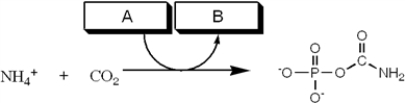 I. 2 2+ II. ATP + III. ATP IV. NADPH
 (Multiple Choice)
4.9/5 (79)
(79) The form in which nitrogen waste is removed from the body is dependent mostly on the organism's availability of water.
(True/False)
4.8/5 (79)
(79) The nitrogen-fixing enzyme system, nitrogenase, is found exclusively in
(Multiple Choice)
4.7/5 (70)
(70) A metabolic intermediate that is not a precursor for an amino acid family is
(Multiple Choice)
4.9/5 (74)
(74) If an amino acid's degradation pathway leads to α-ketoglutarate, is it glucogenic?
(Multiple Choice)
4.8/5 (80)
(80) Kwashiorkor is a malnutrition disease in which high quality proteins are lacking, even if enough calories are available for survival.
(True/False)
4.9/5 (76)
(76) Which of the following is not an intermediate in the urea cycle?
(Multiple Choice)
5.0/5 (72)
(72) The initial, common intermediate in purine catabolism for both AMP and GMP is
(Multiple Choice)
4.8/5 (77)
(77) 
Filters
- Essay(0)
- Multiple Choice(0)
- Short Answer(0)
- True False(0)
- Matching(0)