



 Chat with AI
Exam 14: Valuation: Market-Based Approaches

Exam 1: Overview of Financial Reporting, financial Statement Analysis, and Valuation101 Questions
Exam 2: Asset and Liability Valuation and Income Measurement81 Questions
Exam 3: Income Flows Versus Cash Flows: Understanding the Statement of Cash Flows88 Questions
Exam 4: Profitability Analysis97 Questions
Exam 5: Risk Analysis86 Questions
Exam 6: Accounting Quality64 Questions
Exam 7: Financing Activities66 Questions
Exam 8: Investing Activities100 Questions
Exam 9: Operating Activities94 Questions
Exam 10: Forecasting Financial Statements63 Questions
Exam 11: Risk-Adjusted Expected Rates of Return and the Dividends Valuation Approach52 Questions
Exam 12: Valuation: Cash-Flow-Based Approaches65 Questions
Exam 13: Valuation: Earnings-Based Approaches67 Questions
Exam 14: Valuation: Market-Based Approaches64 Questions
Select questions type


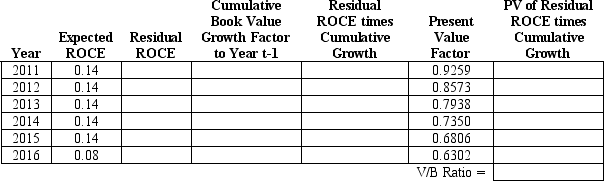
Assume an analyst is evaluating a firm with $1,000 of book value of common equity and a cost of equity capital equal to 8 percent.Assume that the analyst forecasts that the firm will earn ROCE of 14 percent until year 2016,when the firm will start earning ROCE equal to 8 percent.The company pays no dividends and will not engage in any stock transactions.Use this information to complete the following table and calculate the firm's value-to-book ratio.
(Essay)
4.9/5  (73)
(73) All of the following are accounting factors that can drive a firm's price-earnings ratio in a given period to be higher than that of other firms in the same industry except:
(Multiple Choice)
5.0/5 (79)
(79) Industries with relatively high market-to-book ratios are more likely to have ___________________________________ assets.
(Short Answer)
4.7/5 (89)
(89) Which of the following normally does not introduce measurement error into the calculation of P/E ratios?
(Multiple Choice)
4.8/5 (83)
(83) 
Filters
- Essay(0)
- Multiple Choice(0)
- Short Answer(0)
- True False(0)
- Matching(0)