



 Chat with AI
Exam 1: Scarcity and Choice

Exam 1: Scarcity and Choice78 Questions
Exam 2: Market Transactions: Demand and Supply Analysis93 Questions
Exam 3: Demand and Supply Applications92 Questions
Exam 4: Production and the Costs of Production77 Questions
Exam 5: Competition and Monopoly: Virtues and Vices92 Questions
Exam 6: Imperfect Competition90 Questions
Exam 7: Labor Markets86 Questions
Exam 8: Government and Markets89 Questions
Exam 9: The Mixed Economy of the United States80 Questions
Exam 10: Gross Domestic Product and Economic Growth87 Questions
Exam 11: The Business Cycle, Unemployment, and Inflation87 Questions
Exam 12: Macroeconomic Instability: Aggregate Demand and Aggregate Supply78 Questions
Exam 13: Fiscal Policy and the Federal Budget90 Questions
Exam 14: Money and the Banking System92 Questions
Exam 15: The Federal Reserve and Monetary Policy84 Questions
Exam 16: The United States and the Global Economy84 Questions
Exam 17: International Finance70 Questions
Exam 18: Economic Systems and Developing Countries76 Questions
Select questions type


Suppose that one hour of additional studying would raise a students's score on an exam by an additional 5 points. What can we conclude from this?
(Multiple Choice)
4.7/5  (82)
(82) Economic models are built from words, diagrams, and/or mathematical equations.
(True/False)
4.9/5 (65)
(65) A(n) ______ is a person who organizes, manages, and assembles the other factors of production to produce goods and services.
(Multiple Choice)
4.9/5 (89)
(89) In the 1970s, Japanese and European steel companies were able to increase their productivity relative to U.S. steel companies when they
(Multiple Choice)
4.8/5 (85)
(85) Table 1.1. U.S. Production Possibilities Curve Data
A B C D E F Capital goods 5 4 3 2 1 0 Consumer goods 0 12 22 30 36 40
-Refer to Table 1.1. Points A, B, C, D, E and F are
(Multiple Choice)
5.0/5 (85)
(85) FedEx, founded by entrepreneur Frederick Smith, was an overnight success in 1971.
(True/False)
4.9/5 (72)
(72) Which of the following countries faced U.S. economic sanctions in the 1980's to fight discriminatory laws and practices?
(Multiple Choice)
4.9/5 (72)
(72) Assuming that rational people are motivated by incentives, what would occur if the average salary of finance majors rises by 30 percent and the average salary of philosophy majors remains constant?
(Multiple Choice)
4.8/5 (85)
(85) A point located on a production possibilities curve represents
(Multiple Choice)
4.7/5 (75)
(75) In the studying example given in the text, how was the relationship between study time and course grade depicted graphically?
(Multiple Choice)
4.8/5 (76)
(76) Figure 1.1 U.S. Production Possibilities Curve
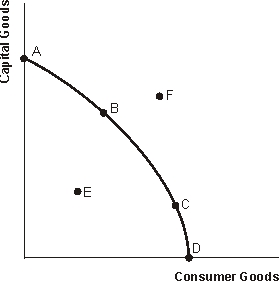 -Refer to Figure 1.1. Which current production alternative would best induce increases in the economy's future production capabilities in the long run?
 (Multiple Choice)
4.7/5 (81)
(81) Which of the following statements about consumer goods is false?
(Multiple Choice)
5.0/5 (79)
(79) Figure 1.1 U.S. Production Possibilities Curve
-Refer to Figure 1.1. If the economy moves from point A to point B, it will produce
-Refer to Figure 1.1. If the economy moves from point A to point B, it will produce (Multiple Choice)
4.9/5 (80)
(80) As a factor of production, capital includes money that is used to finance the purchase of plants and equipment.
(True/False)
4.7/5 (70)
(70) According to the "economic way of thinking," every choice has a cost, people make better choices by thinking at the margin, and people act as if they are motivated by self-interest.
(True/False)
4.9/5 (61)
(61) The opportunity cost of taking a trip to Disneyland includes the money you
(Multiple Choice)
4.9/5 (80)
(80) 
Filters
- Essay(0)
- Multiple Choice(0)
- Short Answer(0)
- True False(0)
- Matching(0)