



 Chat with AI
Exam 15: The Federal Reserve and Monetary Policy

Exam 1: Scarcity and Choice78 Questions
Exam 2: Market Transactions: Demand and Supply Analysis93 Questions
Exam 3: Demand and Supply Applications92 Questions
Exam 4: Production and the Costs of Production77 Questions
Exam 5: Competition and Monopoly: Virtues and Vices92 Questions
Exam 6: Imperfect Competition90 Questions
Exam 7: Labor Markets86 Questions
Exam 8: Government and Markets89 Questions
Exam 9: The Mixed Economy of the United States80 Questions
Exam 10: Gross Domestic Product and Economic Growth87 Questions
Exam 11: The Business Cycle, Unemployment, and Inflation87 Questions
Exam 12: Macroeconomic Instability: Aggregate Demand and Aggregate Supply78 Questions
Exam 13: Fiscal Policy and the Federal Budget90 Questions
Exam 14: Money and the Banking System92 Questions
Exam 15: The Federal Reserve and Monetary Policy84 Questions
Exam 16: The United States and the Global Economy84 Questions
Exam 17: International Finance70 Questions
Exam 18: Economic Systems and Developing Countries76 Questions
Select questions type


Figure 15.1 Aggregate Supply and Aggregate Demand
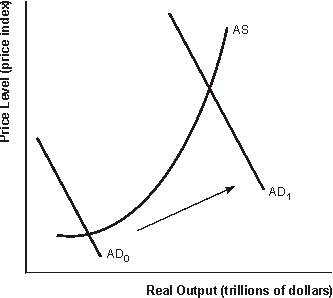 -Refer to Figure 15.1. If the Fed's goal is to increase AD0 to AD1 through monetary policy, it may have trouble doing so because
 (Multiple Choice)
5.0/5  (79)
(79) Which component of aggregate demand tends to be most sensitive to changes in interest rates by the Federal Reserve?
(Multiple Choice)
4.8/5 (91)
(91) The main argument for Federal Reserve independence is that monetary policy-which affects inflation, employment, growth, and exchange rates-is too important to be determined by politicians.
(True/False)
4.7/5 (74)
(74) 
Filters
- Essay(0)
- Multiple Choice(0)
- Short Answer(0)
- True False(0)
- Matching(0)