



 Chat with AI
Exam 5: The Economics of Environmental Regulation I: Emission Standards and Effluent Charge

Exam 1: The Natural Environment and the Human Economy: the Neoclassical Perspective25 Questions
Exam 2: The Natural Environment and the Human Economy: an Ecological Perspective25 Questions
Exam 3: Ecological and Technological Determinants of the Trade-Off Between Economic Activity and Environmental Quality25 Questions
Exam 4: The Economic Theory of Pollution Control25 Questions
Exam 5: The Economics of Environmental Regulation I: Emission Standards and Effluent Charge25 Questions
Exam 6: The Economics of Environmental Regulation Ii: Transferable Emission Credits, and the Macroeconomic Effects of Environmental Regulation25 Questions
Exam 7: Alternative Methods of Valuation of Environmental Goods and Services25 Questions
Exam 8: Frameworks for Assessing the Worthiness of Environmental Projects25 Questions
Exam 9: The Economics of Climate Change25 Questions
Exam 10: The Economics of Biodiversity25 Questions
Exam 11: Biophysical Limits to Economic Growth: the Malthusianneo-Malthusianecological Economics Perspectives25 Questions
Exam 12: Biophysical Limits to Economic Growth: the Neoclassical Perspective25 Questions
Exam 13: The Economics of Sustainability25 Questions
Exam 14: Green Accounting and Alternative Indicators of Sustainability25 Questions
Select questions type


When a polluter has many options for pollution control, then technology standards are
best among those options.
(True/False)
4.7/5  (94)
(94) Emission standards, effluent charges and transferable emission credits favor a centralized
or command-and-control approach to pollution control.
(True/False)
4.8/5 (67)
(67) Figure 5C
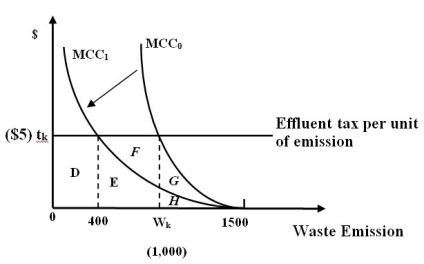 -Refer to Figure 5C. In Figure 5C, a polluting firm is subjected to an effluent charge of tk per unit of emission. Assume that the shift of this firm's marginal control cost curve
from MCC0 to MCC1 is caused by an introduction of a new and improved method of
pollution control. Which of the following statements does not apply to Figure 5C?
-Refer to Figure 5C. In Figure 5C, a polluting firm is subjected to an effluent charge of tk per unit of emission. Assume that the shift of this firm's marginal control cost curve
from MCC0 to MCC1 is caused by an introduction of a new and improved method of
pollution control. Which of the following statements does not apply to Figure 5C? (Multiple Choice)
4.9/5 (83)
(83) Figure 5C
-Refer to Figure 5C. In Figure 5C, a polluting firm is subjected to an effluent charge of tk per unit of emission. Assume that the shift of this firm's marginal control cost curve from MCC0 to MCC1 is caused by an introduction of a new and improved method of pollution control. Which of the following statements applies to Figure 5C?
-Refer to Figure 5C. In Figure 5C, a polluting firm is subjected to an effluent charge of tk per unit of emission. Assume that the shift of this firm's marginal control cost curve from MCC0 to MCC1 is caused by an introduction of a new and improved method of pollution control. Which of the following statements applies to Figure 5C? (Multiple Choice)
4.9/5 (84)
(84) The double dividend feature of pollution tax is an important advantage that an effluent
charge has over emission standards.
(True/False)
4.8/5 (80)
(80) 
Filters
- Essay(0)
- Multiple Choice(0)
- Short Answer(0)
- True False(0)
- Matching(0)