



 Chat with AI
Exam 12: Biophysical Limits to Economic Growth: the Neoclassical Perspective

Exam 1: The Natural Environment and the Human Economy: the Neoclassical Perspective25 Questions
Exam 2: The Natural Environment and the Human Economy: an Ecological Perspective25 Questions
Exam 3: Ecological and Technological Determinants of the Trade-Off Between Economic Activity and Environmental Quality25 Questions
Exam 4: The Economic Theory of Pollution Control25 Questions
Exam 5: The Economics of Environmental Regulation I: Emission Standards and Effluent Charge25 Questions
Exam 6: The Economics of Environmental Regulation Ii: Transferable Emission Credits, and the Macroeconomic Effects of Environmental Regulation25 Questions
Exam 7: Alternative Methods of Valuation of Environmental Goods and Services25 Questions
Exam 8: Frameworks for Assessing the Worthiness of Environmental Projects25 Questions
Exam 9: The Economics of Climate Change25 Questions
Exam 10: The Economics of Biodiversity25 Questions
Exam 11: Biophysical Limits to Economic Growth: the Malthusianneo-Malthusianecological Economics Perspectives25 Questions
Exam 12: Biophysical Limits to Economic Growth: the Neoclassical Perspective25 Questions
Exam 13: The Economics of Sustainability25 Questions
Exam 14: Green Accounting and Alternative Indicators of Sustainability25 Questions
Select questions type


Figure A 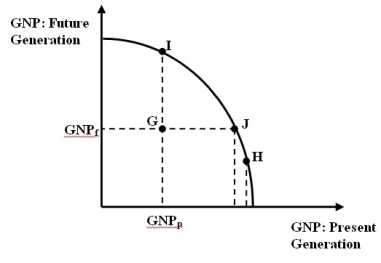 -Refer to Figure A. Which of the following moves would benefit at least one of the generations without affecting the well being of the other generation?
Free
(Multiple Choice)
4.8/5  (75)
(75) Correct Answer: Verified
E
Which of the following statements about strong sustainability is correct?
Free
(Multiple Choice)
4.8/5 (80)
(80) Correct Answer:Verified
VerifiedE
With weak sustainability, the transfer of the capital stock from one generation to the next
can be in any form.
Free
(True/False)
4.7/5 (68)
(68) Correct Answer:Verified
VerifiedTrue
The neoclassical approach to sustainability assumes that natural capital is a nonbinding
constraint on sustainability.
(True/False)
4.8/5 (71)
(71) The Brundtland Commission Report definition of sustainable development implies that
development is measured through increases in the production of goods and services.
(True/False)
4.8/5 (78)
(78) Which one of the following statements best describes a difference between weak and strong sustainability?
(Multiple Choice)
4.9/5 (77)
(77) The Brundtland Commission Report definition of sustainable development is consistent
with the theoretical frameworks for sustainability developed by followers of both the
neoclassical and ecological schools of economics.
(True/False)
4.7/5 (83)
(83) The earliest attempt to construct a theoretical model of a sustainable economy with an
explicit account of biophysical limits traces its roots to Herman Daly in 2007.
(True/False)
4.8/5 (86)
(86) Weak sustainability allows an economy a great deal of flexibility since the various types
of capital stocks are considered to be close substitutes.
(True/False)
4.8/5 (85)
(85) The Hartwick sustainability rule states that maintaining constant real consumption of
goods and services is possible even in the presence of exhaustible resources.
(True/False)
4.8/5 (77)
(77) The neoclassical economics variation of sustainability is most commonly referred to as
weak sustainability because it renders natural capital as an absolute necessity for
sustaining net national income.
(True/False)
5.0/5 (73)
(73) The Brundtland Commission Report definition of sustainability has a very strong ethical
component.
(True/False)
4.7/5 (80)
(80) In which of the following ways does the safe minimum standard (SMS) approach to sustainability does not invalidate the standard economics approach to resource assessment and management?
(Multiple Choice)
4.8/5 (80)
(80) The Brundtland Commission Report attempted to define sustainable development as
development which meets the needs of the future.
(True/False)
4.8/5 (77)
(77) The safe minimum standard approach in practice really mimics the neoclassical approach
to sustainability.
(True/False)
4.9/5 (84)
(84) A 'general' rule of sustainability criterion is to achieve which of the following?
(Multiple Choice)
4.9/5 (81)
(81) Figure A
-Refer to Figure A. Which of the following is correct?
-Refer to Figure A. Which of the following is correct? (Multiple Choice)
4.8/5 (90)
(90) Figure A
-Refer to Figure A. Which of the following is correct concerning a move from point G to point H?
-Refer to Figure A. Which of the following is correct concerning a move from point G to point H? (Multiple Choice)
4.8/5 (70)
(70) 
Filters
- Essay(0)
- Multiple Choice(0)
- Short Answer(0)
- True False(0)
- Matching(0)