



 Chat with AI
Exam 6: The Economics of Environmental Regulation Ii: Transferable Emission Credits, and the Macroeconomic Effects of Environmental Regulation

Exam 1: The Natural Environment and the Human Economy: the Neoclassical Perspective25 Questions
Exam 2: The Natural Environment and the Human Economy: an Ecological Perspective25 Questions
Exam 3: Ecological and Technological Determinants of the Trade-Off Between Economic Activity and Environmental Quality25 Questions
Exam 4: The Economic Theory of Pollution Control25 Questions
Exam 5: The Economics of Environmental Regulation I: Emission Standards and Effluent Charge25 Questions
Exam 6: The Economics of Environmental Regulation Ii: Transferable Emission Credits, and the Macroeconomic Effects of Environmental Regulation25 Questions
Exam 7: Alternative Methods of Valuation of Environmental Goods and Services25 Questions
Exam 8: Frameworks for Assessing the Worthiness of Environmental Projects25 Questions
Exam 9: The Economics of Climate Change25 Questions
Exam 10: The Economics of Biodiversity25 Questions
Exam 11: Biophysical Limits to Economic Growth: the Malthusianneo-Malthusianecological Economics Perspectives25 Questions
Exam 12: Biophysical Limits to Economic Growth: the Neoclassical Perspective25 Questions
Exam 13: The Economics of Sustainability25 Questions
Exam 14: Green Accounting and Alternative Indicators of Sustainability25 Questions
Select questions type


Strictly enforced environmental policy could, in effect, force firms to adopt
efficient pollution abatement technology, which will lead to a competitive
advantage in the long-term.

Free
(True/False)
4.9/5  (80)
(80) Correct Answer: Verified
True
A system of transferable credits operates on the basis that there is a legally
sanctioned right to pollute.
Free
(True/False)
4.9/5 (68)
(68) Correct Answer:Verified
VerifiedTrue
Figure 6A
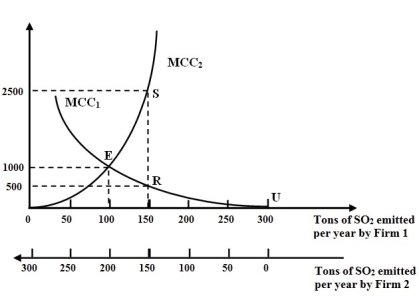 -Refer to Figure 6A. Why do the two firms not pollute at points R and S respectively when pollution credits and regulations exist ?
Free
(Multiple Choice)
4.9/5 (90)
(90) Correct Answer:Verified
VerifiedD
What does the empirical evidence, on the whole, concerning the relationships between environmental protection, the economy, and jobs reveal?
(Multiple Choice)
4.9/5 (61)
(61) In the United States, the acid rain program (ARP), was established under Title IV
of the 2009 Clean Air Act Amendment which requires major emission reduction
of sulfur dioxide (SO2) and nitrogen oxide (nox).
(True/False)
4.9/5 (77)
(77) Which of the following is a (are) characteristic(s) of the US acid rain program?
(Multiple Choice)
4.8/5 (74)
(74) There has been considerable resistance in the application of emission trading
program particularly in the member states of the European Union (EU) and some Latin American countries.
(True/False)
4.9/5 (79)
(79) Although not a human health issue, the accumulation over time of sulfur dioxide
(SO2) and acid rain depositions on lakes, streams, and forests are believed to
cause substantial damage to aquatic organisms and trees.
(True/False)
4.7/5 (70)
(70) A bubble policy is generally used by a firm that has only one source of pollution
so that it remains in compliance with a set emission standard.
(True/False)
4.9/5 (87)
(87) Figure 6A
-Refer to Figure 6A. Assume that government regulation limits sulfur dioxide emissions to 150 tons per year. Also assume that Firm 1 cannot reduce its emissions below 100 tons per year. Which of the following would apply in this situation?
-Refer to Figure 6A. Assume that government regulation limits sulfur dioxide emissions to 150 tons per year. Also assume that Firm 1 cannot reduce its emissions below 100 tons per year. Which of the following would apply in this situation? (Multiple Choice)
4.8/5 (63)
(63) In the presence of uncertainty, when control costs that are higher than expected, a
regulatory scheme based on transferable pollution credits can result in a cleanup
costing more than the socially optimal level.
(True/False)
4.8/5 (79)
(79) Which one of the following statements about a system of tradable carbon permits is false?
(Multiple Choice)
4.8/5 (83)
(83) Underestimation of the cost of environmental regulations remains a serious
concern.
(True/False)
4.9/5 (80)
(80) The banking policy allows firms to use their initial credit allotment over time.
(True/False)
4.8/5 (101)
(101) Hot-spots are any areas that contain high local concentration of any pollutant.
(True/False)
4.7/5 (91)
(91) The purpose for creating a tradable emission credit system is to substitute the
market for pollution rights.
(True/False)
4.9/5 (80)
(80) Transferable credits work better when the number of parties involved in the
exchange of credit are limited or capped.
(True/False)
4.9/5 (82)
(82) Which of the following would allow a polluter to treat all its different types of sources of pollution as a single source?
(Multiple Choice)
4.8/5 (85)
(85) 
Filters
- Essay(0)
- Multiple Choice(0)
- Short Answer(0)
- True False(0)
- Matching(0)