



 Chat with AI
Exam 1: Origins of Human Language

Exam 1: Origins of Human Language50 Questions
Exam 2: Language and the Brain41 Questions
Exam 3: Learning Sound Patterns46 Questions
Exam 4: Learning Words53 Questions
Exam 5: Learning the Structure of Sentences45 Questions
Exam 6: Speech Perception40 Questions
Exam 7: Word Recognition43 Questions
Exam 8: Understanding Sentence Structure and Meaning46 Questions
Select questions type


Six-year old Olivia has trouble expressing herself verbally and seems to have an abnormally short working memory span. Doctors have not been able to find any specific neurological or physiological problems, but her twin sister, Jane, seems to have similar impairments. If you were her pediatrician, which of the following disorders of speech would you believe was affecting Olivia?
(Multiple Choice)
4.9/5  (77)
(77) In terms of social cognition and intention, how does human pointing behavior tend to differ from ape pointing behavior?
(Essay)
5.0/5 (81)
(81) Senghas et al. (2004) noticed that during the formation and evolution of Nicaraguan Sign Language, purely gestural signs tended to develop a more linguistic style as the sign language evolved from earlier to later "generations" of signers. How would a late-generation signer of NSL describe a bird flying up?
(Essay)
4.7/5 (94)
(94) A 30-month-old child, who at 6 months engaged relatively little with her parents in joint-attention activities, is expected to _________ than a 30-month-old who had at 6 months engaged more in joint-attention activities.
(Multiple Choice)
4.8/5 (77)
(77) Even though vervet monkeys seem to be able to produce specific distress calls from birth without the benefit of experience, they acquire the ability to respond appropriately to those calls only after several months of life, presumably due to experience. This finding suggests that
(Multiple Choice)
4.8/5 (97)
(97) Refer to the figure shown here.
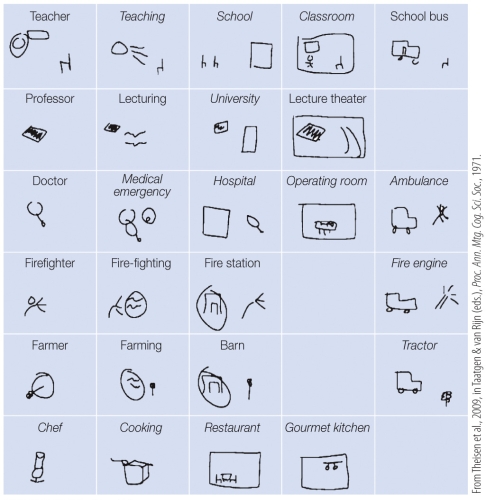 Consider the drawings and the words they represent from Theisen et al. (2010). Explain how the participants' synthetic language "evolved" over the course of the experiment and what these changes imply about how other languages have evolved over time.
 (Essay)
4.9/5 (88)
(88) Keith and Cathy Hayes (1951) were able to teach Viki, a young female chimpanzee, to
(Multiple Choice)
4.8/5 (78)
(78) Researchers have found that chimpanzees are not able to understand pointing cues but dogs are able to do so. This suggests that compared to chimpanzees, dogs
(Multiple Choice)
4.7/5 (86)
(86) Which statement conveys the most accurate comparison of spoken English and American Sign Language (ASL)?
(Multiple Choice)
4.9/5 (86)
(86) Do you agree with the nativist view of the evolution of language? Provide evidence to support your argument.
(Essay)
4.9/5 (74)
(74) An example of Hockett's productivity characteristic in non-human primate communication would be demonstrated by an ape making the sign for
(Multiple Choice)
4.9/5 (91)
(91) The difference between a monkey sounding an alarm call and a bird mimicking sounds from its environment is that the bird is using a(n)
(Multiple Choice)
4.8/5 (83)
(83) Which scenario would most likely result in significant language change?
(Multiple Choice)
4.9/5 (86)
(86) Research suggests that human children produce more examples of _______ communication than apes, who produce primarily _______ messages.
(Multiple Choice)
4.9/5 (64)
(64) Chomsky suggested that human knowledge must have a(n) _______ component, as evidenced by the slave boy/Pythagorean theorem dialogue demonstration.
(Multiple Choice)
4.8/5 (80)
(80) How does the use of gesture by apes in the wild differ from the use of alarm calls by vervet monkeys? Which more closely resembles the linguistic behavior of humans?
(Essay)
4.8/5 (82)
(82) Cross-fostering experiments suggest that the main reason primates do not produce human-like variety in their vocalizations is because apes
(Multiple Choice)
5.0/5 (85)
(85) Explain how comparative studies can help us understand various species' cognitive abilities, and give an example of a comparative study.
(Essay)
4.9/5 (95)
(95) If a child is taught a foreign language during her sensitive period in language development, she will
(Multiple Choice)
4.9/5 (84)
(84) 
Filters
- Essay(0)
- Multiple Choice(0)
- Short Answer(0)
- True False(0)
- Matching(0)