



 Chat with AI
Exam 2: Language and the Brain

Exam 1: Origins of Human Language50 Questions
Exam 2: Language and the Brain41 Questions
Exam 3: Learning Sound Patterns46 Questions
Exam 4: Learning Words53 Questions
Exam 5: Learning the Structure of Sentences45 Questions
Exam 6: Speech Perception40 Questions
Exam 7: Word Recognition43 Questions
Exam 8: Understanding Sentence Structure and Meaning46 Questions
Select questions type


When designing an fMRI study, which would be the best strategy for isolating the neural activity associated with the vocal component of reading a word from other potential actions related to reading?
(Multiple Choice)
4.9/5  (78)
(78) Which would you expect to be especially difficult for a patient with Broca's aphasia?
(Multiple Choice)
4.9/5 (72)
(72) Voxel-based lesion-symptom mapping (VLSM) is most useful because it allows researchers to
(Multiple Choice)
4.7/5 (89)
(89) Imagine that you are a psycholinguist working with a deaf ASL signer who is having trouble remembering and producing ASL signs that they once knew well but is able to carry out actions such as pouring coffee. Would you expect that any brain damage that you found would be in language-specific brain areas such as Broca's or motor-specific areas such as the primary motor cortex?
(Essay)
4.8/5 (94)
(94) In a 2004 fMRI study of word reading, Olaf Hauk and his colleagues demonstrated that language-specific brain regions
(Multiple Choice)
4.8/5 (87)
(87) The symptoms exhibited by _______ and _______ illustrate a double dissociation.
(Multiple Choice)
4.8/5 (91)
(91) During a visit to a coffee shop, a patient who has a lesion along the dorsal stream of information processing would have the most trouble
(Multiple Choice)
4.8/5 (68)
(68) Broca's aphasia is characterized by a patient's inability to
(Multiple Choice)
4.8/5 (59)
(59) Which ERP component, the N400 or the P600, you would expect to find in a waveform generated by a participant's brain exposed to the following sentence: Priscilla give the toast to her sister? Why?
(Essay)
4.7/5 (87)
(87) Imagine you are conducting an ERP study. You would expect to see an N400 waveform produced as a result of the italicized stimulus word in this sentence:
(Multiple Choice)
5.0/5 (82)
(82) Imagine you are conducting an ERP study. You would expect to see a P600 waveform as a result of the italicized stimulus word in this sentence:
(Multiple Choice)
4.9/5 (70)
(70) A(n) _______ is evident if one patient exhibits a language impairment with normal mathematical abilities and another patient exhibits a mathematical impairment with normal language.
(Multiple Choice)
4.7/5 (77)
(77) You are a physician working with patients who have been diagnosed as being in a vegetative state. If you present these patients with various types of auditory stimuli, you would likely find that
(Multiple Choice)
4.9/5 (81)
(81) Refer to the figure.
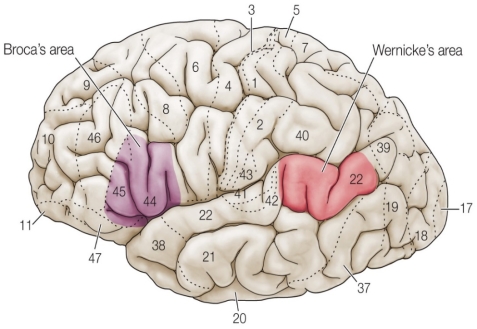 Identify Broca's and Wernicke's areas, and summarize the types of linguistic deficits that patients with lesions in each would typically experience. Provide an example of spoken language that would represent lesions in each of these two cortical regions.
 (Essay)
4.9/5 (71)
(71) A nineteenth century phrenologist would most likely be found
(Multiple Choice)
4.9/5 (82)
(82) Sanjay is a patient with distinct damage to Broca's area, but he doesn't seem to exhibit the constellation of language impairments that characterize Broca's aphasia. Judy is a patient with fairly widespread damage to the left hemisphere, not limited to Broca's area, and she has been diagnosed with Broca's aphasia but with only some of the traditional symptoms. Explain the implications of these findings.
(Essay)
4.8/5 (76)
(76) A physician asks four patients with aphasia to describe how to make a peanut butter sandwich. Which response most likely came from a patient with Wernicke's aphasia?
(Multiple Choice)
4.8/5 (79)
(79) 
Filters
- Essay(0)
- Multiple Choice(0)
- Short Answer(0)
- True False(0)
- Matching(0)