



 Chat with AI
Exam 6: Speech Perception

Exam 1: Origins of Human Language50 Questions
Exam 2: Language and the Brain41 Questions
Exam 3: Learning Sound Patterns46 Questions
Exam 4: Learning Words53 Questions
Exam 5: Learning the Structure of Sentences45 Questions
Exam 6: Speech Perception40 Questions
Exam 7: Word Recognition43 Questions
Exam 8: Understanding Sentence Structure and Meaning46 Questions
Select questions type


______ is a clear example of how visual perception can influence how we hear speech.
(Multiple Choice)
4.8/5  (74)
(74) Which kind of sound contrast differs along the sound dimension that is called "manner of articulation"?
(Multiple Choice)
4.8/5 (81)
(81) What general cognitive skill may support adaptation to variations of the sound categories in speech?
(Multiple Choice)
4.8/5 (91)
(91) Refer to the figure.
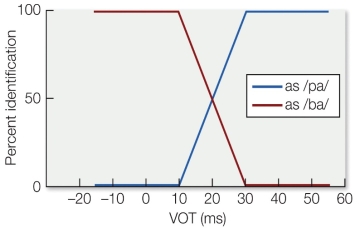 If the figure refers to the categorical perception of /ba/ and /pa/, summarize how a person would interpret these sounds as the VOT changed for each.
 (Essay)
4.8/5 (78)
(78) Imagine that you were a participant in William Ganong's 1980 study, and you were asked to report whether you heard the word bid or pid when presented with an ambiguous phoneme sound between /b/ and /p/ at the start of _id. You would
(Multiple Choice)
4.8/5 (90)
(90) Suppose researchers ask participants to identify syllables from a set of stimuli that were created such that they vary systematically by equal steps of difference in voice onset time. How well will the participants identify stimuli?
(Multiple Choice)
4.9/5 (81)
(81) Refer to the figure.
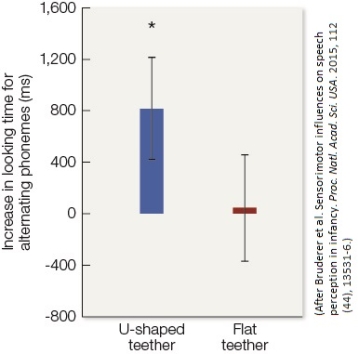 Figure. Average looking time was measured while broadcast phonemes either alternated (between Hindi /d_/ and /dj/) or stayed the same (repeating /d_/, or repeating /dj/). Observations were taken when infants sucked on either a U-shaped teether that allowed free tongue movement (left bar) or a flat teether that immobilized subjects' tongues (right bar). Scores greater than zero indicate a preference for the alternating phonemes. Error bars denote Standard Error of the Mean. The asterisk marks a significant difference from zero.
Infants spend more time looking at a loudspeaker, on average, if they detect an acoustic change within a stream of repeating sounds that it broadcasts. Based on the figure from Bruderer et al.'s 2015 study of speech perception by 6-month-old English-speaking infants (above), does the articulatory system of infants influence whether the babies hear phoneme distinctions between non-English consonants? Explain briefly.
Figure. Average looking time was measured while broadcast phonemes either alternated (between Hindi /d_/ and /dj/) or stayed the same (repeating /d_/, or repeating /dj/). Observations were taken when infants sucked on either a U-shaped teether that allowed free tongue movement (left bar) or a flat teether that immobilized subjects' tongues (right bar). Scores greater than zero indicate a preference for the alternating phonemes. Error bars denote Standard Error of the Mean. The asterisk marks a significant difference from zero.
Infants spend more time looking at a loudspeaker, on average, if they detect an acoustic change within a stream of repeating sounds that it broadcasts. Based on the figure from Bruderer et al.'s 2015 study of speech perception by 6-month-old English-speaking infants (above), does the articulatory system of infants influence whether the babies hear phoneme distinctions between non-English consonants? Explain briefly. (Essay)
4.9/5 (83)
(83) Which statement accurately describes a similarity or difference in the way acoustic speech and visual sign languages are perceived?
(Multiple Choice)
4.8/5 (64)
(64) Judging from the psycholinguistic evidence, what is a benefit of raising a toddler with exposure to a variety of voices and vocal accents?
(Multiple Choice)
4.9/5 (76)
(76) Suppose you are trying to automate the production of speech using computer software and a loudspeaker. Why would it fail to sound natural if your message was generated by splicing together exemplar phonemes that had been spoken one at a time in isolation on a recording?
(Essay)
4.7/5 (91)
(91) Describe examples of evidence that show how context can help a listener comprehend specific phonemes or syllables.
(Essay)
4.9/5 (76)
(76) What was the result when researchers used fMRI to image brain activity while subjects listened to syllables that differed in place of articulation?
(Multiple Choice)
4.9/5 (71)
(71) Which of the following adds nothing to variability between different instances of the same phoneme in speech?
(Multiple Choice)
4.8/5 (97)
(97) When a 50-year-old man says the name Rex, he pronounces the vowel with a lot of intensity at 500 Hz. When a 7-year-old girl says the name Rex, she pronounces the vowel without a strong component in the frequency range around 500 Hz. You have no trouble hearing both of their speech as examples of the same word. This phenomenon is known as
(Multiple Choice)
4.8/5 (78)
(78) What determines which sound features become prioritized as cues about sound category distinctions?
(Multiple Choice)
4.8/5 (90)
(90) Refer to the figure.
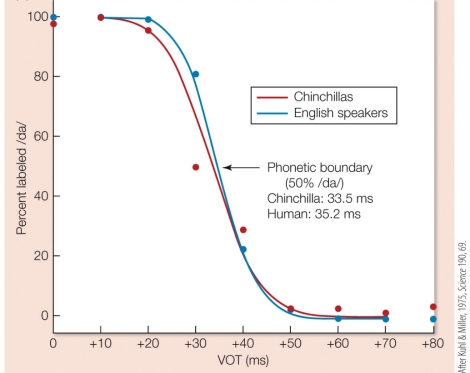 Based on the figure from Kuhl and Miller's 1975 study of categorical perception in chinchillas, what can you conclude about humans' and chinchillas' abilities to detect sound boundaries and language?
 (Essay)
4.9/5 (83)
(83) What would be the best stage name for a ventriloquist, in order to best support the illusion that the dummy is the one saying the name during the script?
(Multiple Choice)
4.8/5 (78)
(78) While researching a language that linguists have not catalogued before, you discover that there are very strong accents within it. In a paper presenting a hypothesis about the origin of the accents, you use Bill Labov's research in the United States to corroborate your hypothesis. Your hypothesis is most likely:
(Multiple Choice)
4.9/5 (78)
(78) How is categorical perception different from continuous perception?
(Multiple Choice)
4.9/5 (76)
(76) When testing the perceptual effects of music training, why should a researcher use random assignment of participants to a musical group or control activity?
(Multiple Choice)
4.8/5 (89)
(89) 
Filters
- Essay(0)
- Multiple Choice(0)
- Short Answer(0)
- True False(0)
- Matching(0)