



 Chat with AI
Exam 10: Fat-Soluble Vitamins

Exam 1: The Cell: A Microcosm of Life90 Questions
Exam 2: The Digestive System: Mechanism for Nourishing the Body90 Questions
Exam 3: Carbohydrates91 Questions
Exam 4: Fiber91 Questions
Exam 5: Lipids90 Questions
Exam 6: Protein90 Questions
Exam 7: Integration and Regulation of Metabolism and the Impact of Exercise90 Questions
Exam 8: Energy Expenditure, Body Composition, and Healthy Weight91 Questions
Exam 9: Water-Soluble Vitamins90 Questions
Exam 10: Fat-Soluble Vitamins90 Questions
Exam 11: Major Minerals90 Questions
Exam 12: Water and Electrolytes90 Questions
Exam 13: Essential Trace and Ultratrace Minerals90 Questions
Exam 14: Nonessential Trace and Ultratrace Minerals90 Questions
Select questions type


What percentage of vitamin D from the diet is absorbed?

Free
(Multiple Choice)
4.9/5  (86)
(86) Correct Answer: Verified
D
Describe how vitamin A affects bone growth.
Free
(Essay)
4.8/5 (79)
(79) Correct Answer:Verified
VerifiedGrading rubric - answer should include the following items:
Bone growth and resorption rely on cells called osteoblasts and osteoclasts,respectively.A vitamin A deficiency will cause excess deposition of bone by osteoblasts and a reduction in bone degradation by osteoclasts because it stimulates the former and suppresses the latter.An excess of vitamin A will cause the reverse to occur.Osteoclasts will be stimulated causing excess bone resorption and osteoblasts will be suppressed leading to a decrease in bone density.This might lead to an increased risk of bone fracture.
Match the factor to its correct action.
-XIIIa
Free
(Multiple Choice)
4.7/5 (83)
(83) Correct Answer:Verified
VerifiedB
If asked about the relationship of vitamin D to autoimmune disease,the best information for a dietetic professional to provide is ____.
(Multiple Choice)
4.8/5 (100)
(100) Subclinical vitamin K deficiency may be associated with diminished bone mineral density and increased fracture rates.
(True/False)
4.9/5 (87)
(87) Calcium homeostasis in the blood depends on intestinal absorption,bone resorption,and kidney reabsorption.
(True/False)
4.8/5 (74)
(74) Vitamin D increases the abundance of calbindin (Ca++ transporter)in enterocytes by increasing the transcription of the calbindin gene.
(True/False)
4.8/5 (76)
(76) Which vitamin D molecule would you expect to see in fortified foods?
(Multiple Choice)
4.8/5 (72)
(72) Although for micronutrients increasing the amount of a protein by directly inducing gene expression is certainly a common mechanism,we have encountered other mechanisms by which vitamins can regulate proteins.Provide one example of posttranslational modification,being as specific as possible.
(Essay)
4.8/5 (82)
(82) Which antioxidant is most effective in rapidly eliminating hydroxyl radicals prior to initiation of oxidative damage?
(Multiple Choice)
4.8/5 (84)
(84) Indicate: (1)the active form of vitamin K, (2)the general function of vitamin K,and (3)an example of the general function (this could be a specific reaction or simply indicate a pathway/ process where it occurs).Your answers do not need to be long!
(Essay)
4.8/5 (75)
(75) Would you recommend β-carotene supplementation to a smoker to decrease the risk of lung cancer?
(Multiple Choice)
4.8/5 (64)
(64) Which bacteria produce vitamin K and in what form? Because this production is not sufficient to meet the body's needs,name five foods that provide large amounts of vitamin K and in which form.
(Essay)
4.8/5 (80)
(80) The best source of vitamin D per recommended serving is ____.
(Multiple Choice)
4.7/5 (77)
(77) Many anticoagulants work by inhibiting the regeneration of active vitamin K (i.e.,dihydrovitamin KH₂)during the vitamin K cycle.
(True/False)
4.8/5 (64)
(64) Instructions: Use the molecules below to answer the next three questions.
A)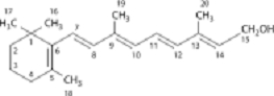 B)
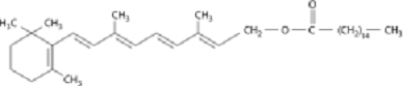 C)
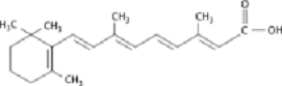 D)
 -Which is molecule is retinoic acid?
B)
C)
D)
-Which is molecule is retinoic acid? (Multiple Choice)
4.8/5 (84)
(84) 
Filters
- Essay(0)
- Multiple Choice(0)
- Short Answer(0)
- True False(0)
- Matching(0)