



 Chat with AI
Exam 17: International Trade.

Exam 1: The Art and Science of Economic Analysis.203 Questions
Exam 2: Economic Tools and Economic Systems.209 Questions
Exam 3: Economic Decision Makers.225 Questions
Exam 4: Demand, Supply, and Markets.205 Questions
Exam 5: Introduction to Macroeconomics.201 Questions
Exam 6: Tracking the U. S. Economy.211 Questions
Exam 7: Unemployment and Inflation.199 Questions
Exam 8: Productivity and Growth.200 Questions
Exam 9: Aggregate Demand.200 Questions
Exam 10: Aggregate Supply.202 Questions
Exam 11: Fiscal Policy.202 Questions
Exam 12: Federal Budgets and Public Policy.203 Questions
Exam 13: Money and the Financial System.201 Questions
Exam 14: Banking and the Money Supply.200 Questions
Exam 15: Monetary Theory and Policy.200 Questions
Exam 16: Macro Policy Debate: Active or Passive?198 Questions
Exam 17: International Trade.200 Questions
Exam 18: International Finance.195 Questions
Exam 19: Economic Development.200 Questions
Select questions type


The second largest category of U.S. exports in 2016 was _____, which accounted for _____ of total exports.
(Multiple Choice)
5.0/5  (80)
(80) Exhibit 17.6
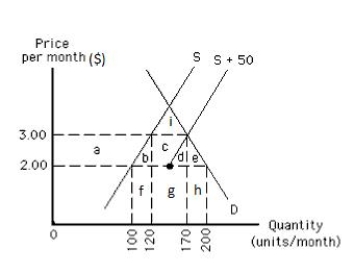 -Refer to Exhibit 17.6, which shows the demand for and the supply of a good in a country. If the world price of the good is $2.00 per unit and an import quota of 50 units per month is imposed, then _____
 (Multiple Choice)
4.7/5 (88)
(88) The production possibilities curve of a country will be a straight line if _____
(Multiple Choice)
4.8/5 (68)
(68) Quotas and tariffs discourage foreign governments from retaliating with quotas and tariffs of their own.
(True/False)
4.8/5 (85)
(85) In the case of declining industries, wage subsidies or special tax breaks that decline over time _____
(Multiple Choice)
4.9/5 (73)
(73) Economies of scale in the production of a good imply that _____
(Multiple Choice)
4.8/5 (80)
(80) International trade between countries typically produces a winner and a loser. Generally, it is the more economically advanced country that gains at the expense of the less developed nation.
(True/False)
4.9/5 (84)
(84) The world price of a good refers to the quantity of one good exchanged for a unit of another good.
(True/False)
4.9/5 (82)
(82) Domestic producers of goods who compete with cheaper imports benefit from protectionism in the short run.
(True/False)
4.8/5 (80)
(80) Some industries have argued that since their output is vital for national defense, _____
(Multiple Choice)
4.7/5 (69)
(69) Exhibit 17.b
 -Refer to Exhibit 17.b, which shows the supply of a product in the United States. If the world price is P, U.S. producers would supply _____
 (Multiple Choice)
4.8/5 (86)
(86) Exhibit 17.2
 -Refer to Exhibit 17.2, which shows U.S. demand for and domestic supply of a good. Suppose the world price of the good is $1.00 per unit, and a specific tariff of $0.50 per unit is imposed on each unit of the imported good. In such a case, the gain in producer surplus as a result of a tariff of $0.50 per unit is represented by the area _____
 (Multiple Choice)
4.8/5 (79)
(79) Exhibit 17.4
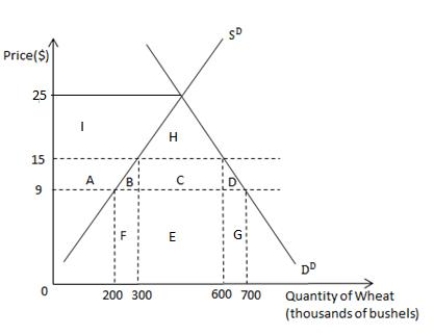 -Refer to Exhibit 17.4, which shows the market for wheat for the country of Palatino. SD is the domestic supply of wheat, and DD is the domestic demand for wheat. Suppose the world price of wheat is $9 per bushel of wheat and a specific tariff of $6 is imposed on each bushel of wheat imported. Government revenue from the tariff equals _____
 (Multiple Choice)
4.8/5 (87)
(87) Exhibit 17.3
 -Refer to Exhibit 17.3, which shows the supply of and the demand for baseballs in the United States. If the world price is $3 per baseball and a tariff of $1 per baseball is imposed, the net welfare loss of the tariff is shown by area(s) _____
 (Multiple Choice)
4.9/5 (69)
(69) Exports account for _____ of the gross domestic product (GDP) in the Netherlands.
(Multiple Choice)
4.9/5 (73)
(73) 
Filters
- Essay(0)
- Multiple Choice(0)
- Short Answer(0)
- True False(0)
- Matching(0)